CEO Watchlist: Week In Review (9/7/25)

TOP NEWS AFFECTING THE STOCK MARKET THIS WEEK:
-
Department of Justice V.S. Google! The Outcome...Who Won...Who Lost...and The 3 Stocks That Will Benefit! (Source)
Stocks mentioned: $GOOG, $AAPL, $META
For years, the Department of Justice (DOJ) pursued Google (GOOG) in one of the most high-profile antitrust battles of the modern era. Regulators alleged that Google abused its dominance in search and advertising by making Google Chrome the default gateway to its services and locking out rivals. The most aggressive remedy on the table was to force Google to sell off Chrome entirely, severing the pipeline between the world’s most widely used browser and the company’s $300+ billion ad empire. This week, the courts struck down that threat. The DOJ lost, and Google will keep Chrome, its most underappreciated strategic asset. This sent Google stock soaring up 10% since the decision.
One of our students in the CEO Watchlist Investment Club asked us, "Why is Google Chrome such a big trigger for you. Seems like something small for me...is it such a big thing in terms of revenue or something?" Now this was a great question because most people probably don't fully understand the implications if Google had to sell off Chrome. Google’s DOJ victory is a much bigger deal than just preserving ad revenue, it protects the engine behind its entire ecosystem. Chrome, with roughly 60–65% of search market share, doesn’t directly generate revenue but amplifies it by defaulting billions of searches to Google each day, securing traffic that feeds the company’s core ads business across Search, YouTube, and its network. More importantly, Chrome provides a critical stream of user behavior data that powers Google’s ad targeting, AI models, and overall effectiveness. It also acts as the gateway to Google’s tightly integrated ecosystem (Search, Gmail, YouTube, Android) keeping users locked in and creating a seamless experience. Without Chrome, Google would face weaker data, diminished targeting, and strategic vulnerability to rivals like Apple and Microsoft, whose browsers could shift users toward Bing or other search engines. By keeping Chrome, Google retains its strongest leverage point, ensuring its dominance in digital advertising and safeguarding its moat against competitors.
For investors, the key takeaway is that Chrome is staying with Google and that this court decision sets a massive precident to protect tech, in general, from an overreach by the DOJ. So which stocks will be direct beneficiaries of this decision, well I've listed my top 3 below for you:
-
Alphabet (GOOG): The obvious direct winner. Preserving Chrome ensures continuity in ad revenues, data collection, and user lock-in across the ecosystem.
-
Apple (AAPL): One part of the courts decision in this case was that Google can no longer have exclusive only deals with companies like Apple. This benefits Apple because they can still charge Google to have their search on Apple devices but also opens the door to even more revenue from competitors who might also want to get listed. If the court didn't rule this way, Apple could have lost a very powerful revenue stream. This is why we saw a nice pop in Apples share price after the courts decision.
-
Meta Platforms (META): Meta is a direct competitor to Google so why does a court decision that helps Google also help Meta many of our students asked? As we explained to them, since Meta and Google are in the same space (ad revenue) they both actually benefit from this decision because it means less regulation and oversight over all companies in this area. Since there is a court ruling that the DOJ overstepped trying to break Google up then that means if the DOJ ever tries to go after META, for a similiar reason, they will more than likely be shut down thanks to this specific case.
The bottom line, if Google lost, it would have been forced to cede control over the default search funnel and its richest source of behavioral data. Instead, it walks away with its ecosystem intact and a huge win. This case shields, not just Google, but all the big tech companies from DOJ overreach, which adds a positive tailwind to the sector as a whole. As for Google, we still view it as undervalued. With a market cap of $2.8 trillion and a forward P/E of 22 we believe Google has another +30% upside from here! Even when you look at analyst estimates they breakdown each of Googles individual segments as being valued at:
-
Search - $1.25 Trillion
-
Deepmind and TPU - $897 Billion
-
Google Cloud - $572 Billion
-
YouTube - $446 Billion
-
Waymo - $173 Billion
-
Network - $138 Billion
When you add up all of the above segments of Google you get a $3.47 trillion market cap. Since Google is at $2.8 trillion this tells us that based on analyst estimates Google still has another roughly 30% more to go to the upside. We personally have a price target on Google of $300/share with a "Strong Buy" rating, right in line with most of these analyst. For a complete list of ALL the stocks we currently own and are buying this week [CLICK HERE] if you're and Investment Club member and if you're NOT an Investment Club member you can sign up to get access to these and more by [CLICKING HERE] and using our [$200 OFF DISCOUNT CODE] as a thanks to anyone that is subscribed to our Newsletter.

-
-
We Predicted Robinhood & AppLovin ... Here Are the Next 5 Stocks Headed for the S&P 500 (Source)
Stocks mentioned: $HOOD, $APP, $FLUT, $TOST, $VRT, $SOFI, $ARES
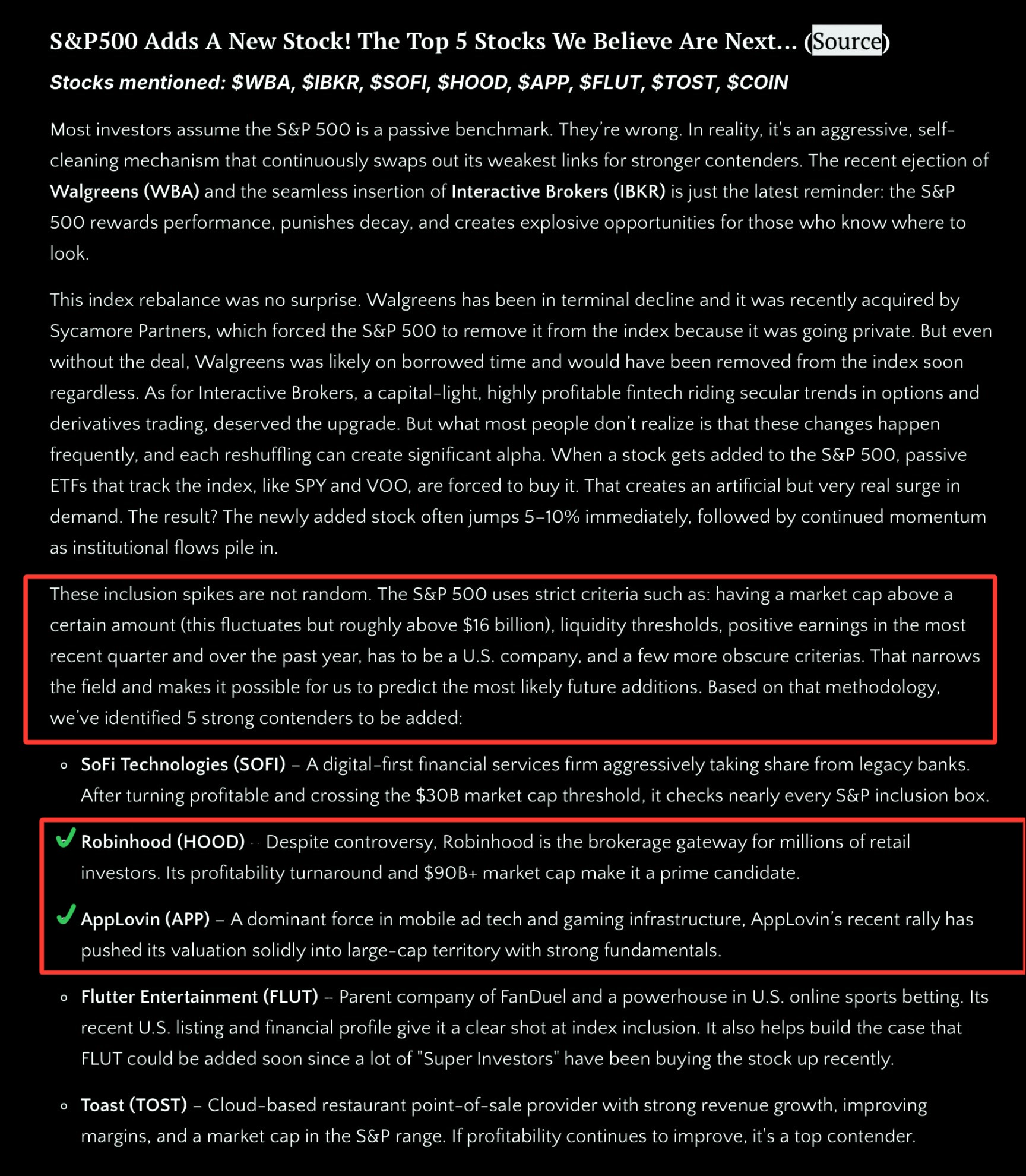
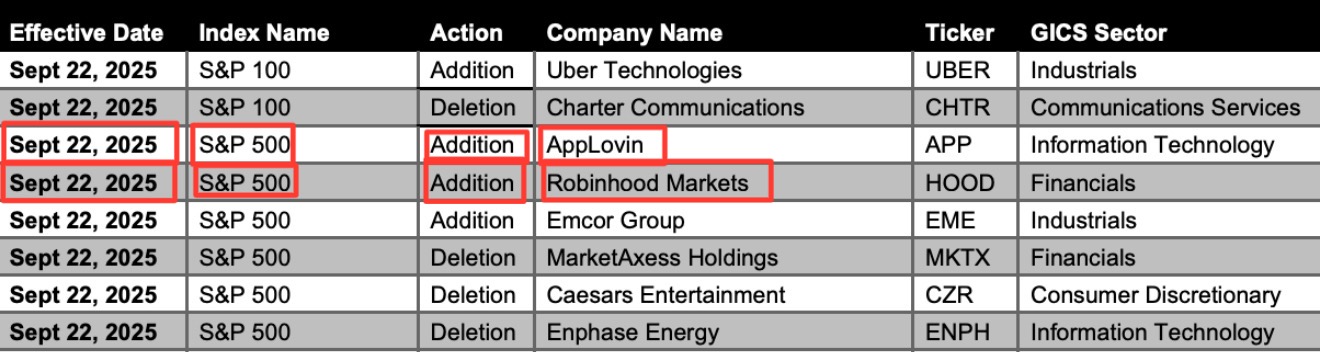
Most investors were stunned on Friday when Robinhood (HOOD) and AppLovin (APP) were officially added to the S&P 500, triggering an immediate surge of more than 7% after the announcement. But if you’ve been following our newsletters, you shouldn’t have been surprised at all. Just last week, we laid out in detail how these two stocks fit every single inclusion criteria, naming them in our "Top 5 Most Likely Candidates to be Added Next". This wasn’t luck. It was the result of a system we’ve refined for years, one that consistently spots these opportunities before the headlines.

The broader thesis is simple: the S&P 500 isn’t a passive mirror of the economy, it’s an active mechanism of creative destruction. It continuously cuts dead weight and rewards rising powerhouses. We saw this with Walgreens (WBA) being forced out, and Interactive Brokers (IBKR) stepping in. Now we’re seeing it again with Robinhood and AppLovin being added on Friday. Their additions validate our framework, and more importantly, they demonstrate the alpha potential for investors who position before index funds are forced to pile in. Every ETF, mutual fund, and institutional allocator that tracks the S&P 500 must now own these names, creating a demand shock that is both artificial and very real.
Yes, critics argue that S&P inclusion pops can fade. But that argument applies far more to stagnating legacy firms than to high-growth platforms. Robinhood has become the gateway for a generation of investors, turning profitable and scaling past a $90B market cap. AppLovin is the silent backbone of mobile ad monetization, building durable infrastructure for the digital economy. These aren’t one-off fads, they are secular growth stories that have now been validated at the highest level of U.S. capital markets.
The real question now is who’s next. Based on the same criteria that led us to Robinhood and AppLovin, five names stand out:
-
Flutter (FLUT): A global leader in online sports betting, parent of FanDuel, with accelerating U.S. exposure and institutional support.
-
Toast (TOST): The embedded software and payments stack for restaurants, steadily moving toward sustainable profitability with massive total addressable market (TAM).
-
Vertiv (VRT): Mission-critical data center infrastructure powering AI and cloud growth, already scaling into S&P territory.
-
SoFi Technologies (SOFI): A digital-first financial platform now firmly profitable, rapidly taking share from legacy banks, and sitting squarely in the inclusion range.
-
Ares Management (ARES): One of the most powerful players in alternative asset management, benefitting from the secular shift toward private credit and infrastructure finance.
The takeaway is crystal clear. Last week we predicted Robinhood and AppLovin. This week, that prediction was vindicated in real time as both names joined the S&P 500 and immediately spiked. The market may treat this as a surprise, but for us, it’s confirmation of a playbook we’ve been executing for years. By accumulating HOOD on dips and flagging APP early, we captured the upside before the crowd. Our Investment Club members know how much we've been pounding the table on Robinhood specifically, just waiting for what we believed to be the inevitable inclusion into the S&P 500. The winners are hiding in plain sight everyday if you just know where to look. The only real question is whether you’re positioning ahead of the next move or waiting to read about it after the gains are already gone.

Note: Pictured above is a screenshot from our Newsletter from last week where we highlighted our predictions of the next possible names to be added to the S&P500.
Ask ChatGPT, -
-
"Super Investor" Spotlight: Bill "The Concentrated Capitalist" Ackman (Source)
Stocks mentioned: $UBER, $BN, $QSR, $AMZN, $HHH, $CMG, $GOOG, $GOOGL, $HLT, $HTZ, $SEG
This week we’re continuing our “Super Investor Spotlight” series, where we break down the moves of the world’s top investors and the stocks they’re betting big on. For new readers, “Super Investors” are elite money managers who oversee billions of dollars and consistently generate outsized returns. Names like Warren Buffett, Michael Burry, and Bill Ackman fall into this category. Every quarter, they’re required to disclose their stock holdings through 13F filings, which are public reports that show what they bought and sold over the prior three months. While these reports are slightly delayed, they remain one of the best tools for seeing where billionaire capital is flowing.
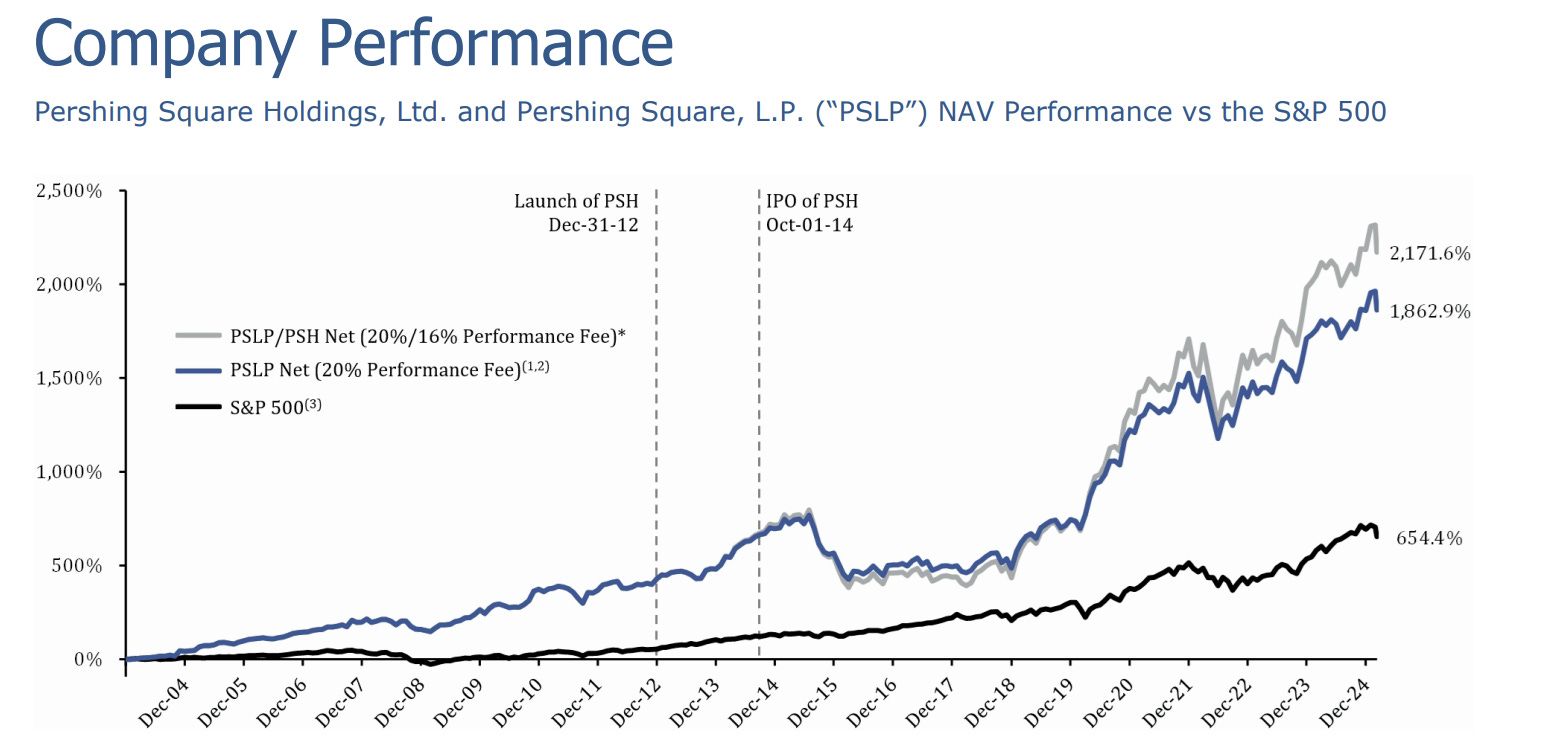
This week’s focus is on Bill Ackman, founder of Pershing Square Capital Management. Ackman is famous for running a concentrated, high-conviction portfolio. Over the past two decades, his investments have both sparked controversy and delivered enormous returns, cementing his reputation as one of Wall Street’s most influential voices. You'll see below we have pulled data from his funds performance versus the S&P500 performance and the results are shocking. While the S&P500 has returned 654% over the past 20 years, you'll see that Ackman has returned 1862%! Roughly triple the return of the S&P500. Needless to say, this is exactly why we pay attention to the stocks he is buying and selling.

His latest Q2 2025 filing reveals $13.7 billion spread across just 11 stocks. A strategy that reflects his belief in focus over diversification. There's a reason he's nicknamed "The Concentrated Capitalist". Here’s the full lineup of his current holdings:
-
Uber Technologies (UBER) – 20.6%: Ackman’s largest bet, Uber represents his conviction in mobility, delivery, and the long-term shift toward platform-based transportation.
-
Brookfield (BN) – 18.5%: A global leader in asset management and infrastructure, Brookfield plays directly into Ackman’s thesis on hard assets and long-term capital allocation.
-
Restaurant Brands International (QSR) – 11.1%: The parent company of Burger King, Tim Hortons, and Popeyes. Ackman continues to view fast food as a resilient consumer staple, even in tough economies.
-
Amazon (AMZN) – 9.3%: One of his NEW key growth bets, Amazon combines dominant e-commerce with AWS cloud power. Ackman sees this as a secular winner well beyond current market cycles. The fact Ackman dumped over 9% of his capital into this name all at once just in the last quarter, shows he has some very strong conviction in this name.
-
Howard Hughes Holdings (HHH) – 9.3%: A unique real estate development company Ackman has supported for years. This position reflects his confidence in long-term urban growth and land value appreciation.
-
Chipotle Mexican Grill (CMG) – 8.8%: Once a huge success story, but now showing cracks as food costs rise and discretionary spending slows. Still, Ackman is holding tight, signaling he views this as a temporary headwind.
-
Alphabet (GOOG) – 8.2%: A cornerstone of big tech. With Search, YouTube, and Cloud, Google remains one of the most profitable and defensible businesses in the market.
-
Alphabet (GOOGL) – 6.9%: Its not a mistake that you're seeing Google twice in his portfolio. GOOG and GOOGL both represent Google stock but with differences in voting rights. In reality we would combine both of these positions to get his true value in Google which is 15.1%, making Google his 3rd largest position.
-
Hilton Worldwide (HLT) – 5.9%: Ackman is betting on the sustained rebound in global travel and Hilton’s powerful brand portfolio.
-
Hertz (HTZ) – 0.8%: A smaller, riskier play that ties into travel demand and mobility. While volatile, it gives Pershing Square a toe-hold in rental markets.
-
Seaport Entertainment Group (SEG) – 0.7%: A niche real estate and entertainment development venture, reflecting Ackman’s interest in overlooked long-term growth assets.
What’s striking is how little turnover Ackman allows. Unlike many hedge funds that shuffle positions each quarter, he prefers to hold through volatility and add only when conviction is strongest. His doubling down on Alphabet signals long-term confidence in AI and tech dominance, while his massive addition in Amazon shows a bullish tilt toward the consumer and tech (robotics/cloud). At the same time, his continued exposure to consumer staples like QSR and Chipotle balance the portfolio with resilience.
The lesson is clear: Ackman plays the long game. He doesn’t scatter his bets, he concentrates them in a few themes he believes will define the next decade: tech, mobility, real estate, and global consumer demand. For everyday investors, following these moves isn’t about copying trade-for-trade, but about learning how the smartest money allocates conviction.

-
INSIDER TRADES FROM THE WEEK:
1. Shenandoah Telecommuications Co. (SHEN) - ECP ControlCo LLC, a Private Equity Firm, bought ~$29,000,000 of SHEN stock between May 27, 2025 - Sep 3, 2025, but it was most recently reported to the public on Sep. 4, 2025 (Source)

2. TriplePoint Venture Growth (TPVG) - James Labe, CEO, bought ~$3,100,000 of TPVG stock between Aug 20- Sep 3, 2025, but it was most recently reported to the public on Sep 4, 2025 (Source)

3. Direxion Small-Cap 3x Bear ETF (TZA) - Tim Moore, U.S. Rep. From North Carolina (R), bought between $81,000-$215,000 of TZA between August 12-27, 2025, but it was most recently reported to the public on Sep 4, 2025 (Source)

Over 2,000 people have already signed up for my FREE Masterclass video on how to unlock my exact strategies for finding winning stock/options trades! I'll share everything including how to find what Politicians and CEOs are buying. Don’t miss your chance to get in for FREE before spots fill up!

INFOGRAPHICS FOR THE WEEK:


CONTACT US: [email protected]
CEO Watchlist Weekly Newsletter
Keep up to date with stock market news and information


Responses