

TOP NEWS AFFECTING THE STOCK MARKET THIS WEEK:
Intel + Nvidia Partnership: The 3 Stocks That Are Directly Affected! (Source)
Stocks mentioned: $NVDA, $INTC, $TSM ,$AMD, $ASML
This past week, Nvidia (NVDA) invested $5 billion into the struggling Intel (INTC). For our Investment Club Members, this didn't come as too much of a shock, because when President Trump took a 10% stake in Intel less than a month ago, we hinted that this may be the first domino of many to fall in Intel's favor. The Intel–Nvidia partnership looks less like a corporate alliance and more like a state project. Washington is signaling that chipmaking is no longer a free-market exercise, it's becoming a focal point of national security. For decades, America outsourced the hardest problems in semiconductor fabrication to Asia, but within the past 5 years, there has been a silent war on technology going on behind the scenes. The administration doesn't want to have to rely on other countries to produce our technology. That is why now the U.S. is attempting to claw back that lost ground by leaning on Intel as the designated underdog champion.
The macro thesis is clear: the bottleneck in the AI economy is no longer software innovation but access to reliable, secure, and advanced compute capacity. Every large language model, every AI workload, every cloud-native app requires GPUs and high-performance CPUs built into data center racks. For Nvidia, the deal extends its dominance from accelerators into CPUs and client devices. For Intel, it’s a lifeline, tying its relevance to the one company that effectively dictates the trajectory of AI adoption. But this is as much about hedging geopolitical risk as it is about fundamentals. The U.S. government, facing the vulnerability of Taiwanese fabs just 90 miles off the coast of China, is effectively underwriting Intel as a strategic asset.
To contextualize the investment implications, here are the 3 main stocks besides Intel and Nvidia that are directly affected by this deal:
- Taiwan Semiconductor Manufacturing Co. (TSM) – In case you didn't know, TSM makes 90% of the high-end chips in the entire world. There really has not been any competition for them until now. Intel may pose some competition for TSM, not because their technology is better, but rather they have become the charity case in the semiconductor world. Due to the administration's push to produce more on American soil, capital flows have been heading more in favor of Intel than ever before. Today, there is no direct threat to TSM, but if the government keeps their foot on the gas and continues to back Intel over the coming years, it could possibly turn into a true rival for TSM. This is probably why we have seen TSM start to build their factories on US soil, to try and keep friendly ties with the current administration and avoid a narrowing divide between them and Intel.
- Advanced Micro Devices (AMD) – Probably the most impacted stock from this deal is AMD. When listening in on the conference between Nvidia's CEO and Intel's CEO, it was made clear that this partnership was focused more on Intel's CPU's, which compete directly with AMD. When it came to conversations around Intel's fab business, which competes directly with TSM, they acknowledge this is not where the investment from Nvidia is going towards. This means there won't be as big of an impact for TSM today, like there will be for AMD. Because AMD competes against Nvidia and Intel, it feels like Nvidia just continues to get stronger and is backing the underdog vs. their closest competitor in AMD, putting AMD in a very tough spot.
- ASML Holdings (ASML) – We started buying heavily into ASML earlier this year when it dipped down into the $600's with the investment thesis that they were extremely undervalued for being a monopoly in the semiconductor space. You cannot produce any high-end chip without an ASML machine. ASML machines sell for roughly $400 million a pop, so naturally there's only a handful of companies that can actually afford them. These machines go in fabs to produce the chips. So if there is more chip demand, that means there is demand for more fabs to be able to produce more chips. With this deal in particular, it's giving Intel an infusion of cash and a new shot at life, which means there's a high liklihood that they can expand their fabs over the years. Again, more fabs means more business for ASML which is why we saw the stock jump higher on news of this deal. ASML is no longer extremely undervalued like it was in the $600's just a few months ago, but it is still a "soft buy" according to us.
The story is pretty straightforward: this partnership, alongside the administration's 10% stake, is working to ensure that America will not be left behind in the AI race. The 3 companies we mentioned above aren't the only ones that will be impacted by a growing Intel, there are dozens of other companies that will either have capital trickle down into them, or in a worse case scenario, have their market share eaten away by these big tech partnerships.
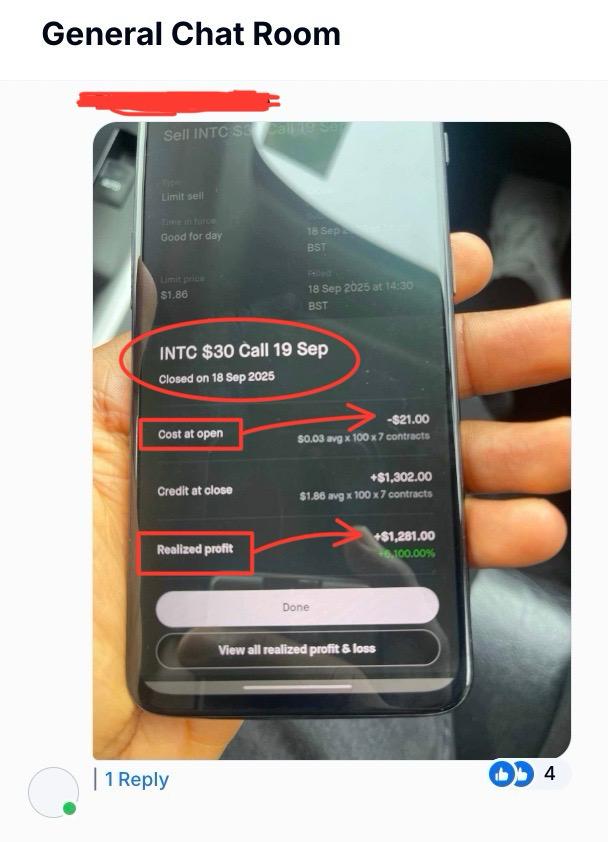
The U.S. has chosen Intel as its proxy for semiconductor independence, and that fact alone will shift capital flows. Investors should see this for what it is: not a fundamental turnaround, but a geopolitical trade. When the state declares a winner, markets adjust, often faster than fundamentals can catch up. That gap, today, is Intel’s most valuable asset. We believe Intel may have more room to run, but most of the easy gains have already been made this past week. Luckily for members of our Investment Club, we brought this trade to them on September 10, 2025 where we took out call options, betting on the upside for Intel through the end of the month:

Many of our students were able to lock in massive profits on this one trade alone. Some of them turning a few hundred dollars into thousands of dollars and even one Club Member turning a mere $21 into over $1,280 in profit! That's why when people ask us, "Do I need a lot of money to get started?" we always point them to our students who are able to make trades like this, which cost them less than a night out at dinner.
In the Investment Club, we've been able to find stocks before they run up, and sell them before they fall. If you struggle with buying a stock too late and then it crashes, or selling a stock too soon right before it jumps up, then it might be time to learn the strategies we teach in the Investment Club. If you're not an Investment Club Member, and you're tired of missing out on the next big stock, consider using this as an opportunity to finally make a change. We are going to give you [$200 OFF] when you join today. [CLICK HERE] to take advantage of this discounted offer. We will see you in the Investment Club soon!
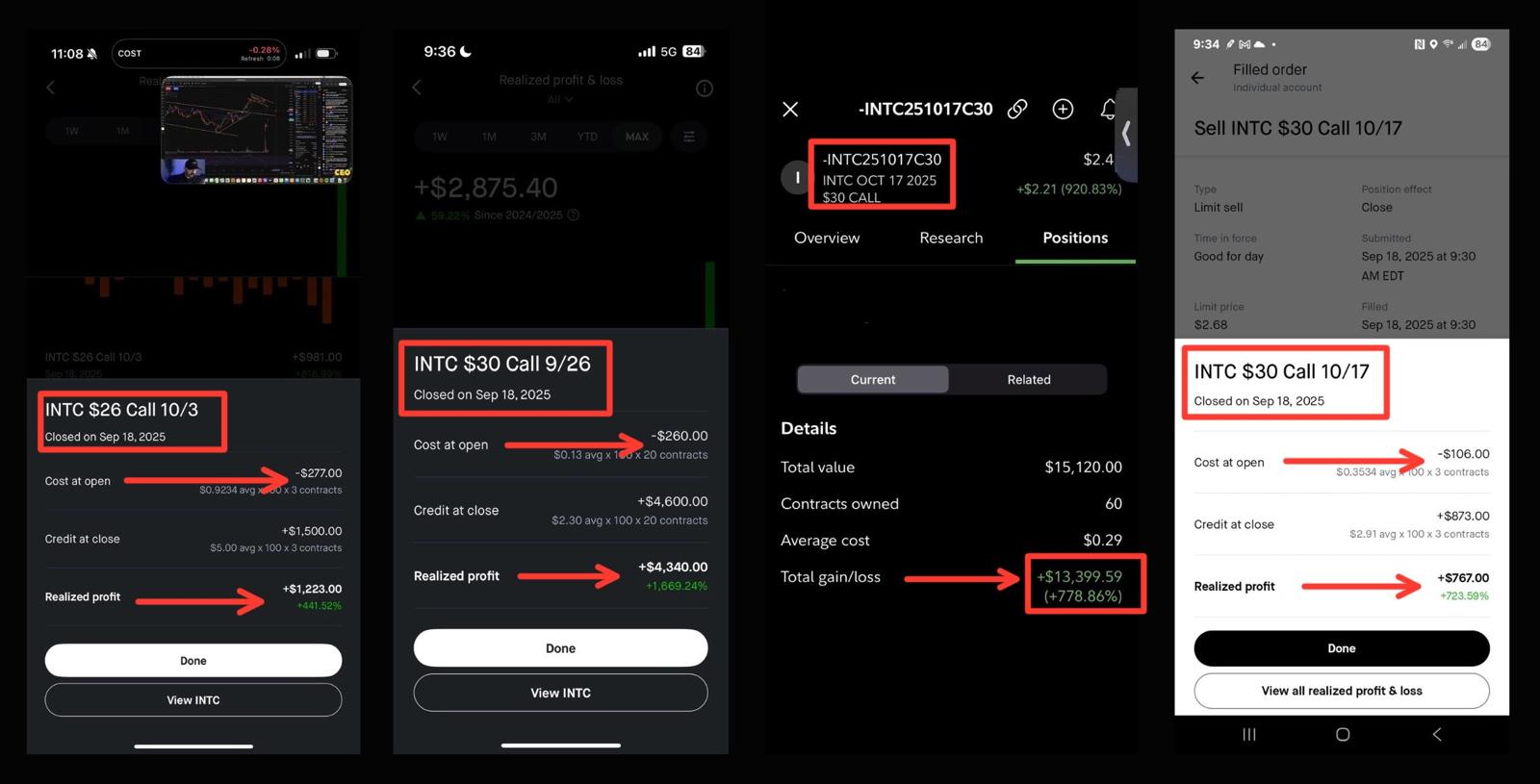
Note: The image above is a few screenshots sent to us from Investment Club Members on their Intel trades from this past week.
A New Bull Market Is Coming For These 4 Stock Sectors! (Source)
Stocks mentioned: $IWM, $XLF, $XLK, $BMNR
The Federal Reserve’s latest move, a 25 basis point rate cut, was widely expected, but the stock sectors poised to benefit the most may surprise you! Rate cuts aren’t just numbers on a screen; they are the oxygen that powers risk assets. For new investors, here’s the quick version: when the Fed lowers interest rates, it reduces borrowing costs across the economy. When it's cheaper to borrow money, it's easier for businesses to grow and expand while keeping people hired. This also fuels more consumer spending and capital investments. For stocks, this is typically bullish (positive), because investors rotate out of safe assets like bonds (that are earning less interest since the rate they're earning is lower) into equities, like stocks, that offer higher potential returns. What’s surprising is not the cut itself, but Jerome Powell’s reasoning for the cut. Inflation is no longer the singular enemy. The Fed is now telegraphing concern for the labor market, a shift that signals both opportunity and risk for stocks.
The macro-thesis is clear: Powell has shifted the battlefield from inflation to employment. Rate cuts, while supportive of growth, can cause inflation to go up, but the trade-off is that it improves the labor market. Balancing keeping inflation under control and maintaining a strong labor market is the tough part for the Fed. Powell tried to paint a picture of a weak labor market, but investors read between the lines. In his speech, he acknowledged that although he felt the labor market was weakening, the data today doesn’t suggest imminent collapse. If Powell and the Fed are concerned about the labor market that means our big risk to the downside is we get a recession. But there are many things preventing that currently. Unemployment remains relatively low and GDP is rising, which is a good sign because it means that people have jobs and are spending more money, which is good for the economy and stock market. Remember, a recession is only possible if we have negative GDP and high levels of unemployment, so as long as these conditions persist, recessionary fears are likely overstated. Critics will argue that cutting too soon risks re-accelerating inflation. That is a fair concern, but the Fed’s refusal to consider a larger 50 basis point cut shows they do not yet see systemic weakness. This middle path, stimulative but cautious, positions stocks for upside. Here are 4 ETFs/stocks positioned to benefit:
- iShares Russell 2000 ETF (IWM): Small-cap companies are the most sensitive to borrowing costs. Lower rates reduce their debt burden and make it easier to finance expansion, which can turbocharge growth relative to large caps. This is why historically small caps outperform the overall stock market during rate cuts.
- Financial Select Sector SPDR ETF (XLF): Financials gain from higher loan demand and stronger credit activity. Even though lower rates can compress margins, the uptick in lending volume and deal-making activity provides a net positive.
- Technology Select Sector SPDR ETF (XLK): Growth-oriented tech stocks benefit when discount rates fall, because their future cash flows become more valuable today. XLK captures this dynamic across the sector in one trade.
- Bitmine Immersion Technologies (BMNR): A speculative high-risk, but high-upside play. BMNR is a play on crypto, specifically Ethereum, and backed by popular investors like Tom Lee. Crypto, which is extremely high risk, should benefit from rate cuts as they tend to benefit more risk-on investing. We believe BMNR is the best way to get crypto exposure outside of owning the cryptos themselves.
The inevitable conclusion is this: the Fed’s pivot is not merely an incremental move, it is a structural signal that growth, not inflation, is the new priority. Markets are underpricing what a sustained easing cycle means for stocks. Small caps, financials, crypto and technology are positioned to compound value at a faster pace than the broader index. Recessions do not materialize in an environment of low unemployment and rising GDP. Unless conditions shift dramatically, Powell’s cut marks the start of a cycle that investors will look back on as the beginning of the next leg higher. Even when we look at seasonality data, the last quarter of the year (October-December) historically looks very strong, and we expect stocks to rally into the end of the year. The time to position is not after consensus arrives, but before.
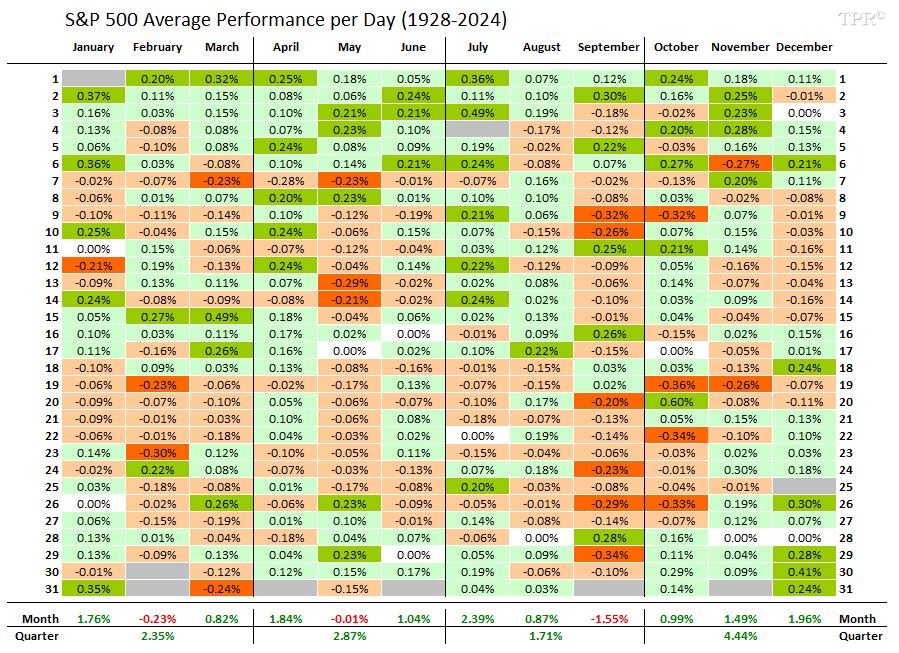
With only a couple weeks left in September, we see that historically there can be a lot of volatility according to the data above. Because of this, we have rotated our stock portfolios heavily this past week to capitalize on the seasonality data. If you're already an Investment Club Member, make sure to check out "The Top 5 Small Cap Stocks" we just bought by [CLICKING HERE]. These are the 5 stocks we think could double in value fairly easily over the next year. If you're not an Investment Club Member, and want to see how we are protecting our portfolios from this seasonality data, as well as profiting off the rate cuts and all the stocks/options we are buying right now, [CLICK HERE] to take [$200 OFF] and unlock all this and more in The Investment Club today!

"Super Investor" Spotlight: Dev Kantesaria, The Focused Financier (Source)
Stocks mentioned: $FICO, $SPGI, $MA, $MCO, $V, $INTU, $ASML, $EFX, $MSCI
This week’s Super Investor Spotlight shines on Dev Kantesaria, founder of Valley Forge Capital Management. While not as much of a household name as Warren Buffett or Bill Ackman, Kantesaria has quietly built a reputation as one of the sharpest concentrated investors in the game. For new readers, “Super Investors” are the elite class of fund managers who oversee billions and consistently generate outsized returns. Each quarter, they’re required to file 13F reports disclosing their stock holdings, which gives us a rare window into how top money managers are allocating capital.
What makes Kantesaria unique is his razor-sharp focus. Instead of spreading his bets across dozens of names, his portfolio is tightly concentrated in just 9 financial and technology-related companies. His philosophy is simple: only own the world’s highest-quality businesses with durable competitive advantages, even if it means paying up for them. This approach has helped him achieve strong long-term returns while keeping risk tightly controlled. Dev has been able to achieve over 30% gains year after year with this strategy. For comparison, the average hedge fund can't even beat the S&P500 which does around 12% per year in gains. Needless to say, this is why we follow and respect Dev Kantesaria.
Here’s a full breakdown of Kantesaria’s 9-stock portfolio:
- Fair Isaac Corp (FICO) – 31%: His single largest holding, showing enormous conviction. FICO dominates the credit scoring industry, an essential backbone of the financial system.
- S&P Global (SPGI) – 20.4%: A powerhouse in ratings, benchmarks, and financial analytics. This position reflects Kantesaria’s belief in data as the currency of modern markets.
- Mastercard (MA) – 18.4%: A global leader in payments technology. With cashless transactions only increasing, Mastercard remains a long-term growth compounder.
- Moody’s (MCO) – 14.6%: Another dominant credit ratings agency, pairing with SPGI to form a near-duopoly in the sector. Stable cash flows and pricing power make this a textbook Valley Forge pick.
- Visa (V) – 7.2%: Alongside Mastercard, Visa cements Kantesaria’s strong bet on the long-term future of digital payments.
- Intuit (INTU) – 4.6%: The software giant behind TurboTax, QuickBooks, and Credit Karma. A smaller position, but consistent with his theme of data-driven financial platforms.
- Other – 3.8%: A small basket of 3 minor holdings compared to his core six. ASML (ASML) - makes up 2.2% of his portfolio, Equifax (EFX) - makes up 0.82% of his portfolio, and finally MSCI (MSCI) - makes up 0.76% of his portfolio.
What stands out here is the extreme concentration. Nearly 85% of his portfolio sits in just four companies: FICO, S&P Global, Mastercard, and Moody’s. This is the definition of conviction. Kantesaria is clearly betting on the backbone of modern finance, credit, and payments. These are all industries with enormous barriers to entry and long runways for growth. While some might see this as risky, history shows that the best-performing investors often win by going deep into their highest-conviction themes rather than diversifying too broadly.
The lesson for retail investors is clear: focus on quality and conviction. Kantesaria doesn’t chase headlines or hot sectors; he doubles down on global financial infrastructure that compounds steadily year after year. For everyday investors, it’s a reminder that sometimes the best strategy isn’t finding the next shiny object, it’s holding onto the world’s most indispensable businesses.

INSIDER TRADES FROM THE WEEK:
1. Tesla (TSLA) - Elon Musk, CEO, bought ~$1,000,000,000 of TSLA stock on Sep 12, 2025, but it was most recently reported to the public on Sep. 15, 2025 (Source)

2. CG Oncology, Inc. (CGON) - Brian Liu, Director, bought ~$50,000,000 of CGON stock on Sep 11, 2025, but it was most recently reported to the public on Sep 15, 2025 (Source)

3. Ryan Specialty Holdings (RYAN) - Patrick Ryan, Executive Chairman, bought $14,200,000 of RYAN on Sep 12, 2025, but it was most recently reported to the public on Sep 15, 2025 (Source)

Over 2,000 people have already signed up for my FREE Masterclass video on how to unlock my exact strategies for finding winning stock/options trades! I'll share everything including how to find what Politicians and CEOs are buying. Don’t miss your chance to get in for FREE before spots fill up!

INFOGRAPHICS FOR THE WEEK:



CONTACT US: [email protected]
Responses