

TOP NEWS AFFECTING THE STOCK MARKET THIS WEEK:
-
China Is Building Their Own Nvidia?! Why We're Not Worried, And The 3 Stocks We Like Better... (Source)
Stocks mentioned: $BABA, $NVDA, $AMZN, $SNOW, $MDB, $CRM, $ADBE, $FIG, $GOOG, $NOW
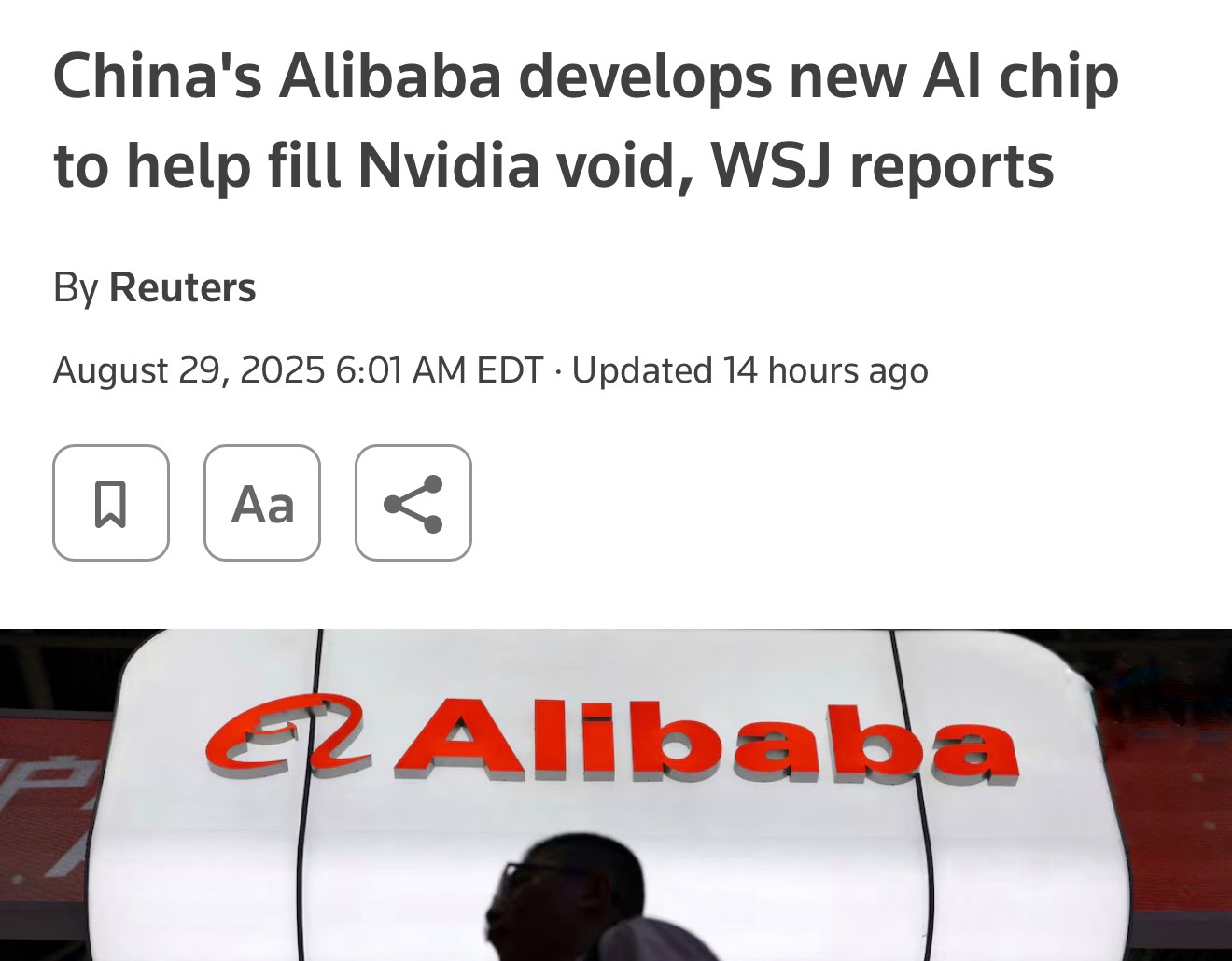
In a bold new move, Alibaba (BABA) has announced the development of a new artificial intelligence chip intended to fill the void left by Nvidia (NVDA) after U.S. export restrictions cut off China’s access to the most advanced semiconductors. Some are calling this the beginning of a new era, one where Alibaba becomes "China's Nvidia." But here’s the truth: this isn’t the end of Nvidia’s dominance, it’s confirmation that the AI arms race is just getting started. And that’s incredibly bullish for tech investors.
For context, Alibaba is not just the next "Chinese Nvidia", it actually serves as the current Amazon (AMZN) of China. Baba boasts itself as the number one e-commerce platform in Asia, but it's much bigger than even that. It's a sprawling technology empire, spanning not just e-commerce, but also cloud computing, digital payments, and now, chip design. The announcement comes just days after Nvidia’s latest earnings blew past expectations with a double beat and raised guidance, yet again. That tells us two things: demand for AI chips is not slowing, and this market is still in its early innings. In that light, Alibaba’s move looks less like a threat to Nvidia’s crown and more like validation that chips are the future, and nations are racing to secure their place at the table.
Skeptics will argue that software is dead in the age of AI, that all value now belongs to hardware. But last week, Snowflake (SNOW) and MongoDB (MDB) proved otherwise. Both software companies were written off as casualties of AI disruption, yet each delivered massive beats and raised guidance. Their share prices surged in after-hours trading. This tells us that we're entering a software stock renaissance, a recalibration, not a funeral. The next major test is Salesforce (CRM), reporting this week. If they can show that AI is helping them accelerate out of the single-digit growth doldrums, CRM could become one of our top picks into year-end. But failure to demonstrate that leverage may force us to downgrade it from our watchlist.
Not all software names are created equal. Adobe (ADBE), for example, is one we believe is being cannibalized by AI. With pressure from design tools like Canva and Figma (FIG), and now Google (GOOG) entering the fray with its new “Imagen” tool (reportedly nicknamed internally as Nano-Banana), Adobe is losing ground fast. This divergence highlights a critical nuance: winners in this tech cycle won’t just be those who say “AI” the loudest, but those who can integrate it meaningfully into their business model and defend their moat.
Here’s where we’re focused now:
-
Nvidia (NVDA): Still the gold standard in AI chips. Capital, talent, and software ecosystem remain unmatched. Not much else to say about this phenomenal company.
-
ServiceNow (NOW): A quiet giant in enterprise automation, ServiceNow is deeply embedded in corporate workflows, and its integration of generative AI into IT and HR, positions it as a key infrastructure layer in the AI era. It reported an incredible earnings, but the stock sold off unjustly, and we believe it should be valued at over $1,000 per share. This is one of the stealth AI winners that institutions will pile into as software rebounds.
-
Snowflake (SNOW): A data-layer winner poised to benefit from AI workflows. Strong earnings and guidance signal renewed investor appetite. It's still expensive, but with the growth they're demonstrating, there's plenty of upside potential.
-
MongoDB (MDB): Another surprise winner, proving that modern databases are critical infrastructure in the AI era. Incredible earnings sent this one up over +40% in the past week alone! After this run-up, we aren't chasing it here, as we believe a lot of the value has already been priced into the stock.
-
Salesforce (CRM): On the edge, this week’s earnings could reveal whether AI is a tailwind or a threat. This is a "make it or break it" point for the company. Depending on how their earnings are, we'll decide whether we own the name going into the future, or we shun it completely. We expect good earnings for them so we lean on the side that they will ouperform expectations with a strong quarter.
The real takeaway? This isn’t a China vs. U.S. story. It’s not Nvidia vs. Alibaba. It’s a broader rearmament in the global tech economy, with chips as the new oil and AI as the combustion engine. The nations and companies building now will define the next decade. Investors waiting on the sidelines will miss what could be one of the greatest multi-year tech rallies of our generation. Tech isn’t dead...it’s just getting started.
-
-
S&P500 Adds A New Stock! The Top 5 Stocks We Believe Are Next... (Source)
Stocks mentioned: $WBA, $IBKR, $SOFI, $HOOD, $APP, $FLUT, $TOST, $COIN
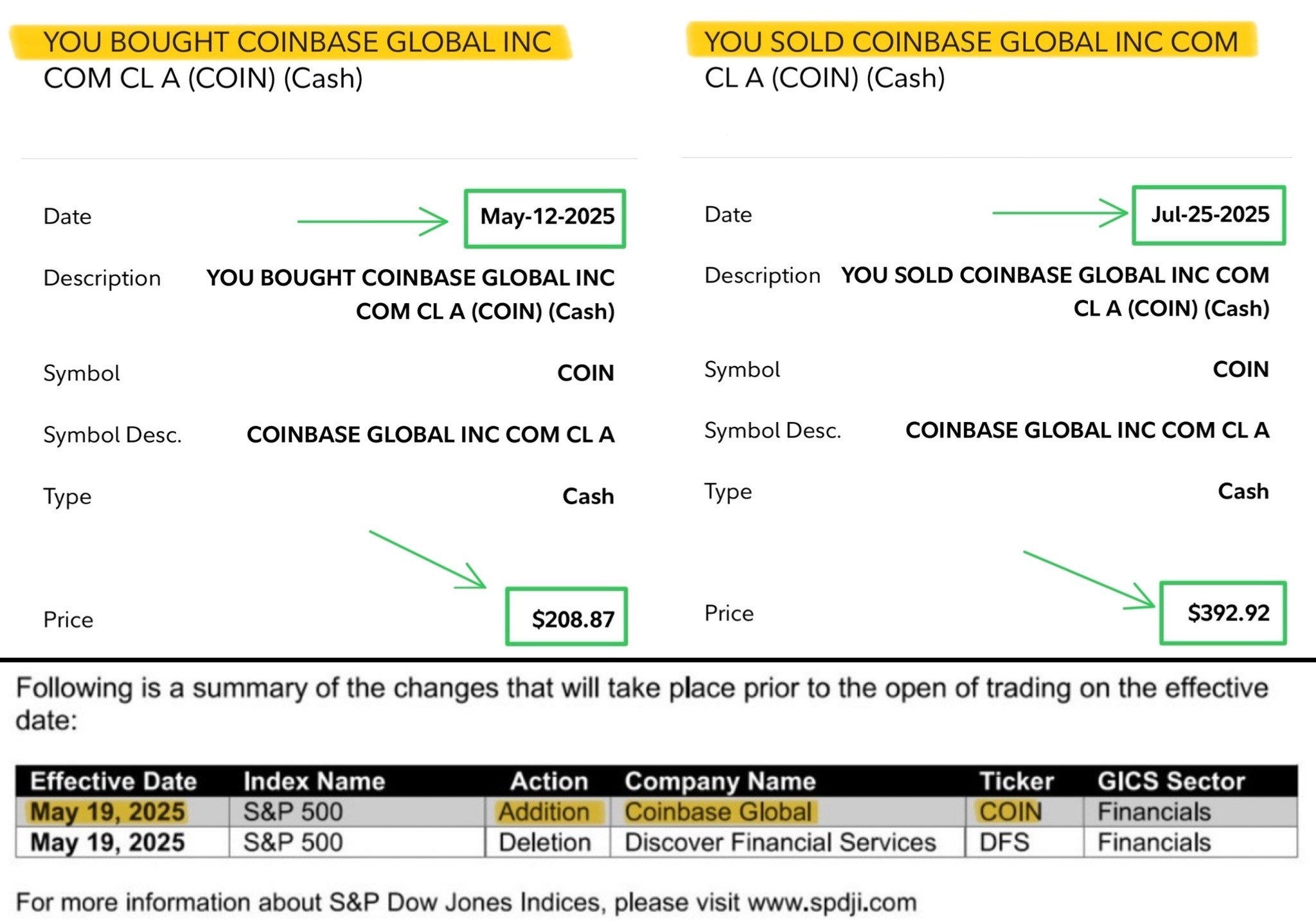
Most investors assume the S&P 500 is a passive benchmark. They’re wrong. In reality, it's an aggressive, self-cleaning mechanism that continuously swaps out its weakest links for stronger contenders. The recent ejection of Walgreens (WBA) and the seamless insertion of Interactive Brokers (IBKR) is just the latest reminder: the S&P 500 rewards performance, punishes decay, and creates explosive opportunities for those who know where to look.
This index rebalance was no surprise. Walgreens has been in terminal decline and it was recently acquired by Sycamore Partners, which forced the S&P 500 to remove it from the index because it was going private. But even without the deal, Walgreens was likely on borrowed time and would have been removed from the index soon regardless. As for Interactive Brokers, a capital-light, highly profitable fintech riding secular trends in options and derivatives trading, deserved the upgrade. But what most people don’t realize is that these changes happen frequently, and each reshuffling can create significant alpha. When a stock gets added to the S&P 500, passive ETFs that track the index, like SPY and VOO, are forced to buy it. That creates an artificial but very real surge in demand. The result? The newly added stock often jumps 5–10% immediately, followed by continued momentum as institutional flows pile in.
These inclusion spikes are not random. The S&P 500 uses strict criteria such as: having a market cap above a certain amount (this fluctuates but roughly above $16 billion), liquidity thresholds, positive earnings in the most recent quarter and over the past year, has to be a U.S. company, and a few more obscure criterias. That narrows the field and makes it possible for us to predict the most likely future additions. Based on that methodology, we’ve identified 5 strong contenders to be added:
-
SoFi Technologies (SOFI) – A digital-first financial services firm aggressively taking share from legacy banks. After turning profitable and crossing the $30B market cap threshold, it checks nearly every S&P inclusion box.
-
Robinhood (HOOD) – Despite controversy, Robinhood is the brokerage gateway for millions of retail investors. Its profitability turnaround and $90B+ market cap make it a prime candidate.
-
AppLovin (APP) – A dominant force in mobile ad tech and gaming infrastructure, AppLovin’s recent rally has pushed its valuation solidly into large-cap territory with strong fundamentals.
-
Flutter Entertainment (FLUT) – Parent company of FanDuel and a powerhouse in U.S. online sports betting. Its recent U.S. listing and financial profile give it a clear shot at index inclusion. It also helps build the case that FLUT could be added soon since a lot of "Super Investors" have been buying the stock up recently.
-
Toast (TOST) – Cloud-based restaurant point-of-sale provider with strong revenue growth, improving margins, and a market cap in the S&P range. If profitability continues to improve, it's a top contender.
To be fair, critics of S&P additions argue that the price gains are often short-lived and prone to reversal, and there is some evidence to support that in specific cases. But over time, names added to the index tend to outperform, because they are usually in secular growth markets, improving their fundamentals, and getting real validation from institutional capital.
The takeaway? The S&P 500 isn’t just a reflection of the economy, it shapes it. By tracking the index’s next additions, we aren’t just speculating, we’re positioning ahead of inevitable demand. These 5 stocks aren’t just candidates, they’re early-stage entries into a machine that buys strength and dumps weakness. And right now, the market hasn’t priced that in.
-
-
"Super Investor" Spotlight: Nancy "The Market Mover" Pelosi (Source)
Stocks mentioned: $NVDA, $AVGO, $GOOGL, $VST, $TEM, $PANW, $AMZN, $MSFT, $CRWD, $AAPL, $TSLA
This week’s spotlight turns to Nancy Pelosi, not just as the former Speaker of the House, but as one of the most closely tracked names in the stock market. What many people don’t realize is that it’s actually her husband, Paul Pelosi, a long-time venture capitalist and money manager, who executes their trades. While the headlines often make it sound like Nancy is directly buying and selling stocks herself, the reality is Paul has been managing their investments for decades. Still, because the disclosures are filed under her name as a member of Congress, these trades carry enormous visibility. Whether you believe she has access to insider information or not, one fact is undeniable: her portfolio has consistently outperformed not only the S&P 500, but also a majority of hedge funds and professional managers. That’s why investors across all of social media follow her filings closely, using them as a roadmap for where “smart money” in Washington might be moving next.
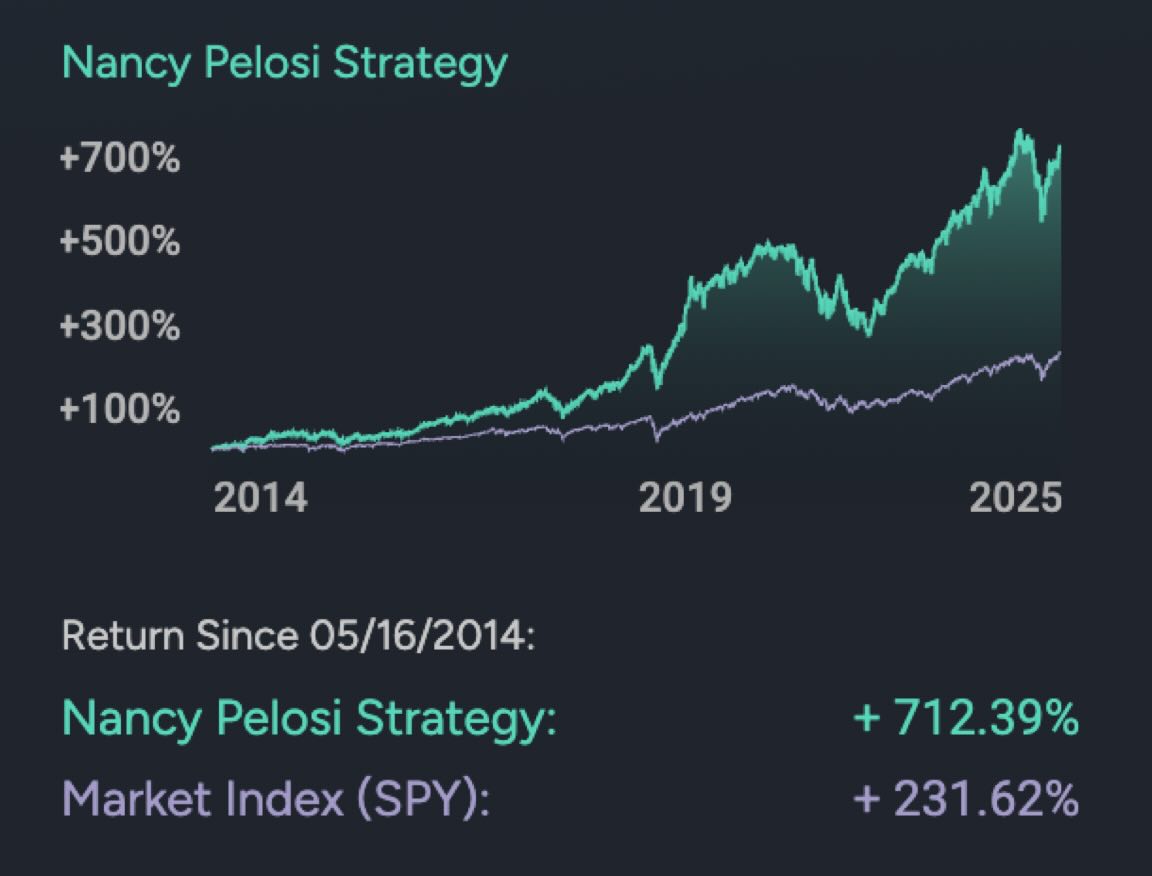
When you line up the data, the outperformance is striking. Since 2014, Pelosi disclosed trades that have generated returns that put her up there with some of the best investors of all time, like Warren Buffett and Charlie Munger. Charts comparing her portfolio’s performance to the S&P 500 show just how wide the gap has grown. At CEO Watchlist, we don’t simply follow politicians for the headlines, we follow them because the numbers back it up. If you’re serious about learning from top-tier investors, ignoring the Pelosi track record would mean leaving money on the table. As you can see below, since 5/16/2014, Pelosi has returned over 700% while the S&P500 is barely above 200%! For a politician who helps pass laws and no background in the stock market, these are some really impressive numbers. For reference, Warren Buffett over the last 10 years, is only up 287.98%, barely beating the S&P500 and nowhere near Nancy "The Market Mover" Pelosi!
In her most recent disclosure, Pelosi’s portfolio remains heavily tilted toward technology. Here are all of her stock positions:
-
-
Nvidia (NVDA) – 21%: The largest holding, a clear bet on artificial intelligence and the chip industry’s long-term growth. Pelosi continues to hold this position despite how much it has grown in her portfolio.
-
Broadcom (AVGO) – 14%: A semiconductor leader that helps create custom chips for companies. This is actually our second favorite semiconductor company after Nvidia. They're reporting earnings this Thursday after the close, and we consider this the most important earnings report coming out next week.
-
Alphabet (GOOGL) – 11%: One of the most diversified and undervalued tech stocks in the entire market. Once the DOJ makes a decision about whether or not to split up Google, we will finally have some answers about which direction this stock will move. But since Nancy hasn't sold it yet, we would venture to say the odds are pretty good that Google wins this case.
-
Vistra (VST) – 10%: Utility and energy exposure positioned to profit from surging power needs at AI-driven data centers. Currently, we don't have enough power to supply the AI demand, and Vistra stands at the forefront of powering the AI revolution.
-
Tempus (TEM) – 9%: An AI-driven healthcare company, which is shaping the future of diagnostic healthcare. For a high-risk, speculative name, this one is very interesting and we believe it can have some decent upside potential over the coming years.
-
Palo Alto Networks (PANW) – 7%: One of our personal favorite cybersecurity names, which just beat and raised on their earnings report. Incredible company in an incredible sector, growing at some incredible numbers. There's not much to critique here.
-
Amazon (AMZN) – 9%: E-commerce dominance paired with AWS’s profitable cloud segment. They just continue to impress year after year, and with them just hitting 1,000,000 robots working in their factories, we view them as a top 3 player in the robotics space currently. On top of this, we think the stock is undervalued significantly.
-
Microsoft (MSFT) – 5%: Blue-chip tech giant driving growth in cloud and AI, but moreso known for their massive investment in Chat GPT. This might be one of the greatest companies to ever exist. One flaw with Microsoft is that they are not cheap to own, you pay a high premium to own this stock.
-
Crowdstrike (CRWD) – 5%: Similar to Palo Alto, this is a top-tier name in cybersecurity. They just put up some amazing numbers on their recent earnings report this past week. We believe this is the current pure-play leader in cybersecurity. Again, this is another company that is not cheap on any valuation metric, but their growth is out of this world. When you buy this stock, you are paying for the future, not what it is today.
-
Apple (AAPL) – 4%: With slowing growth over the past few years, Apple has been a little bit of a dissapointment. But if there was one company that could put themselves back on the right track, it is Apple. Not our favorite stock, but we don't hate it either. We have Apple as a neutral rating at CEO Watchlist.
-
Tesla (TSLA) – 3%: A surprising inclusion given Pelosi’s criticisms of Elon Musk, which means she must really believe in Tesla's vision. She's putting money over her personal feelings with this investment. No doubt Tesla is a leader in autonomous driving, and the future of robotics, two sectors which we really like.
From our perspective, there’s a lot to like here. If you're an Investment Club member, CLICK HERE to see our current stock portfolios and which of these stocks we actually just bought this past week. All of these companies sit at the intersection of secular megatrends: artificial intelligence, cybersecurity, cloud computing, and rising energy demand. The outlier, Tesla, raises eyebrows because of Nancy’s rocky relationship with Musk, but that makes the position even more interesting, it may be purely financial, divorced from politics or personal preference. The overall tech tilt mirrors our conviction that technology remains the growth engine of this market cycle.
The takeaway is simple: "The Pelosi’s" portfolio isn’t just tabloid fodder, it’s a performance machine. Whether or not they have "unfair advantages" is up for debate, but the results speak for themselves. By consistently beating the market and leaning into the sectors we believe in most, their portfolio offers a rare window into how wealth and power intersect with investing. For us, tracking Pelosi’s moves is less about politics and more about profit. When someone outperforms the majority of hedge funds, you pay attention. And when their biggest holdings align with the megatrends reshaping the global economy, you act.
-

INSIDER TRADES FROM THE WEEK:
1. ASA Gold & Precious Metals (ASA) - Saba Capital Management, hedge fund, bought ~$29 million of ASA Gold & Precious Metals stock between August 7-25, 2025, but it was most recently reported to the public on August 26, 2025. (Source)

2. Match Group (MTCH) - Spencer Rascoff, CEO, bought ~$500,000 of Match Group stock on August 26, 2025, but it was reported to the public on August 28, 2025. (Source)

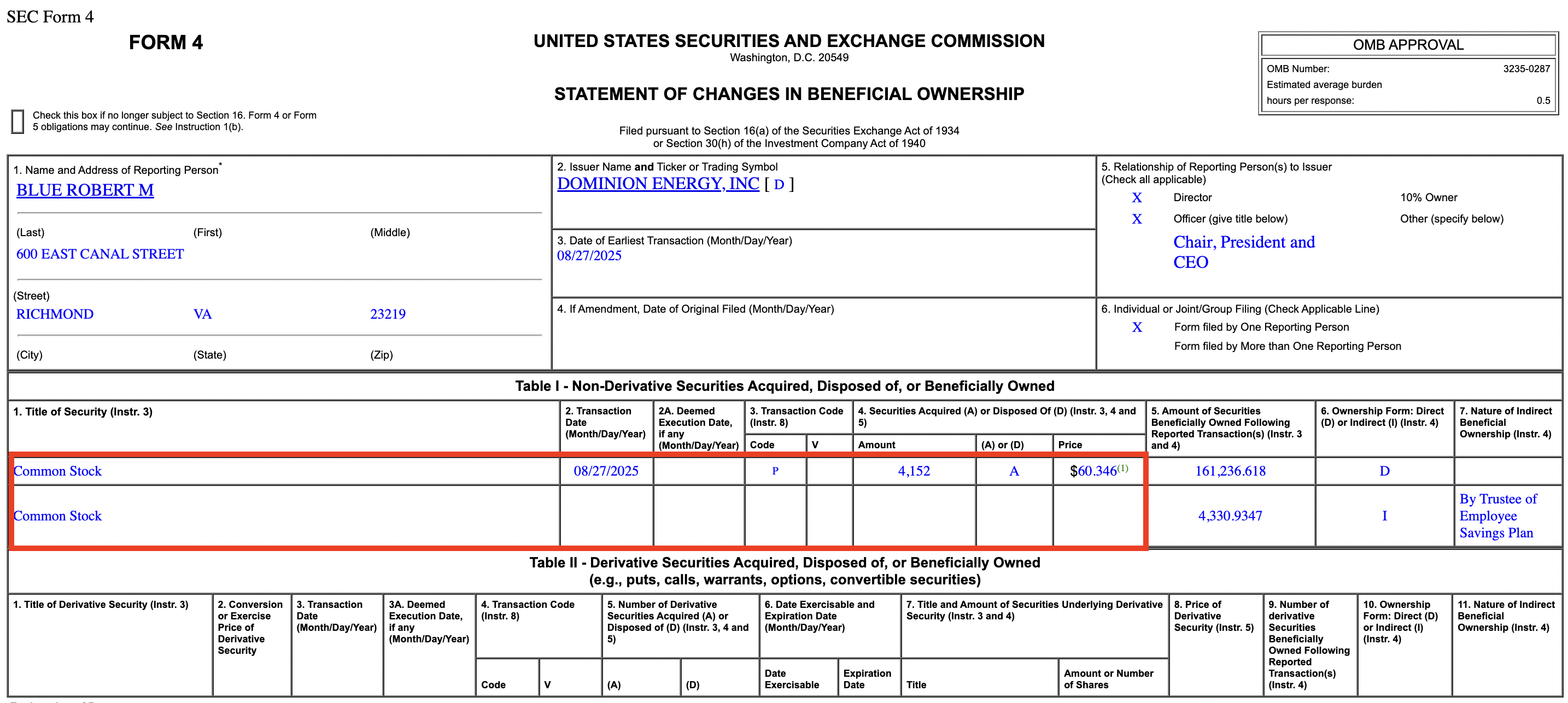
3. Dominion Energy (D) - Robert Blue, CEO, bought ~$250,000 worth of Dominion Energy stock on August 27, 2025, and it was reported to the public later that same day. (Source)
Over 2,000 people have already signed up for my FREE Masterclass video on how to unlock my exact strategies for finding winning stock/options trades! I'll share everything including how to find what Politicians and CEOs are buying. Don’t miss your chance to get in for FREE before spots fill up!

INFOGRAPHICS FOR THE WEEK:



CONTACT US: [email protected]
Responses