
TOP NEWS AFFECTING THE STOCK MARKET THIS WEEK:
From Hero to Zero...Back to Hero Again? How this Young Billionaire is Clawing His Way Back to the Top With These Tech Stocks... (Source)
Stocks mentioned: $SNDK, $MU, $BE, $TSM, $NBIS, $CRWV, $STM, $APLD, $RIOT, $SHAZ, $KEEL, $VSH, $CBRS, $INTC
Two weeks ago, Leopold Aschenbrenner looked finished. The 25-year-old former OpenAI researcher had built "Situational Awareness" into a fund that peaked at roughly $45 billion, making him one of the most successful new fund managers. Then July happened. Reported leverage of up to 400% met a brutal AI infrastructure selloff, margin calls came in from Goldman, JPMorgan, and Bank of America, and the fund collapsed in a matter of days. Think of leverage like using a credit card to buy stocks. When they go up, you look like a genius. When they drop, the bank wants its money back immediately, and you're forced to sell at the worst possible moment. That's exactly what happened. Ken Griffin's Citadel swooped in and bought a huge chunk of his stock portfolio at a massive discount. Leopold got margin-called into oblivion. Or so it seemed.
Here's the twist. He's back. We just got a look at Leopold's newly rebuilt portfolio, now running a $20.2 billion book (cut in half from his peak valuation). He didn't crawl back timid and diversified. If anything, he doubled down on the exact thesis that both made and broke him: that smarter AI systems will drive enormous, insatiable demand for the physical guts that make AI possible, meaning memory chips, semiconductors, data centers, and now the power to run them. But this time is different because Leopold learned from his mistakes and has promised investors that he will steer clear away from heavy leverage, while still maintaining his conviction in the stock themes he believes has the most upside potential going into the future. We like this new approach from Leopold. It allows him to maintain his high conviction investment while not overleveraging himself to the point of destroying his fund. We think this is an important lesson for all investors out there, whether you are running a $1,000 portfolio or a multi-billion dollar portfolio...know your risk tolerance, and ALWAYS incorporate risk management into any investment strategy. As we've said before, we love Leopold's investment thesis and agree with him. Now with his decreased leverage, we believe he has a much higher chance for success with this investment strategy.
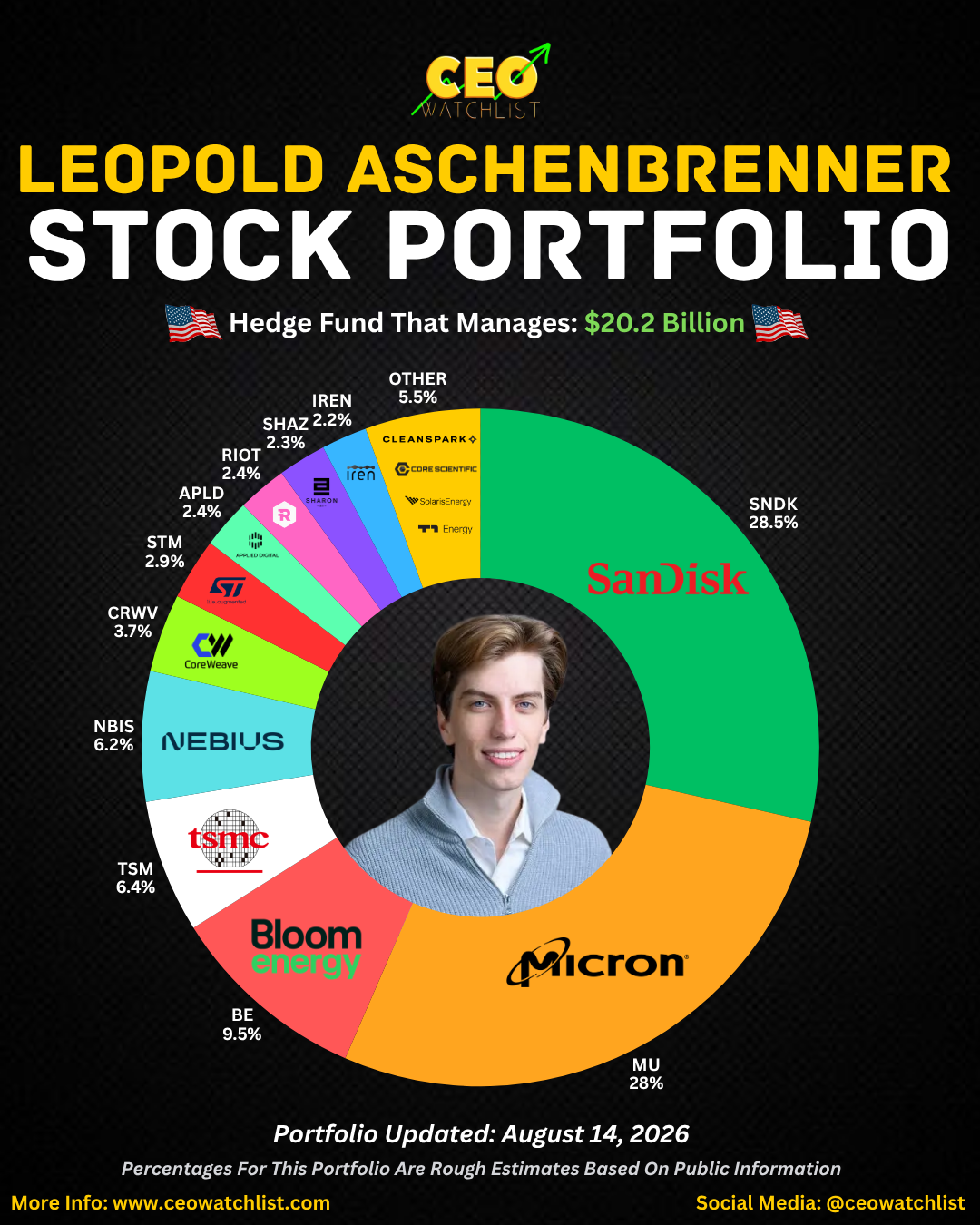
But what really matters here, and what a majority of you truly care about, is what stocks did he buy? And what does his current stock portfolio look like?So without further ado, here is his Top 10 largest stock positions:
- SanDisk (SNDK) - 28.5%
- Micron (MU) - 28.0%
- Bloom Energy (BE) - 9.5%
- Taiwan Semiconductor (TSM) - 6.4%
- Nebius Group (NBIS) - 6.2%
- Coreweave (CRWV) - 3.7%
- STMicroelectronics (STM) - 2.9%
- Applied Digital (APLD) - 2.4%
- Riot Platforms (RIOT) - 2.4%
- Sharon AI (SHZ) - 2.3%
Notice the pattern. Memory, chips, infrastructure, and power, over and over. He continues to focus on the AI buildout narrative with new buys in NBIS, STM, KEEL, VSH, and CBRS, while maintaining his top positions in memory through SNDK and MU. We really just wanted to focus on his Top 10 positions, but we included an infographic of every stock he owns in his portfolio down below at the end of the article for you to save and keep. Personally my favorite top 3 stocks that he owns include NBIS (for higher risk, higher reward), TSM (for lower risk), and SNDK (higher risk, high reward, but they just had an extremely bullish investor day). These 3 names all present great opportunities for my personal portfolio for different reasons. Nebius has been a long term holding of ours, owning it since it was in the $20's, and we continue to believe in this name, especially after their incredible earnings report they put up this past week. Then you have TSM which is just a core position in the portfolio that pairs really well with Intel (INTC). These 2 names pair really well together, one for pure-play domestic production of chips through Intel, and the other that gives us exposure to the current chip production leader, through TSM. Finally, you have SNDK, which is a little bit more risky just because memory has had such a parabolic move up, but the fundamentals remain strong and after their recent pullback and strong investor day, we think now is a time for nibbling at this name.
To pull it all together: a month ago Leopold's leveraged AI empire got vaporized by margin calls and absorbed by Citadel, and plenty of people wrote his obituary. Now he's back with a $20.2 billion portfolio that says he still believes the AI infrastructure boom is the trade of the decade, leaning hard into memory and chipmakers like SanDisk, Micron, and Taiwan Semiconductor, adding a power angle with Bloom Energy, and betting on data center "landlords" like Nebius. The big question this raises is whether the July blowup was a story of a bad thesis or just bad risk management. Leopold is voting, with real money, that it was the latter, AND WE AGREE! Whether he's a genius who just got a little bit ahead of himself with leverage, or a fool going all-in on the wrong sector, only time will tell. But if he's a fool, then we are as well, and we'll be keeping him company all the way to the end of this story.
Retail and Chip Stocks Collide This Week... Here Are The Top 5 Stocks We Are Watching... (Source)
Stocks mentioned: $FN, $HD, $KEYS, $ADI, $WMT
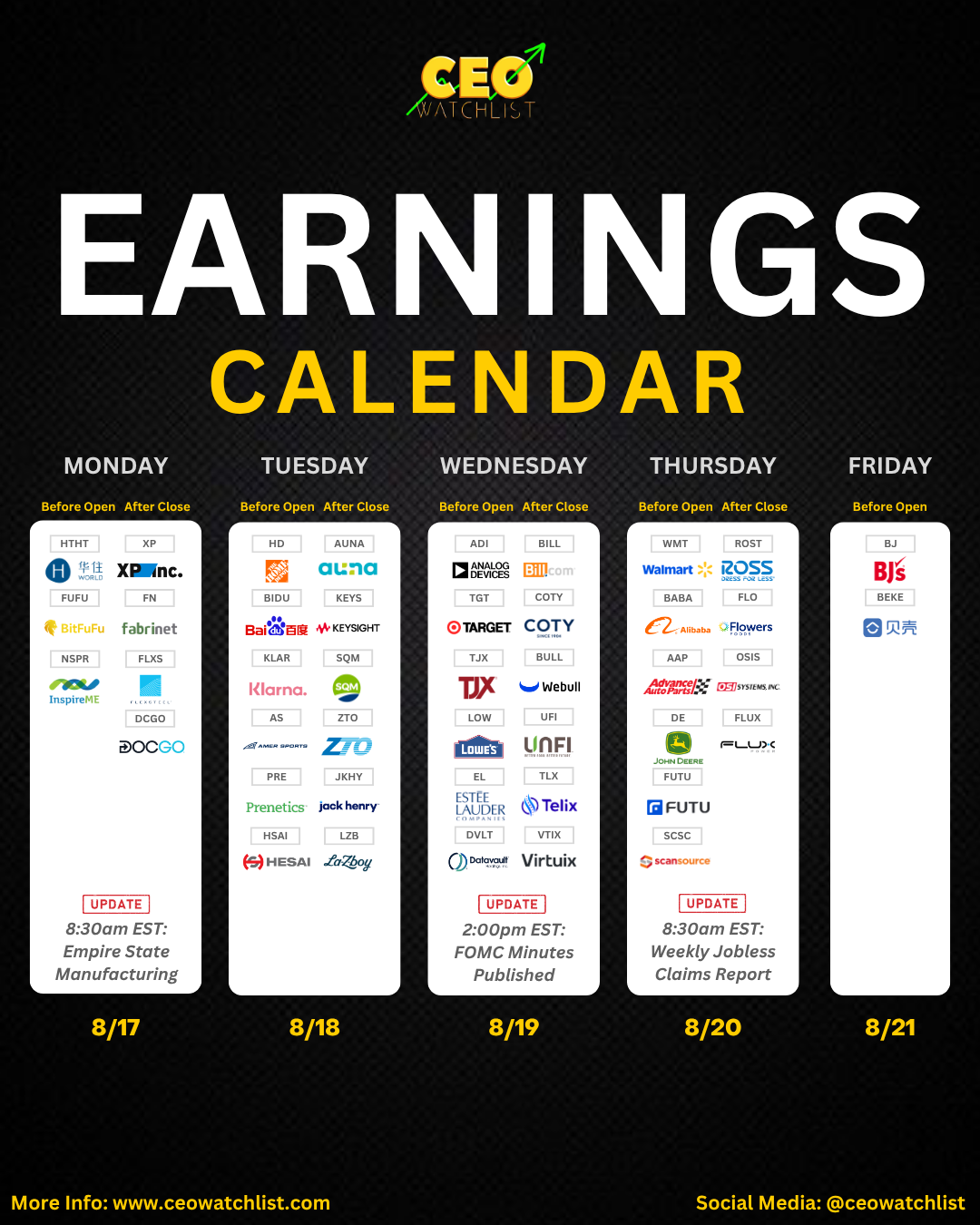
Hope you're rested up, because the calendar this week is a genuine split-screen. On one side we have the consumer bellwether stocks, with the retail giants lining up back to back. On the other, a cluster of AI-adjacent hardware stocks that give us a fresh read on whether the data center buildout is still accelerating. For the sake of this article, we are going to focus on 5 names that I think matter most, and I have deliberately weighted this list toward the AI supply chain because that is where the more interesting questions sit right now. Here is the list:
- Fabrinet (FN) - Reports Monday, August 17, after the close. Fabrinet is one of the more under-the-radar ways to play the AI buildout. It does not design chips or sell a brand-name product, it manufactures the advanced optical packaging and precision components that go into the transceivers moving data around AI data centers, effectively acting as the contract manufacturer for a lot of the optical supply chain. Analysts are looking for revenue of roughly $1.28 billion and adjusted EPS around $3.81, against $909.7 million in revenue and $2.65 in the year-ago quarter. The setup here is the interesting part. Fabrinet has beaten estimates for four straight quarters, but the stock has a genuine tendency to sell off on the print anyway, with shares dropping about 8% after the last report even though the company beat on both lines. That tells me expectations are the enemy here, not the fundamentals. Datacom demand tied to 800G and the transition to higher-speed transceivers is the whole thesis, along with commentary on capacity, since management has been investing heavily in new facilities and a co-packaged optics stake to address future program ramps. We care most about datacom growth and any color on supply constraints, because a beat that comes with cautious capacity language is exactly the kind of print that has knocked this stock down before.
- Home Depot (HD) - Reports Tuesday, August 18, before the open. Home Depot is the largest home improvement retailer in the world, and I treat it as one of the cleanest reads available on whether the U.S. consumer is actually spending on their homes or just window-shopping. Wall Street expects revenue of roughly $47 billion, up about 5% year over year, and diluted EPS around $4.71, up marginally from $4.68 in the year-ago quarter. Q2 holds the year's largest selling weeks, so the revenue jump off Q1's $41.8 billion is normal. The number I actually care about is the comparable sales line underneath it. Management guided fiscal 2026 comps to flat-to-2% growth, and Q1 came in at positive 0.6%, but CEO Ted Decker was blunt on the last call that the expected second-half pickup is driven by storm activity normalizing rather than a rebound in underlying demand. That sets up a clean test for me: a comp near or above the Q1 pace with U.S. comps positive keeps the full-year path intact, while a flat-to-negative print puts the whole guide at the mercy of the back half. The stock walks in with something to prove, down roughly 8% to 11% over the past year while the S&P 500 posted double-digit gains. I am watching the comp line and big-ticket transaction data far more than the headline EPS here.
- Keysight (KEYS) - Reports Tuesday, August 18, after the close. Keysight is another one of my preferred picks-and-shovels ways to play multiple secular themes at once. It makes electronic design and test equipment, the gear that engineers use to build and validate everything from AI networking hardware to semiconductors to aerospace and defense systems. Management guided Q3 fiscal 2026 revenue to a range of $1.73 billion to $1.75 billion, up about 29% at the midpoint, with EPS of $2.43 to $2.49, up roughly 43% at the midpoint. The last quarter was the best in company history, with orders surging 56% year over year past $2 billion and management calling out a stronger sense of urgency from AI customers specifically. That is the line that keeps me interested here, because test-and-measurement demand tends to lead actual production, so an acceleration in Keysight's order book is an early signal for the broader hardware cycle. The catch is the setup. The stock has run up roughly 97% over the past 52 weeks, which means a lot of good news is already in the price. I am focused on the order growth and any commentary on how AI, defense, and semiconductor demand is trending into the back half, because with a stock up this much, in-line is not the same as good.
- Analog Devices (ADI) - Reports Wednesday, August 19, before the open. Analog Devices is one of the largest analog and mixed-signal chipmakers in the world, and it bridges the physical and digital worlds, converting real-world signals into the data that powers automation, automotive systems, and increasingly AI infrastructure at the intelligent edge. The company guided Q3 fiscal 2026 revenue to roughly $3.9 billion, plus or minus $100 million, well above where the Street had been modeling, with adjusted EPS around $3.30. Consensus now sits near $3.92 billion in revenue, up about 36% year over year, and $3.33 in EPS, up roughly 62% from the year-ago quarter. Those are big year-over-year jumps, which tells me ADI is coming off a cyclical trough as much as it is riding a secular wave. On the last call, management flagged record bookings across industrial, automotive, and communications, with industrial AI-related applications and automotive called out as particular areas of strength. The whole debate here is durability. The recovery is real, but the question is whether industrial and automotive demand holds or whether this is inventory restocking that fades. I am watching bookings and the industrial commentary closely, because that segment is the tell on whether the broader analog cycle has legs into 2027.
- Walmart (WMT) - Reports Thursday, August 20, before the open. Walmart is the single best proxy I have for the health of the U.S. consumer, particularly on essentials like groceries and pharmacy, where it keeps taking share even when general merchandise softens. Wall Street expects EPS of roughly $0.74, up about 8.8% from $0.68 in the year-ago quarter, on revenue in the neighborhood of $186 billion to $187 billion. The tension in this one is tariffs and margins. Management has flagged that higher reciprocal tariffs could pressure margins even as they work to hold prices down in core categories, so the read-through on how Walmart is managing that cost pass-through matters for the entire retail complex. The stock has been in an extended downturn recently, which changes the risk-reward into the print. What I am focused on is comparable sales, e-commerce growth, and any commentary on how tariffs are flowing through to the P&L, because Walmart's take on the consumer sets the tone for everyone reporting around it.
The week also carries a macro layer we think matters as much as any single print. The FOMC minutes from the July 28-29 meeting land Wednesday, August 19, at 2:00 p.m. Eastern, and they arrive into a genuinely tense rate backdrop. The Fed under Chairman Kevin Warsh held the policy rate at 3.50% to 3.75% at that meeting, but three regional Fed presidents actually dissented in favor of a 25 basis point hike, which is not something the market takes lightly (HAWKISH DISSENT IS BAD FOR STOCKS). Markets have started leaning back toward pricing in eventual cuts (GOOD FOR STOCKS), so the minutes will be parsed word by word for how close a September move in either direction really is.
Zooming out, here is what we are watching for as this week unfolds. Fabrinet and Keysight together give me the cleanest read available on whether the AI hardware and optical buildout is still accelerating or quietly cooling. Analog Devices tells me whether the broader analog and industrial cycle has actually turned. Home Depot and Walmart bookend the consumer, one on discretionary home spending and one on essentials. Different corners of the market, all answering the same underlying question about whether the spending and the buildout can keep going, and all inside four trading days with the Fed minutes sitting right on top of it. We will be covering all of it live in the CEO Watchlist Investment Club as it comes out.
"Super Investor" Spotlight: Bill Ackman (Source)
Stocks mentioned: $UBER, $BN, $MSFT, $AMZN, $HHH, $QSR, $META, $V, $MA, $SPGI, $NFLX, $PSUS, $SEG, $HTZ
Most people who follow markets know Bill Ackman as one of the loudest and most public figures in the hedge fund world, the guy who says exactly what he thinks whether it lands him in a headline or a Twitter war. But behind the outspoken reputation is one of the most concentrated, high-conviction investors alive. Ackman founded Pershing Square back in 2004 and built his name running a book of just a handful of positions, sizing each one enormous and holding for years at a time. He treats investing more like buying entire businesses than trading tickers, and his willingness to bet big on a small number of names is exactly what has made him one of the most watched managers on the planet. As a sidenote for newer readers, a "Super Investor" is just our term for a major institutional player, think massive corporations, elite hedge funds, or billionaire-run funds, whose quarterly stock disclosures give the rest of us a rare window into where the world's smartest capital is flowing. Ackman checks every box on that list, which is exactly why his 13F is one of the first ones I open every quarter.
Ackman's investing reputation is built on concentration and patience. He runs a famously tight portfolio, often just eight to twelve names, and he's comfortable letting a single position swell to a double-digit weight because he'd rather own a lot of something he understands deeply than a little of everything. This is a manager who leans into high-quality compounders, restaurant and consumer brands, payment networks, and durable franchises he can hold for the long haul. His portfolio right now is a direct reflection of that philosophy. It's not a diversified index fund. It's a focused set of bets on businesses he believes can compound for years, which is exactly what makes his filing so compelling to track.
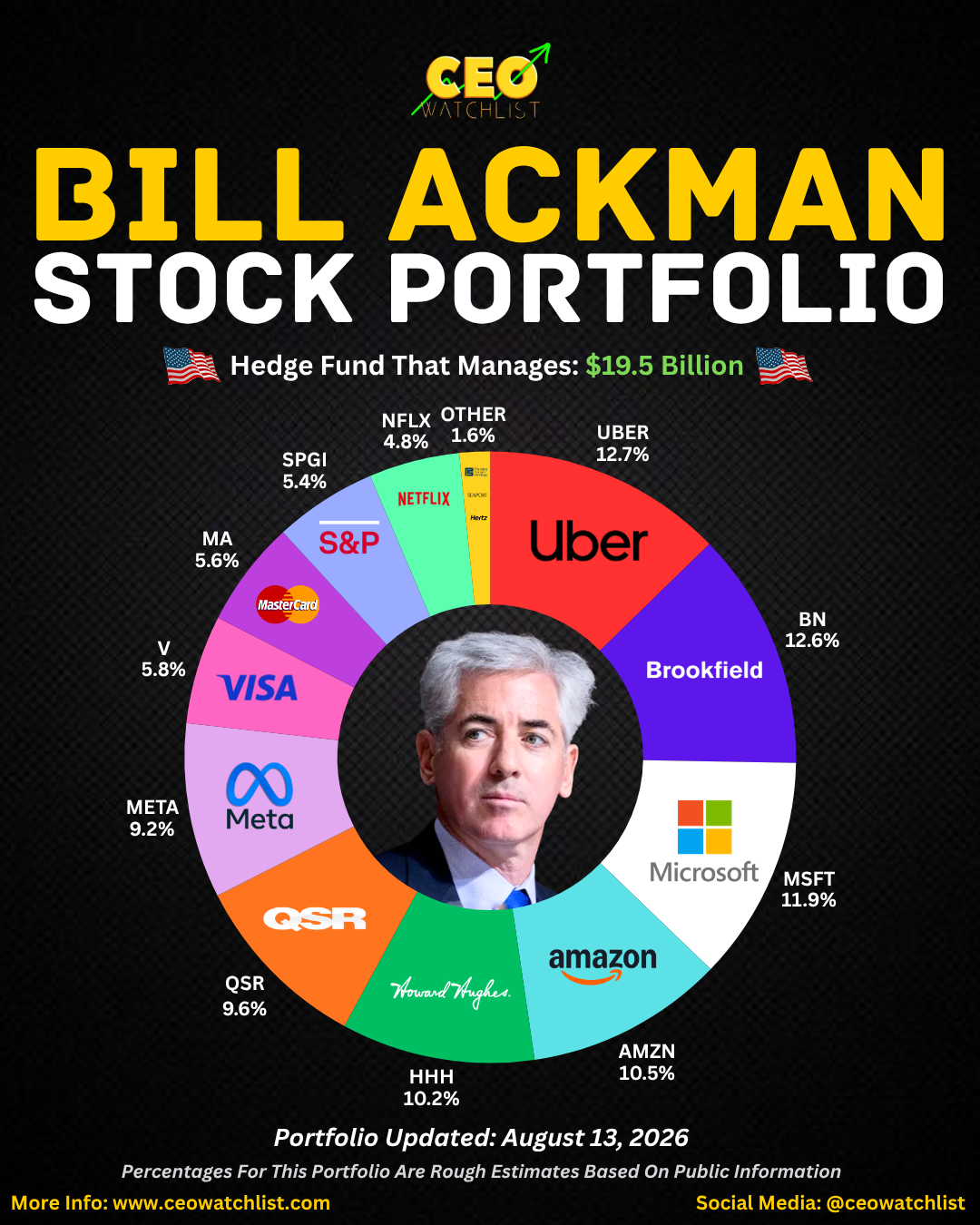
Here's a full breakdown of every stock in Bill Ackman's public stock portfolio:
- Uber Technologies (UBER) – 12.7%
- Brookfield (BN) – 12.6%
- Microsoft (MSFT) – 11.9%
- Amazon (AMZN) – 10.5%
- Howard Hughes (HHH) – 10.2%
- Restaurant Brands (QSR) – 9.6%
- Meta Platforms (META) – 9.2%
- Visa (V) – 5.8%
- Mastercard (MA) – 5.6%
- S&P Global (SPGI) – 5.4%
- Netflix (NFLX) – 4.8%
- Pershing Square USA (PSUS) - 0.77%
- Seaport Entertainment (SEG) - 0.69%
- Hertz Global (HTZ) - 0.17%
The story this quarter is just how balanced Ackman's book has become across a few big themes. His top three, Uber, Brookfield, and Microsoft, are all sitting right around 12% each, which tells me he's spreading his highest conviction fairly evenly rather than betting the whole farm on one name. Uber at the top is notable, since it's become one of his signature positions and reflects his belief in the ride-hailing and delivery flywheel scaling into serious profitability. Brookfield and Microsoft round out the top tier as classic Ackman-style quality compounders, one an asset management and real-assets giant, the other a mega cap he clearly views as a long-term hold.
The payments and data cluster is also worth a look. Between Visa, Mastercard, and S&P Global, he's holding a group of high-margin, toll-booth style businesses that print cash regardless of the macro backdrop, which is the kind of durability he's always favored. Add in Howard Hughes, a name he's been tied to for years and where he's taken an even more hands-on role, and you can see the through-line of owning businesses he wants to be deeply involved in rather than passively along for the ride. Our personal favorite name that he owns currently is Amazon. It's big and boring, but it's one of the few large companies that we still believe has a ton of upside potential over the years with their robotics and a balance sheet that continues to get more and more impressive as time goes on. We will continue to monitor Bill Ackman's portfolio, as well as dozens of other hedge funds and politicians and will continue to report on them every week to you all with updates on any new stock buys they make.
INSIDER STOCK TRADES FROM THE WEEK:
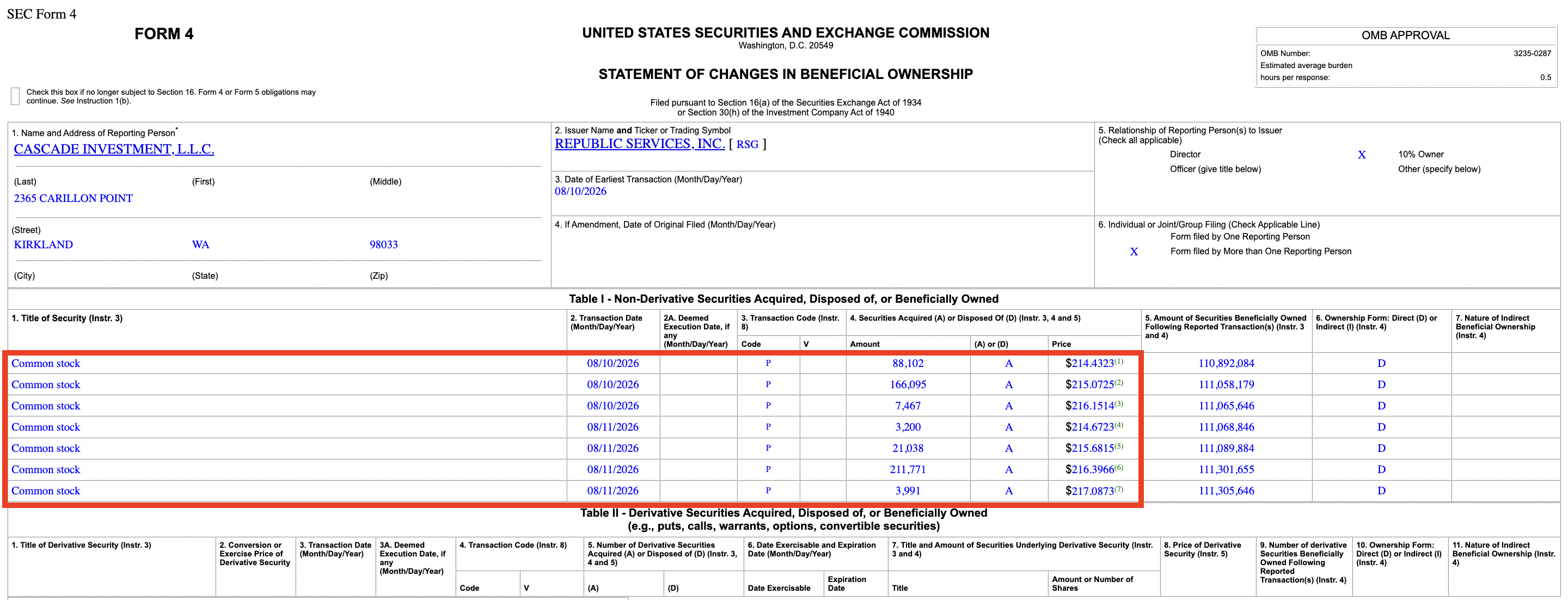
1. Republic Services (RSG) - Cascade Investment (10% owner) bought roughly $100,000,000 of RSG at an average price of $215.57/share between August 10-11, 2026, but it wasn't reported to the public until August 12, 2026. (Source)
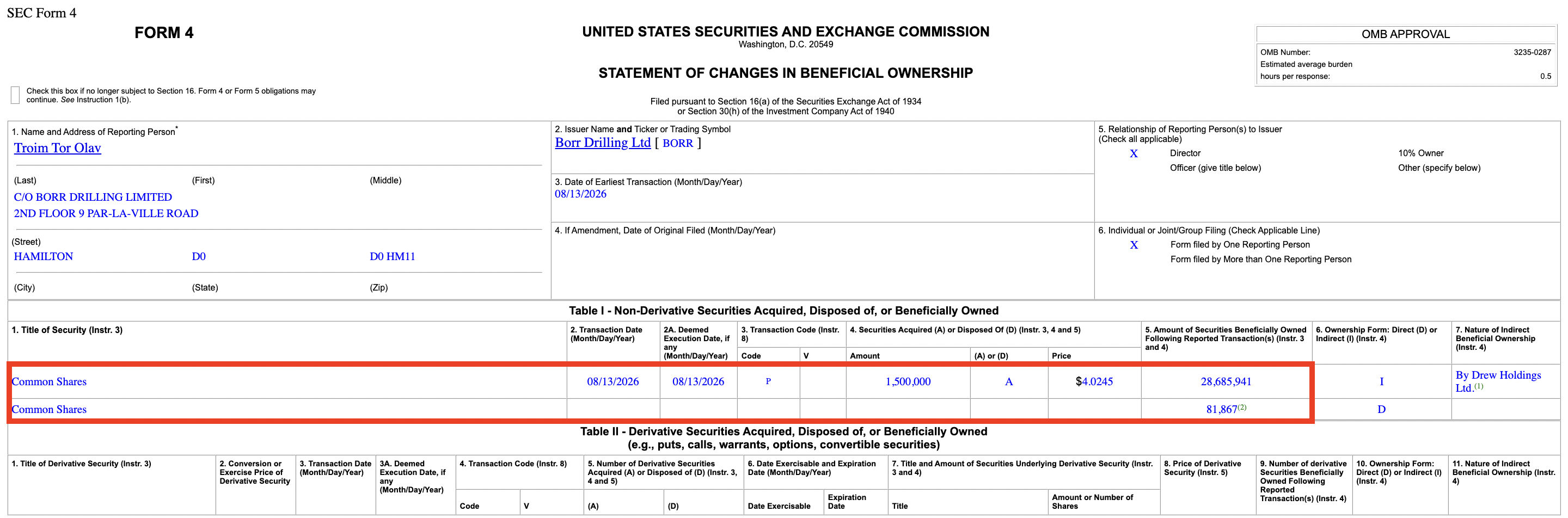
2. Borr Drilling (BORR) - Tor Olav Trøim (Director) bought roughly $6,000,000 worth of BORR at an average price of $4.02/share on August 13, 2026, but it wasn't reported to the public until August 14, 2026. (Source)
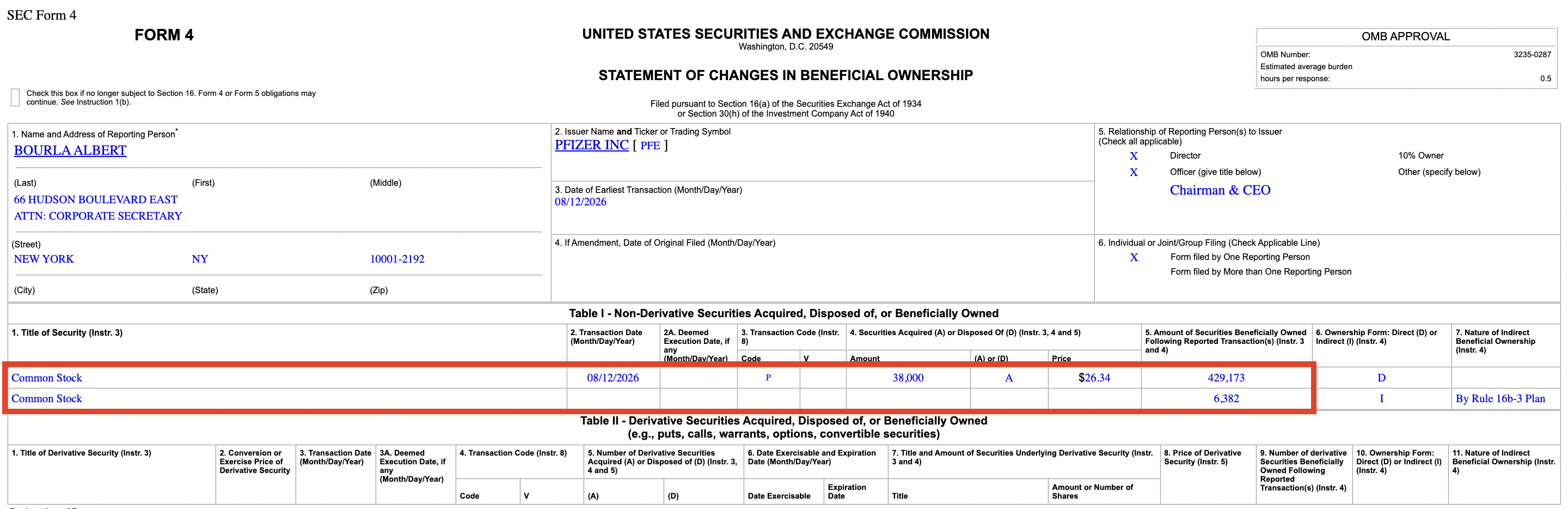
3. Pfizer (PFE) - Albert Bourla (Chairman & CEO) bought roughly $1,000,000 of PFE at an average price of $26.34/share on August 12, 2026, and it was reported later that same day. (Source)
Over 2,000 people have already signed up for my FREE Masterclass video on how to unlock my exact strategies for finding winning stock/options trades! I'll share everything including how to find what Politicians and CEOs are buying. Don’t miss your chance to get in for FREE before spots fill up!

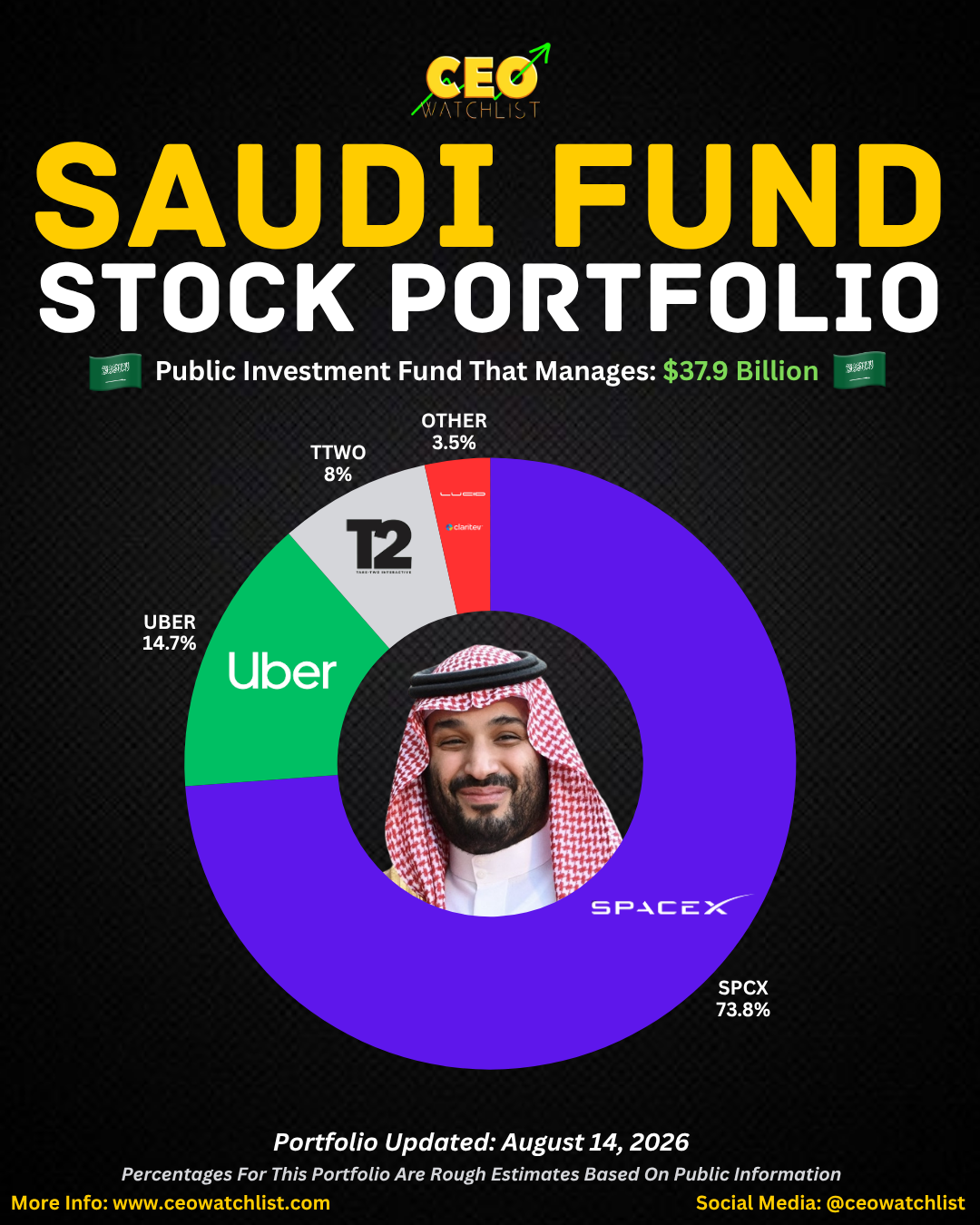
INFOGRAPHICS FOR THE WEEK:

CONTACT US: [email protected]
Responses