

TOP NEWS AFFECTING THE STOCK MARKET THIS WEEK:
-
The Real Threat to Tesla Isn’t Trump...It’s Nvidia! (Source)
Stocks mentioned: $TSLA, $GOOG, $UBER, $NVDA, $AMZN, $AAPL
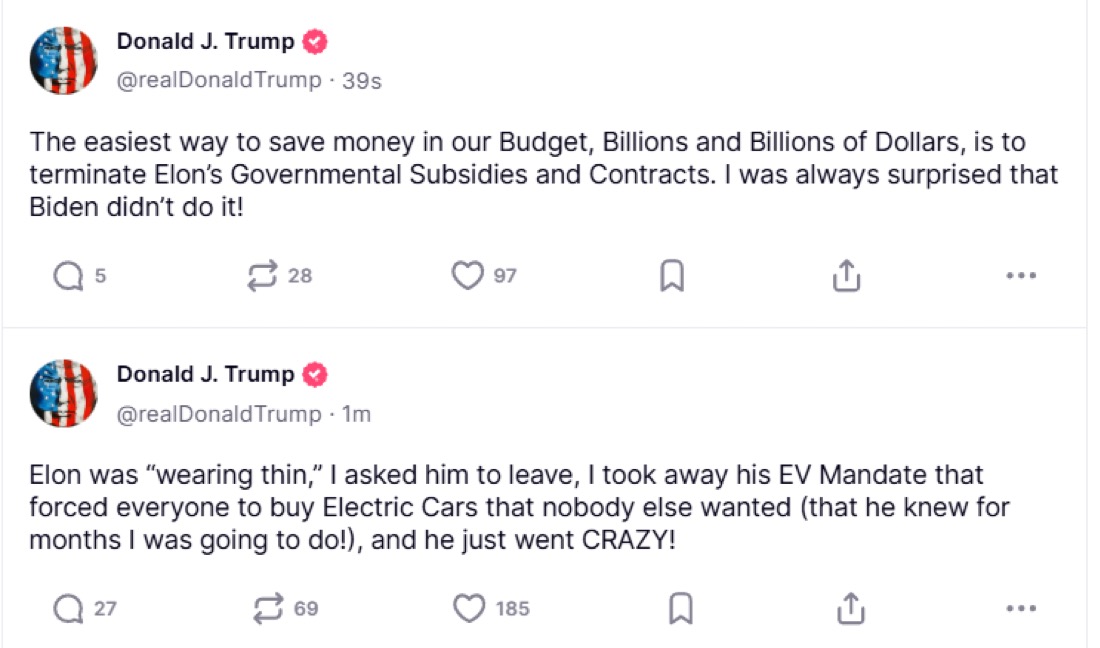
Last week, social media platforms were on fire with the intense back and forth attacks between Elon Musk and President Donald Trump. Shockingly, the realtionship between the two, who seemed to have such a strong bond over these past few months, took a sharp turn over Trump's "Big Beautiful Bill". Trump has recently said, "my relationship with Elon is probably over" after threatening to "terminate Elon's governmental subsidies and contracts". Due to this exchange of words, Tesla ($TSLA) stock fell over 14% just this past week alone! BUT, this isn't even our biggest concern for Tesla stock...
For years, the dominant narrative in autonomous driving has framed the battle as Tesla versus Google's ($GOOG) Waymo, or Tesla versus Uber ($UBER). But that framing is obsolete. It's true that Waymo and Uber are competitors to Tesla but, Tesla’s true competitor is no longer another automaker or ride-hailing service. It’s Nvidia ($NVDA). Elon Musk’s decision to ignite a public feud with Donald Trump, couldn’t have come at a worse moment because just as the political firestorm heats up, Tesla is facing its most existential competitive threat yet: platform-level disruption in AI infrastructure.The autonomous driving race is no longer about who has the best car. It’s about who controls the most powerful stack. The bottleneck is compute. Every breakthrough in full self-driving (FSD) depends on massive AI models, huge datasets, and real-time inference. Tesla’s edge was always its vertically integrated system and fleet data, but Nvidia’s DRIVE platform is quietly becoming the default infrastructure for the rest of the industry. Dozens of global automotive companies, from Mercedes to China's BYD, are building directly on Nvidia DRIVE, not bothering to develop in-house AI. In the age of software A.I. modeling, this makes Nvidia less a chipmaker and more a sovereign platform, which we view as the "Amazon ($AMZN) Web Services" for autonomous driving.
Tesla, by contrast, is increasingly isolated. Elon’s refusal to adopt Nvidia’s hardware or software stack puts Tesla on an island, betting the house on Dojo, its custom AI training supercomputer. Unfortunately for Tesla, Dojo’s rollout has been slower than expected, and the return on investment (ROI) remains speculative. Meanwhile, Nvidia continues to ship software-defined platforms like DRIVE Thor and DriveWorks SDK that others can rapidly deploy. Even Apple ($AAPL), in its secretive EV work, has reportedly leaned on Nvidia hardware. The market has mispriced this divergence. Investors have focused on the Tesla versus Waymo/Uber rivalry, when the more critical shift is automakers consolidating around a shared infrastructure layer, one not controlled by Tesla, but rather Nvidia.
The bottom line: Tesla’s fight today is with Trump, but it’s war is with time. As Musk burns political bridges on social media, Nvidia is quietly onboarding the future of mobility onto its cloud-native, software-defined stack. Tesla still has the talent and data advantage, but in a platform world, those are necessary but no longer sufficient. The market hasn’t priced in how quickly the auto industry is being absorbed into the Nvidia ecosystem. The shift is already underway. Investors who see it early will own the infrastructure of transportation’s next operating system...Nvidia DRIVE.
-
This Retail Stock Just Crashed 20% In A Single Day! Discount Opportunity Or Value Trap? (Source)
Stocks mentioned: $LULU, $NKE, $QQQ
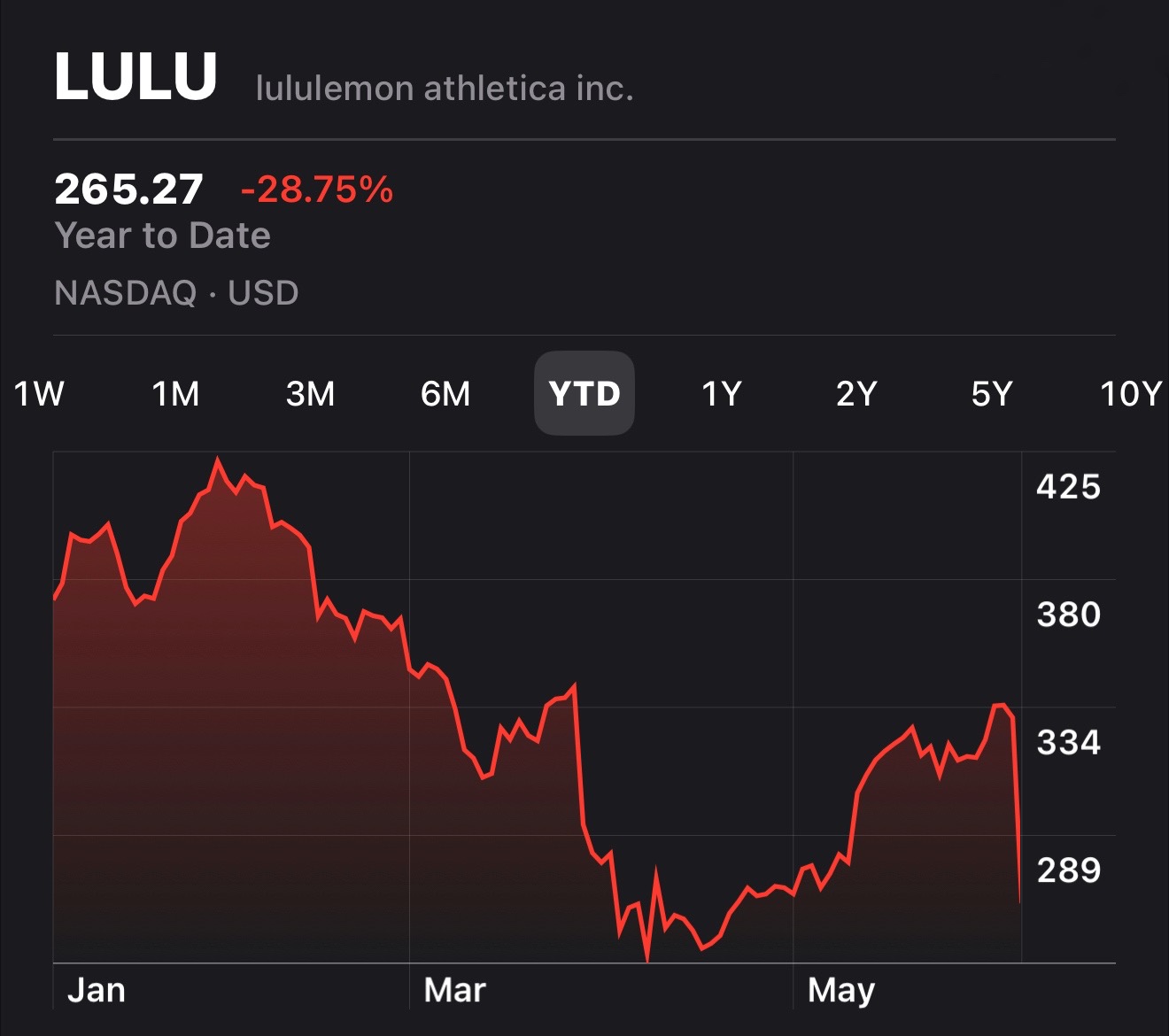
Lululemon ($LULU) has long been the gold standard in premium retail, a high-margin, high-loyalty brand that weathered inflation, supply chain chaos, and category rotation. But this quarter shattered that narrative. Shares fell 20% after earnings, a sharp and justified response to what may be the most alarming development in Lululemon’s post-COVID trajectory: a massive downward revision to full-year guidance, rising inventories, and margins under pressure. The stock wasn’t punished for missing expectations, it was punished for revealing that its core engine might be out of steam.
The long-term bull case hinges on three pillars: pricing power, international expansion, and direct to consumer (DTC) leverage. All three showed cracks. In the U.S., its most profitable region, comparable sales flatlined. Inventories rose 15%. Selling, General, and Administrative expenses (SG&A) were slashed (this is a big red flag because this is a common tactic companies use when revenue is slowing or they're predicting tough times ahead). Management blamed a “dynamic macroenvironment,” which is code for weakening consumer demand. Even with solid growth in Asia, it’s now clear: international momentum can't cover for domestic deceleration fast enough to maintain the stock's premium valuation.
Retail companies in general have all been struggling from Nike ($NKE) to most recently LuluLemon. While some companies will be able to navigate this storm better than others, we believe most traditional retail companies will sink rather than swim. The lesson here isn’t that Lululemon failed, it’s that expectations were priced for perfection, and the real world is messier. A brand this strong can rebound long-term, but right now the margin profile, U.S. saturation, and cautious tone from management make this a stock to avoid, not accumulate. The 20% drop was warranted. What’s underpriced now is the risk that this wasn’t a one-time misstep, but the beginning of a new phase: slower growth, tighter margins, and a lot less room for error.
At CEO Watchlist, we prioritize high-growth stocks to maximize profits in our portfolios. Unfortunately, traditional retail does not cut it anymore if we want to maximize our return on investment. That's why our personal portfolios are filled with over a dozen tech-growth names ($QQQ) that we believe have the opportunity to double in value. Why waste time on struggling retail brands when it's beyond obvious that we are moving into a more digitalized future powered by technology? If you're already an Investment Club Member, and haven't seen our updated stock portfolio, CLICK HERE to access it now! Not a member yet and have been wanting to join? CLICK HERE to join today, as we are offering access to The Club for only $150 (our lowest price we've ever offered for this subscription).
-
Peace With China On The Horizon? Our Top 3 Stocks Poised To Benefit! (Source)
Stocks mentioned: $NVDA, $MP, $TXT, $ALB
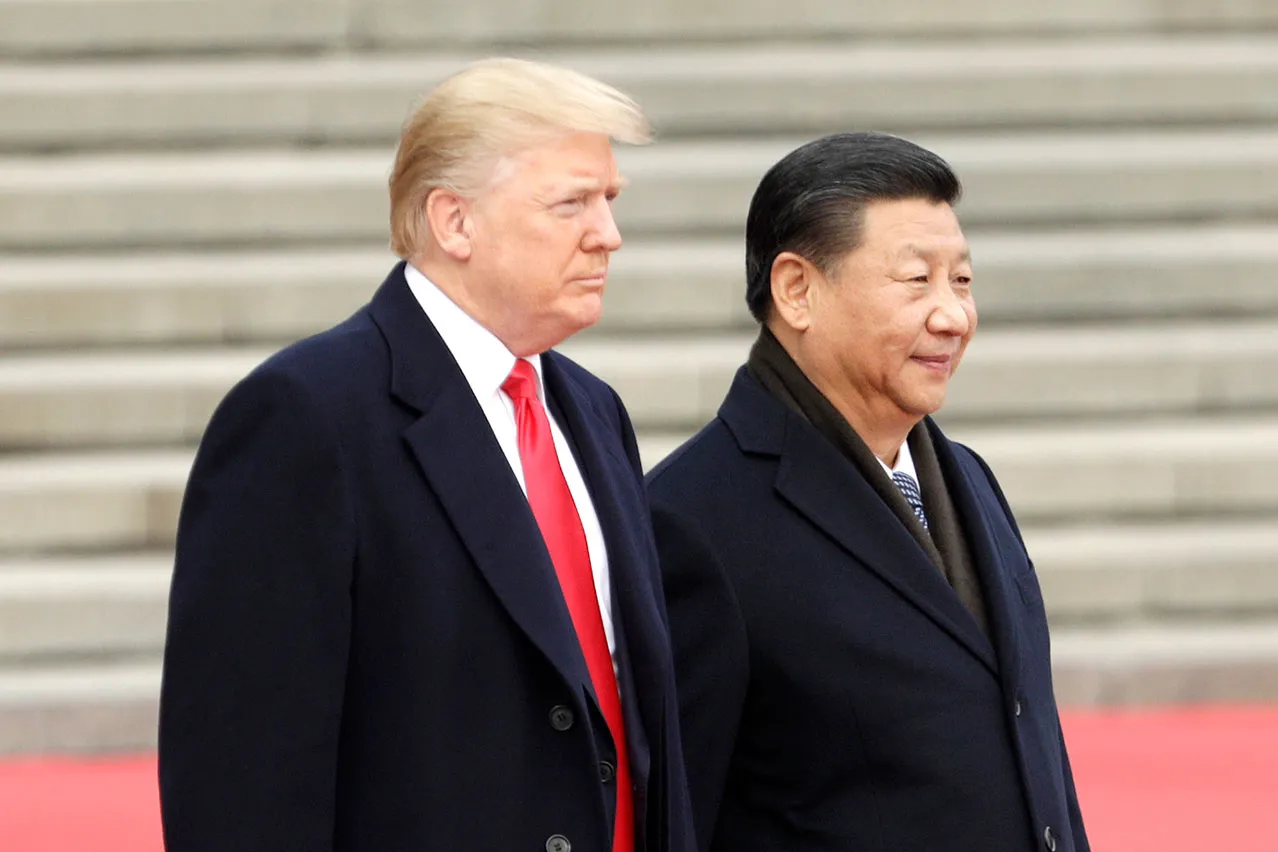
As we discussed in our first article, it's no surprise that we love Nvidia ($NVDA) at CEO Watchlist. Nvidia’s silicon dominance and soaring AI demand is extermely important but, most investors are missing the more critical constraint: access to the raw materials that power it all. Rare earth minerals (fancy hard-to-pronounce names like neodymium, praseodymium, and dysprosium) aren’t just critical to electric vehicles (EVs) and wind turbines. They are the literal backbone of America’s AI, defense, and energy transitions. Shockingly, 90% of the world’s supply of rare earth minerals still runs through China. That’s why Trump’s announcement that China’s President Xi Jinping will let rare earths flow to the U.S. again is not just geopolitical theater, it’s a tectonic shift for a handful of strategic American stocks.
The macro thesis is simple: any consiliation between the U.S. and China over rare earths is a green light for a rerating of U.S. industrial and tech companies that rely on these materials. The bottleneck hasn’t been capital or innovation, it’s been upstream exposure, and if that chokehold eases, the floodgates open for growth in critical supply chains. From defense contractors to magnet manufacturers to mineral processors, the implications are these stocks are underpriced and overlooked.
Here are three, relatively unknown, names that stand to benefit most:
-
MP Materials ($MP): As the only major U.S. producer of rare earths, MP is the front door to the entire domestic supply chain. If the U.S. gains more predictable access to Chinese supply, it allows MP to blend domestic output more strategically, optimize margin, and fast-track its Texas magnet facility without the existential fear of export bans.
-
Textron ($TXT): Maker of defense systems, drones, and aircrafts, all of which require rare earth magnets. With more stable access to these minerals, Textron’s production timelines improve, costs stabilize, and long-term contracts (including classified Department of Defense programs) gain resilience.
-
Albemarle ($ALB): While known for lithium, Albemarle’s global footprint and processing expertise position it to become a diversified energy materials giant. With U.S. and China trade thawing, Albemarle could partner or expand into rare earth separation and processing, an area with massive potential upside.
A trade deal on rare earths is more than a diplomatic headline, it’s a reconfiguration of global leverage. For over a decade, China has weaponized its mineral dominance and if that monopoly begins to soften, U.S. firms closest to extraction, application, and innovation will finally be recognized by the markets and stock prices could soar. Markets are still pricing in supply chain fragility, but the narrative is changing. Smart capital will move before the headlines do.
-
INSIDER TRADES FROM THE WEEK:
1. Topgolf Callaway Brands (MODG) - Adebayo Ogunlesi, Director, bought ~$2.4 million of MODG stock on June 4-5, 2025, but it was reported to the public on June 6, 2025. (Source)

2. Tyra Biosciences (TYRA) - RA Capital Management L.P., a 10% owner of the company, bought ~$11.7 million of Tyra Biosciences stock between June 4-5, 2025, but it was reported most recently to the public on June 6, 2025. (Source)

3. Keurig Dr. Pepper (KDP) - Michael Van de Ven, a director, bought ~$400,000 worth of Keurig Dr. Pepper stock on June 4, 2025, but it was reported to the public on June 6, 2025. (Source)

UNLOCK ALL INSIDER TRANSACTIONS BY JOINING THE INVESTMENT CLUB. JOIN TODAY FOR ONLY $150!!!

INFOGRAPHICS FOR THE WEEK:



CONTACT US: [email protected]
Responses