
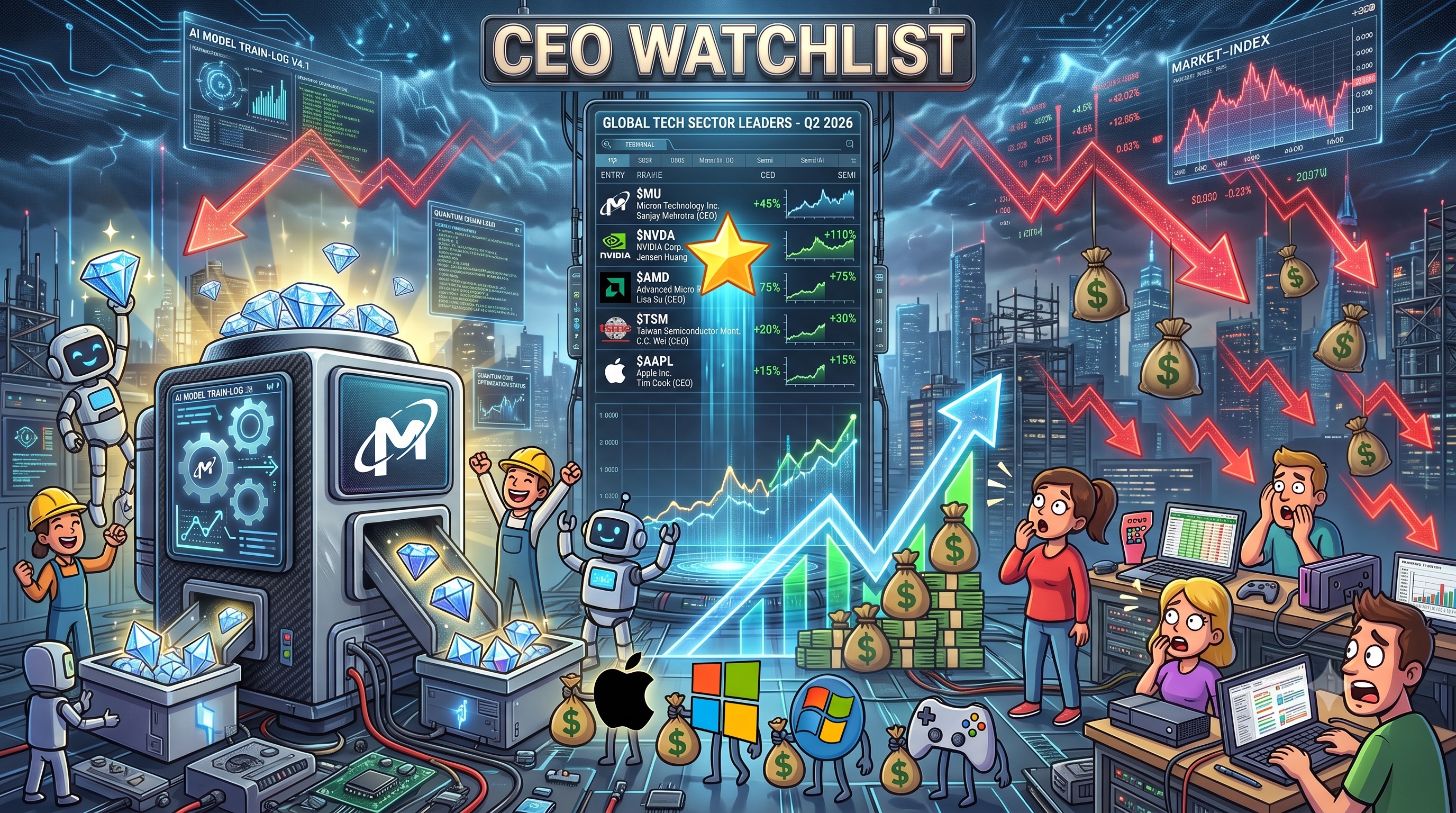
TOP NEWS AFFECTING THE STOCK MARKET THIS WEEK:
This Trillion Dollar Stock Just Reported Earnings, But Is It Enough To Save The Market? (Source)
Stocks mentioned: $MU, $AAPL, $MSFT, $SONY, $DELL, $HPQ, $NVDA
This past week, one of the newly appointed "Trillion Dollar Club" stocks reported earnings. That stock is Micron (MU). After a hawkish Fed report, and some panic in the markets, Micron came in and gave hope that the tech story hasn't run out of steam. But was the report enough to keep the markets going higher? Or have we run out of momentum and are at the start of a market crash? That's exactly what we're going to cover in this article today.
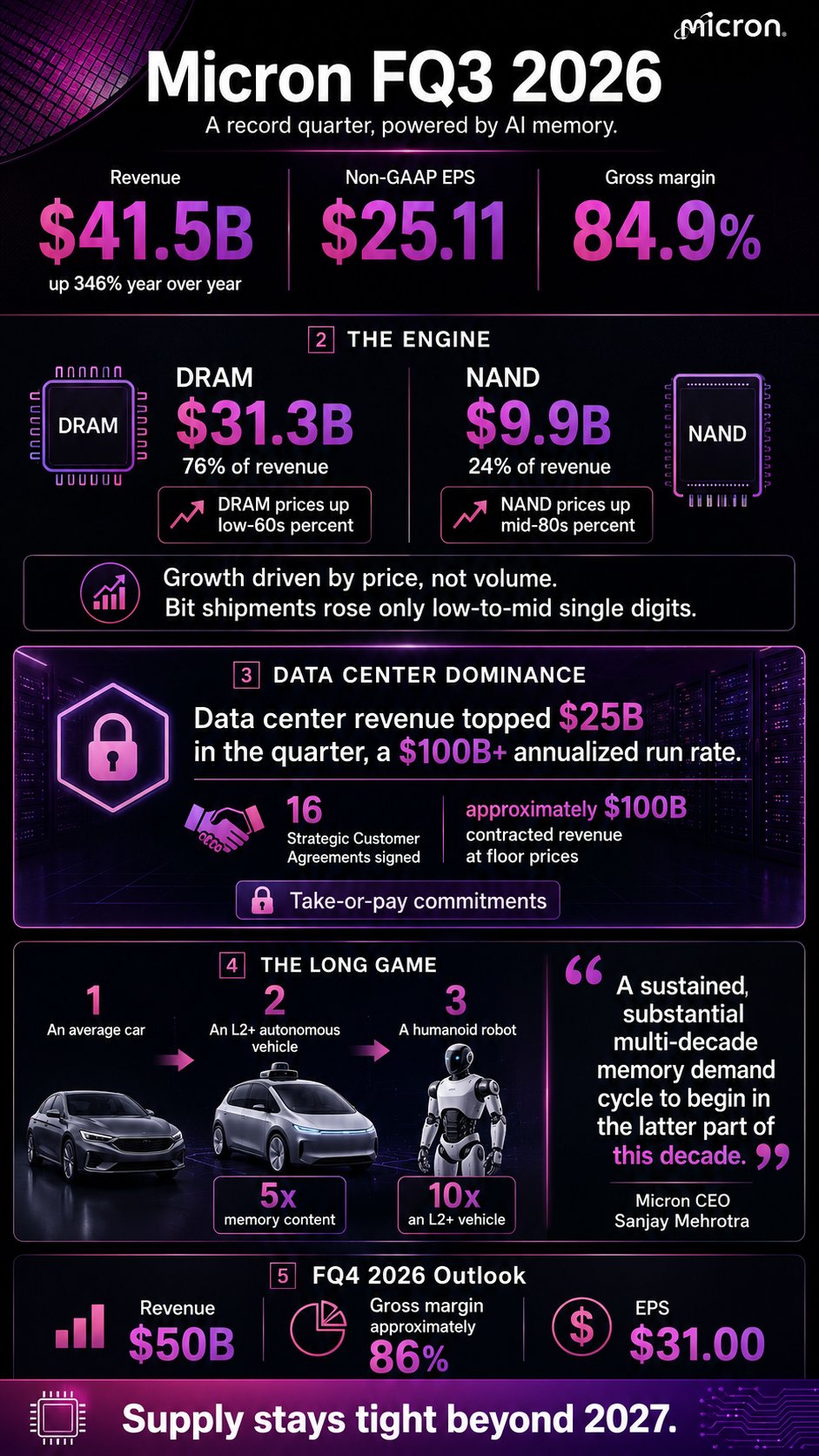
When Micron, one of the world's biggest memory chipmakers, stepped up to report its quarterly earnings after the market closed on Wednesday, June 24, the stakes felt enormous. Earnings reports are essentially a company's quarterly report card, where it tells investors how much money it actually made versus what Wall Street expected. And let me tell you, Micron didn't just pass. It aced the test and then some. The numbers were nothing short of spectacular, so let's walk through just how massive they were. Micron posted record revenue of $41.46 billion, up from just $9.3 billion in the same period a year earlier, meaning its revenue more than quadrupled. Let that sink in: the company made over four times what it made a year ago. Adjusted earnings came in at $25.11 per share, crushing analyst estimates of around $20.49, and gross margins hit a staggering 84.9%, both company records. Gross margins are how much profit a company keeps from each dollar of sales after covering the cost of making its product. An 85% margin is extraordinary; it means Micron is keeping roughly 85 cents of every dollar, which is the kind of profitability you almost never see in the hardware world. The market's reaction was immediate. The stock surged roughly 15% in after-hours trading, pushing it toward record all-time highs near $1,200 a share.
So what's actually driving this? It comes down to one of the most basic forces in economics: supply and demand. Right now there's a massive shortage of memory chips relative to how many the world wants, and that imbalance is sending prices soaring. Here's why. The same memory chips that go into your laptop and phone are also needed in enormous quantities inside AI data centers, and the big tech giants building those data centers are buying up nearly everything the chipmakers can produce. The three companies that control about 95% of global memory production (Micron, SK Hynix, and Samsung) have been systematically redirecting their factory capacity toward AI. Think of it like a popular concert where the venue only has so many seats. When demand wildly outstrips supply, ticket prices go through the roof. That's exactly what's happening with memory. Micron locked in the benefits too, reporting that its HBM3E and HBM4 products (the specialized high-speed memory that powers AI servers) are fully booked through 2027, with demand extending into 2028, and it secured $22 billion in strategic customer agreements.
Here's the twist, though, and it's where this story stops being just a Wall Street win and starts hitting your wallet: this memory boom is creating what people are now calling "AI inflation." Because chip prices are climbing so fast, the big tech companies that build consumer products, the stuff you buy, are being forced to raise prices. Just this week, Apple (AAPL) hiked prices on its MacBooks and iPads by as much as 20-25%, saying it could no longer shield customers from soaring memory and storage costs, and Microsoft (MSFT) followed by announcing Xbox console price increases of up to $150, noting that storage and memory costs have more than doubled since last fall. They weren't alone. Sony (SONY) raised PlayStation prices earlier, and PC makers including Dell (DELL) and HP (HPQ) have flagged comparable increases of 15 to 20%. Apple CEO Tim Cook called it a kind of "chipflation" that he has never seen in over 40 years in the industry. In fairness, here's the bear case worth acknowledging: these same sky-high memory prices that are minting profits for Micron today have historically been cyclical, meaning memory has a long history of boom-and-bust, and if supply eventually catches up or AI demand cools, prices and margins could come back down hard. That's a real risk and part of why memory stocks are so volatile. But the counterpoint is that Micron's order book is locked up years in advance, which suggests this cycle has real staying power that previous ones lacked.
But what does all this mean for the market going forward? Well first, we can obviously acknowledge that memory has never been stronger. Despite the run-up that Micron has had, and other memory names, this trend may see no end anytime soon. It remind me of Nvidia (NVDA) just a few years ago, where it would just keep beating earnings, and keep rallying, and everybody thought that it couldn't go any higher, yet it continued to disprove the naysayers. The bigger issue at hand isn't Micron's earnings, it's moreso an issue of something called "interest rates". I'm going to try and keep this as simple as possible, so stick with me. Interest rates are controlled by the Federal Reserve. When we raise interest rates, it's generally bad for stocks. When we lower interest rates, it's generally good for stocks. As we talked about in last week's newsletter, the Fed is seriously considering raising rates. With the market sitting near all time highs, if we were to get a rate hike, it's almost guaranteed that the market would crash on that news.
So the struggle investors are now facing is, what do you do when you have economic headwinds such as these interest rates, and specific stock tailwinds, such as strong earning reports? We continue to stay in the camp that now is a time for caution, not aggression. For that reason, we are being very particular with the stocks we are buying, as well as, the hedges/options we are using to shield our stock portfolios from downside risk. If you are a CEO Watchlist Investment Club Member, [CLICK HERE] to log in, and see our fully updated stock and option portfolios. If you're not an Investment Club Member, then take advantage of our July 4th sale we have going on this week, by [CLICKING HERE]. This will grant you access not just to our stock and option portfolios, but also access to our private classes/conference calls, and even mentorship from us directly! This is not the time to try to navigate a volatile market like this by yourself. That's exactly how you end up buying stocks right before they crash, or selling stocks right before they shoot up. Make sure to surround yourself with a team of people who know what they're doing and can educate you on these markets. Take $200 OFF today when you use [THIS LINK HERE] and we'll see you in the Investment Club soon!
Qualcomm Investor Day: Why We Are Buying Qualcomm Today... (Source)
Stocks mentioned: $QCOM, $ARM, $META, $MSFT
On June 24, Qualcomm (QCOM) held its 2026 Investor Day. For anyone unfamiliar, an Investor Day is basically a company's big pitch meeting, a scheduled event where management gathers analysts and shareholders to lay out its strategy, show off new products, and set financial targets for the years ahead. Think of it like a team unveiling its game plan for the next several seasons all at once. For those that don't know, Qualcomm is best known as the company that makes the chips and modems inside your smartphone. That's been its bread and butter for decades. But at this event, management made it crystal clear that the smartphone era is no longer the whole story, and that a much bigger opportunity is now in their crosshairs.
Here's the headline that sent shockwaves through the market: Qualcomm is storming into the AI data center business, and it's not doing it alone. The company unveiled its Dragonfly C1000, a powerful new server CPU built with a 250-plus core count, designed specifically for AI data center workloads. Let's break that down simply. A CPU is the central "brain" of a computer, and a data center is one of those massive warehouse-sized buildings packed with servers that power the entire AI revolution. Qualcomm is now building the brains that go inside those buildings. Crucially, the design is built on ARM (ARM) architecture, which is a chip blueprint known for being extremely power-efficient, a huge deal when you're running thousands of chips that guzzle electricity. But the real jaw-dropper wasn't the chip itself. It was who agreed to buy it. Meta (META) signed a multi-generation agreement to deploy the Dragonfly C1000 in its server infrastructure, and Microsoft (MSFT) confirmed it will deploy Qualcomm's HBC architecture on its Azure cloud. Landing two of the biggest tech giants on the planet as launch customers is the kind of validation money can't buy.
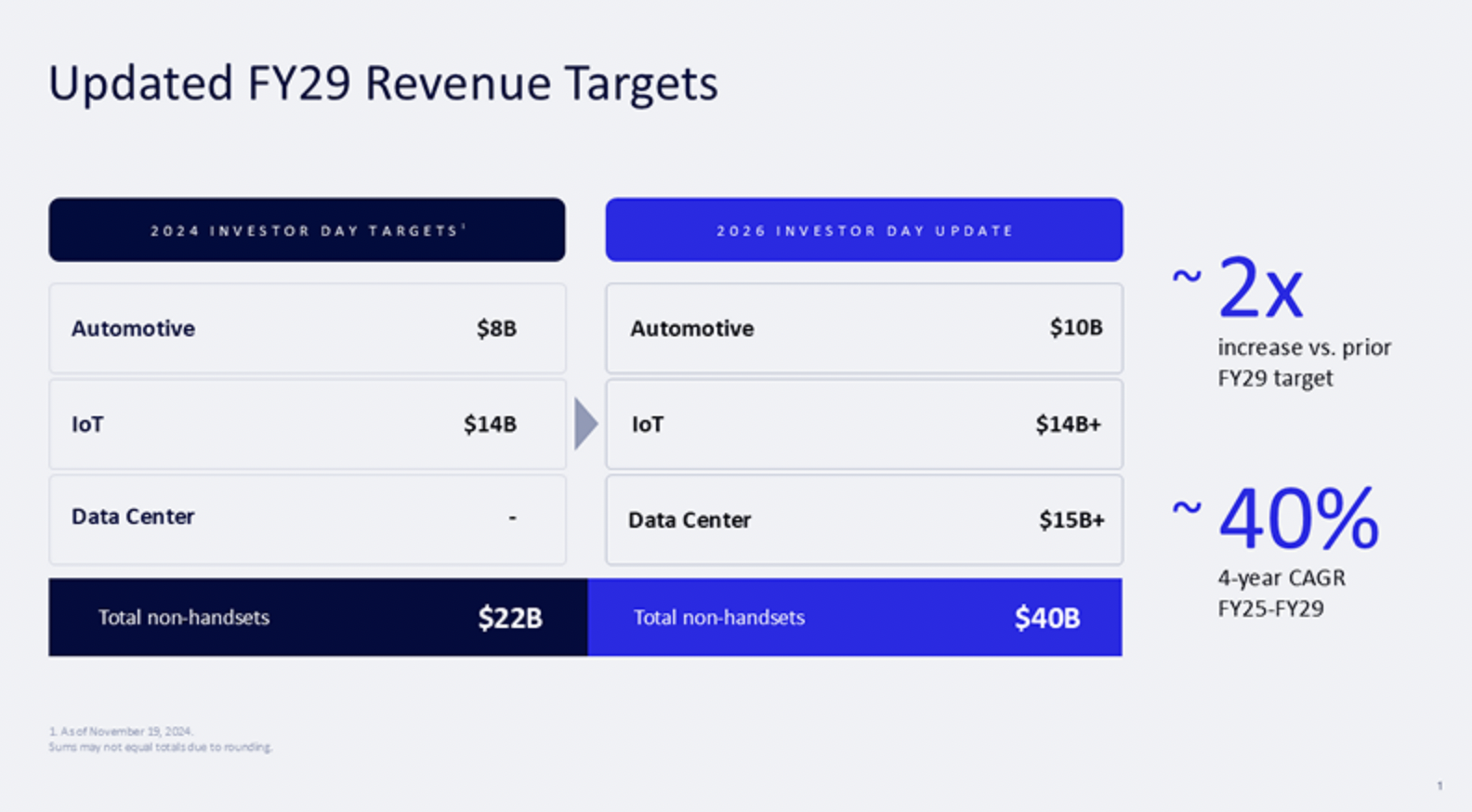
Now here's the part that made investors hit the buy button. With those customer wins in hand, Qualcomm dramatically raised its financial guidance, which is corporate-speak for "we now expect to make a lot more money than we previously told you." Management roughly doubled its non-handset revenue guidance, over the next few years, to $40 billion. This is up from a prior forecast of $22 billion, with the data center business alone targeted at $15 billion. They also set an adjusted earnings target of more than $18 per share over the coming years, well above the $15.26 that analysts had been expecting. When a company tells the market its future profits will be meaningfully higher than everyone assumed, the stock gets repriced almost instantly to reflect that new reality. And that's exactly what happened. Qualcomm shares jumped 15% in extended (after-hours) trading following the announcements. Wall Street analysts piled on too, with JPMorgan raising its price target from $160 to $265 and Wells Fargo arguing the AI inference market could exceed $100 billion, with Qualcomm's opportunity not yet fully priced in.
Now all this sounds extremely positive, right? Well unfortunately the market decided that the AI trade needed to be sold off on Friday, and took Qualcomm down with it. We think Qualcomm is a buying opportunity here, especially on all of the updated bullish news during their investor day. It's in the right sector, it trades at a low valuation, it's significantly off it's highs, and they just landed some major deals with the hyperscalers. There's so many things to like here, and in our opinion, it gives Qualcomm some of the best risk-reward we've seen in the tech sector. Now, it may not go up right away due to concerns over interest rates and other macro headwinds, but as a long-term investor, this seems like an easy "buy and hold" for our portfolios for the foreseeable future.
"Super Investor" Spotlight: Chase Coleman (Tiger Global) (Source)
Stocks mentioned: $GOOGL, $NVDA, $AMZN, $TSM, $META, $SE, $AVGO, $MSFT, $GEV
If you've spent any time in investing circles, you've probably heard people obsess over what the "smart money" is buying. That obsession has a name: "Super Investors". A "Super Investor" is a fund manager or firm with such a strong long-term track record and such deep market instincts that the rest of us literally watch their moves for clues. By law, any institution managing over $100 million has to file a 13F every quarter, which is a public document listing the U.S. stocks they own. It's basically a peek into the smart money's hand, filed up to 45 days after the quarter ends. And this week we're digging into one of the most aggressive growth investors on the planet: Tiger Global.
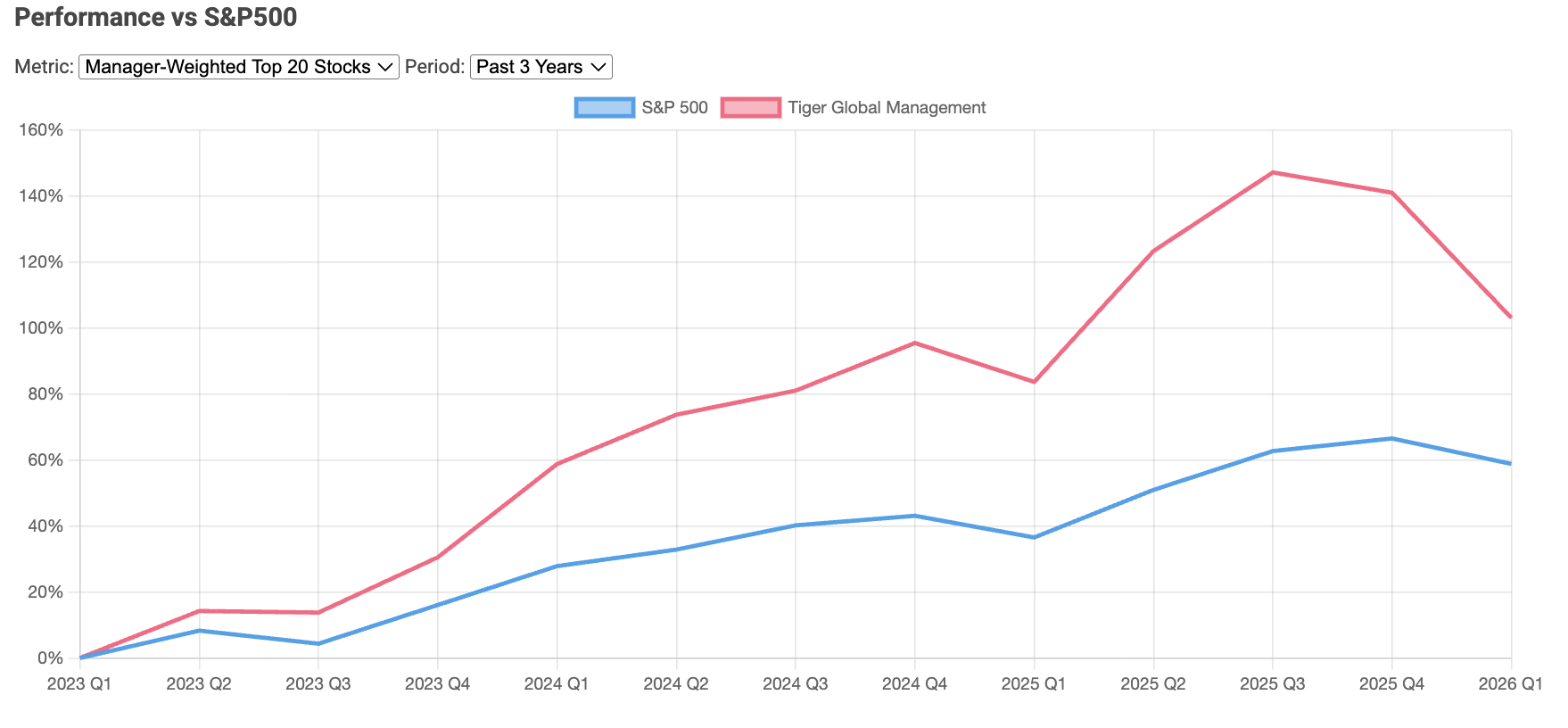
Tiger Global Management was founded by Chase Coleman in 2001, and it grew out of the legendary "Tiger Cub" lineage, meaning Coleman trained under Julian Robertson at the original Tiger Management, one of the most famous hedge funds in history. Tiger Global made its name as a tech-obsessed, high-conviction shop that bets big on the companies it believes will define the next decade, spanning both public stocks and private startups. And lately the bets have been paying off in a big way. Over the past 3 years, Tiger's top holdings returned roughly 103%, versus about 59% for the S&P 500, as you can see below:
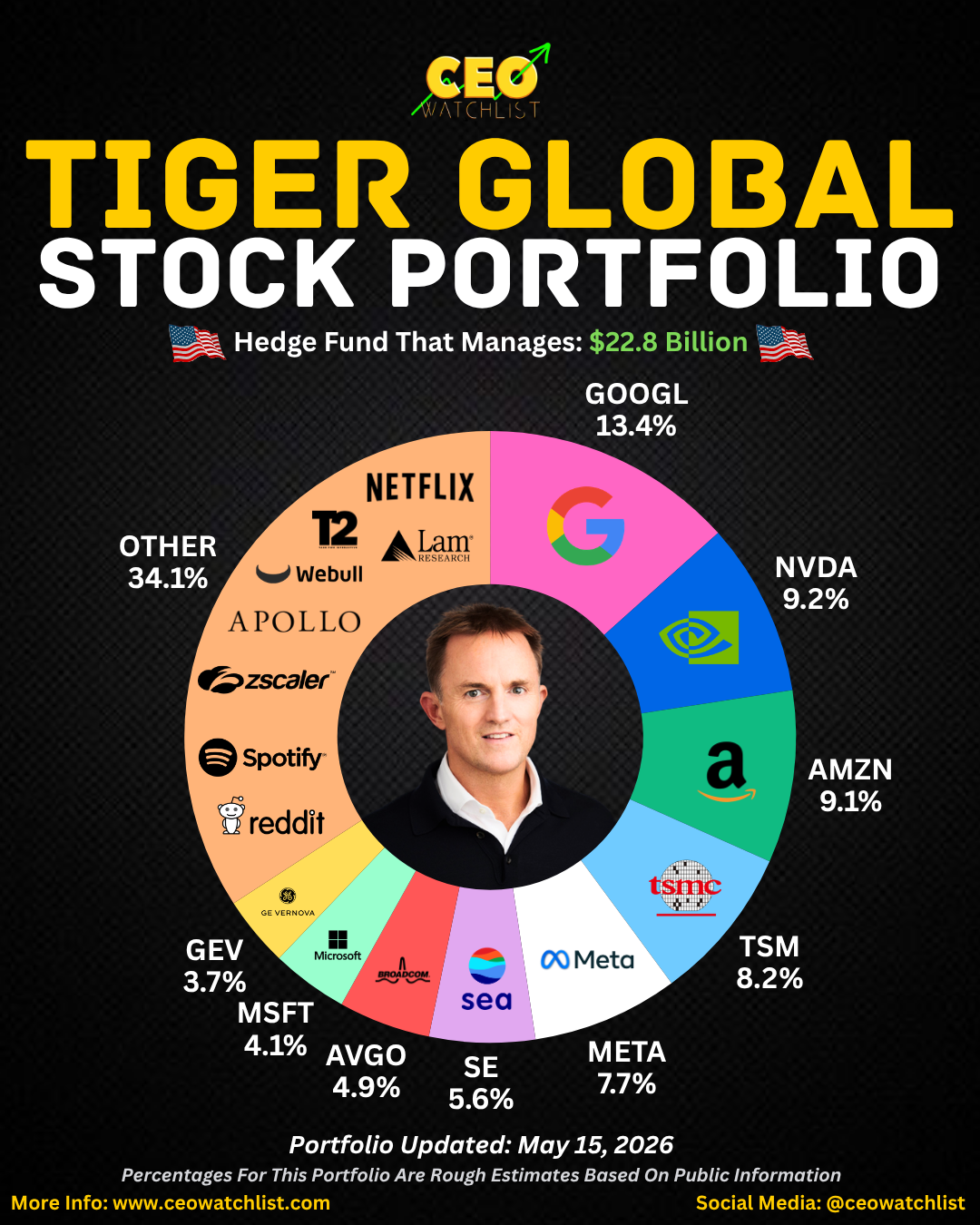
Here's the latest snapshot of Tiger Global's portfolio, ranked by how much of the book each position makes up:
- Google (GOOGL) - 13.4%
- Nvidia (NVDA) - 9.2%
- Amazon (AMZN) - 9.1%
- Taiwan Semiconductor (TSM) - 8.2%
- Meta (META) - 7.7%
- Sea Limited (SE) - 5.6%
- Broadcom (AVGO) - 4.9%
- Microsoft (MSFT) - 4.1%
- GE Vernova (GEV) - 3.7%
So what's the takeaway? Tiger Global is making a confident, vertically-integrated bet that AI is the defining investment theme of the decade, and they're expressing it by owning every layer of the stack rather than guessing at a single winner. We like this portfolio as a teaching tool because it shows what real thematic investing looks like when you have the research muscle to back it up, even with the volatility that comes attached. To recap, Tiger Global runs a roughly $22.8B book led by Google, Nvidia, and Amazon, built around a top-to-bottom AI supply-chain thesis.
INSIDER STOCK TRADES FROM THE WEEK:
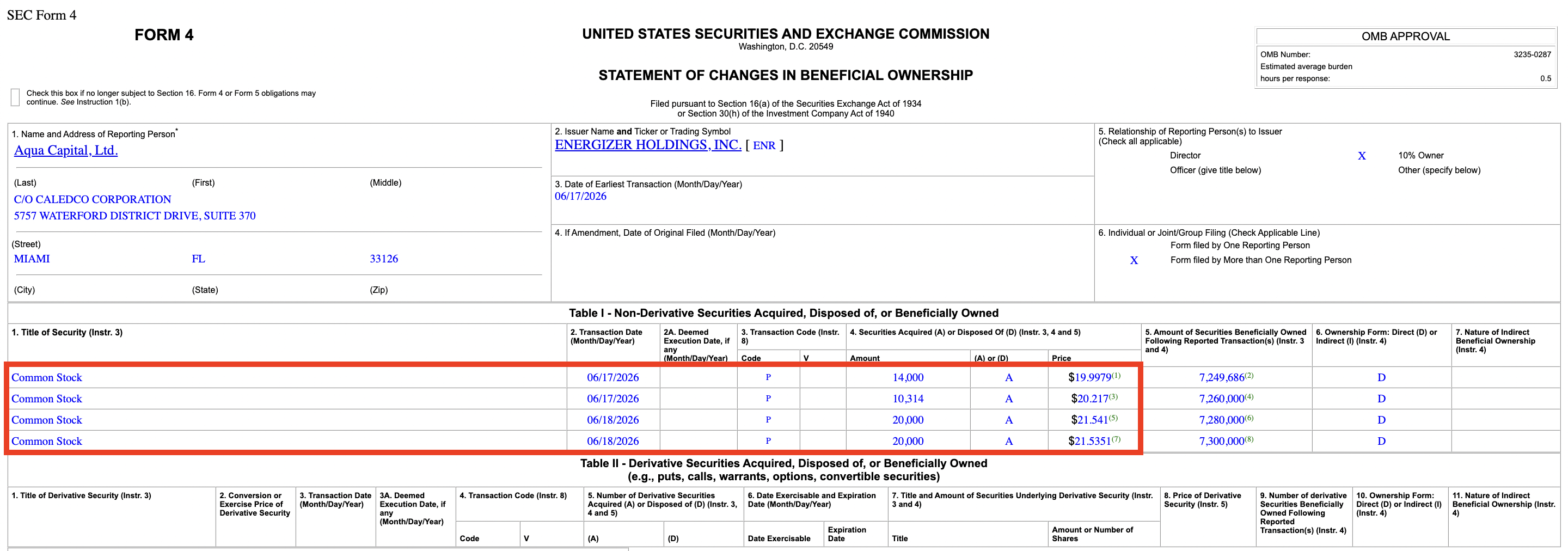
1. Energizer (ENR) - Aqua Capital bought roughly $1,300,000 of ENR at an average price of $20.99/share on June 17-18, 2026, but it wasn't reported to the public until June 22, 2026. (Source).
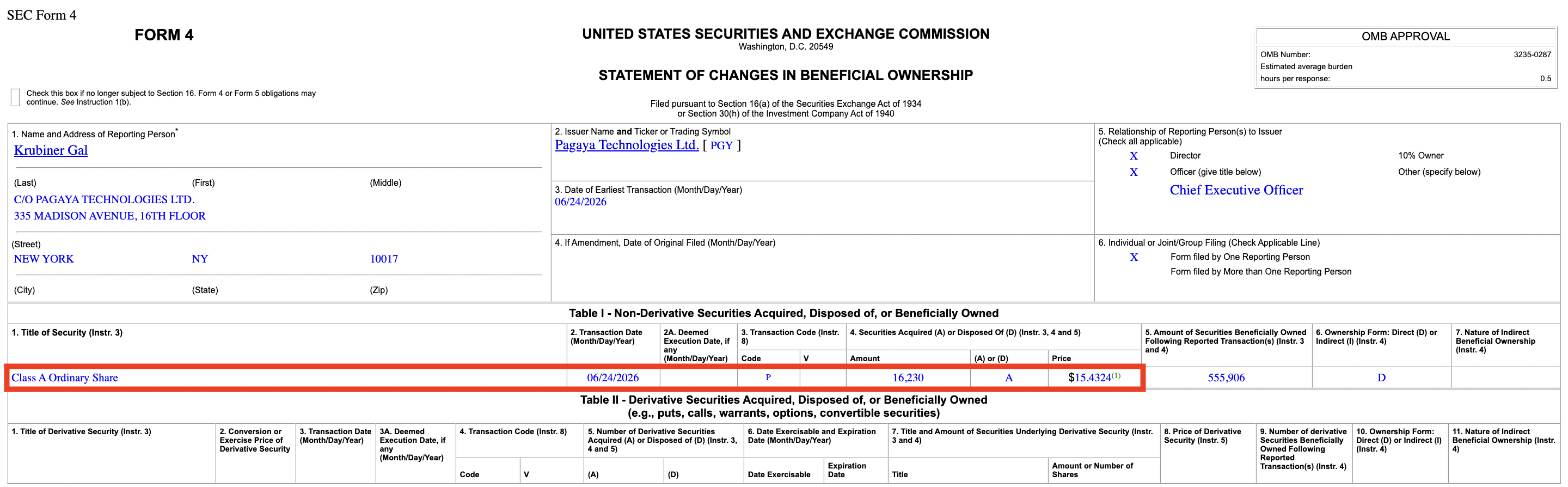
2. Pagaya Technologies (PGY) - Gal Krubiner (CEO) bought roughly $250,000 worth of PGY at an average price of $15.43/share on June 24, 2026, but it wasn't reported to the public until June 25, 2026. (Source)
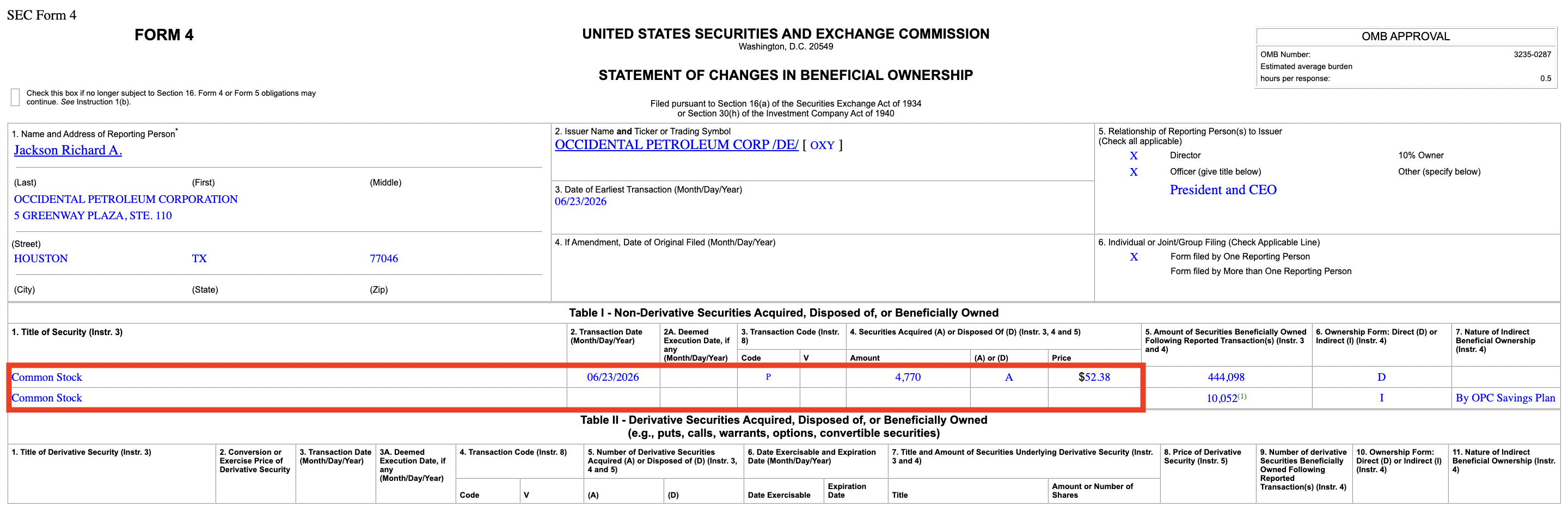
3. Occidental Petroleum (OXY) - Richard Jackson (CEO & President) bought roughly $250,000 of OXY at an average price of $52.38/share on June 23, 2026, but it wasn't reported until June 24, 2026. (Source)
Over 2,000 people have already signed up for my FREE Masterclass video on how to unlock my exact strategies for finding winning stock/options trades! I'll share everything including how to find what Politicians and CEOs are buying. Don’t miss your chance to get in for FREE before spots fill up!

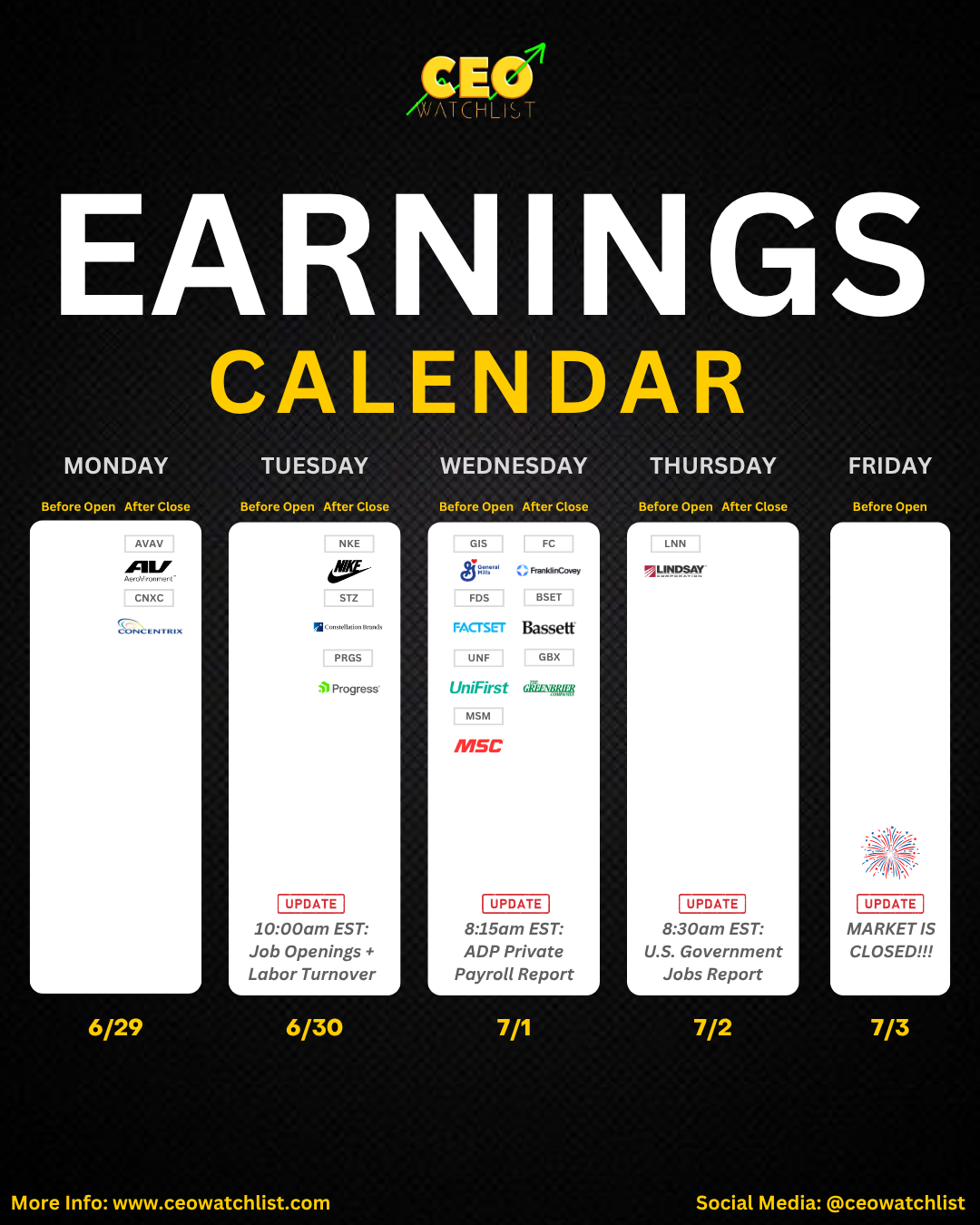
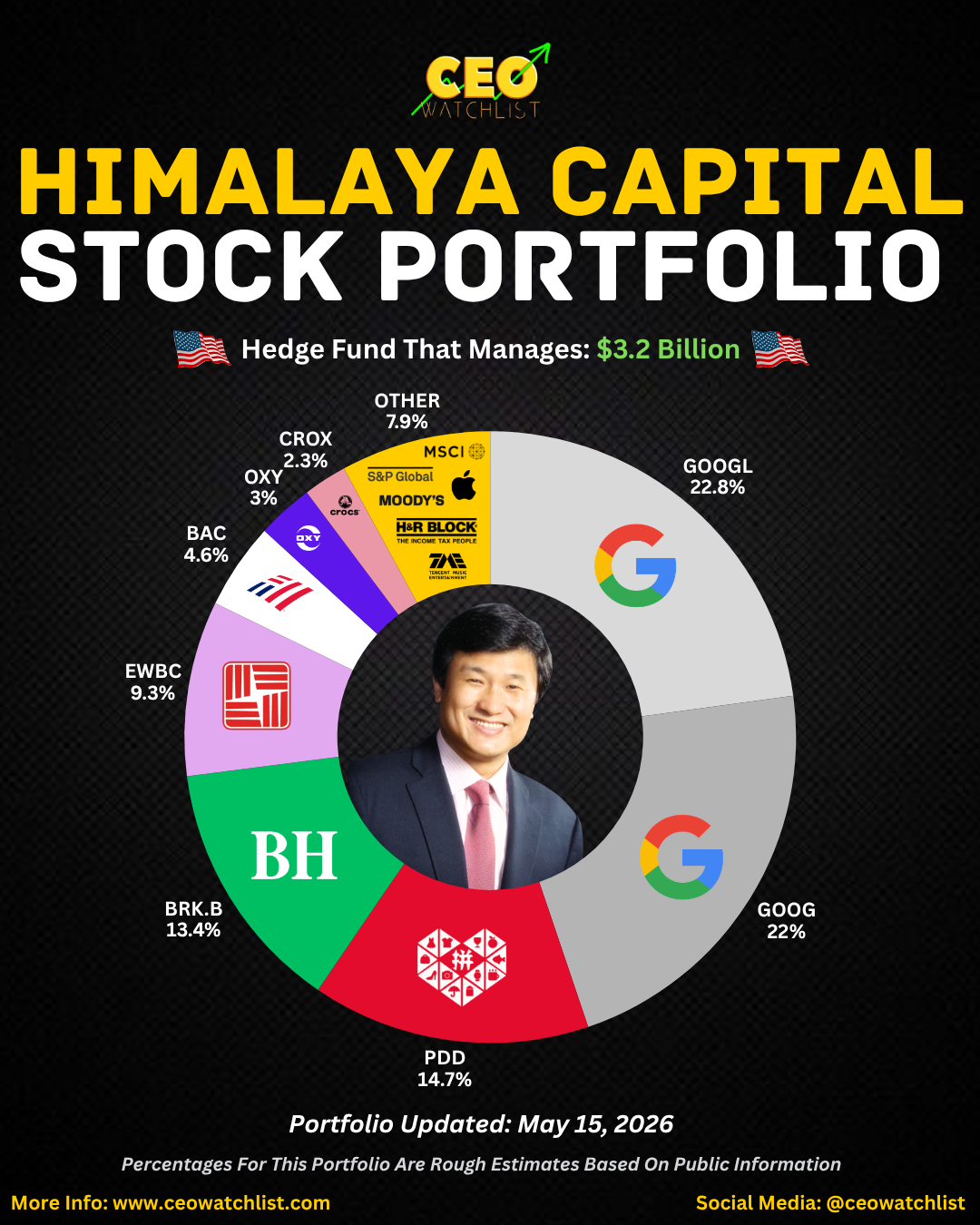
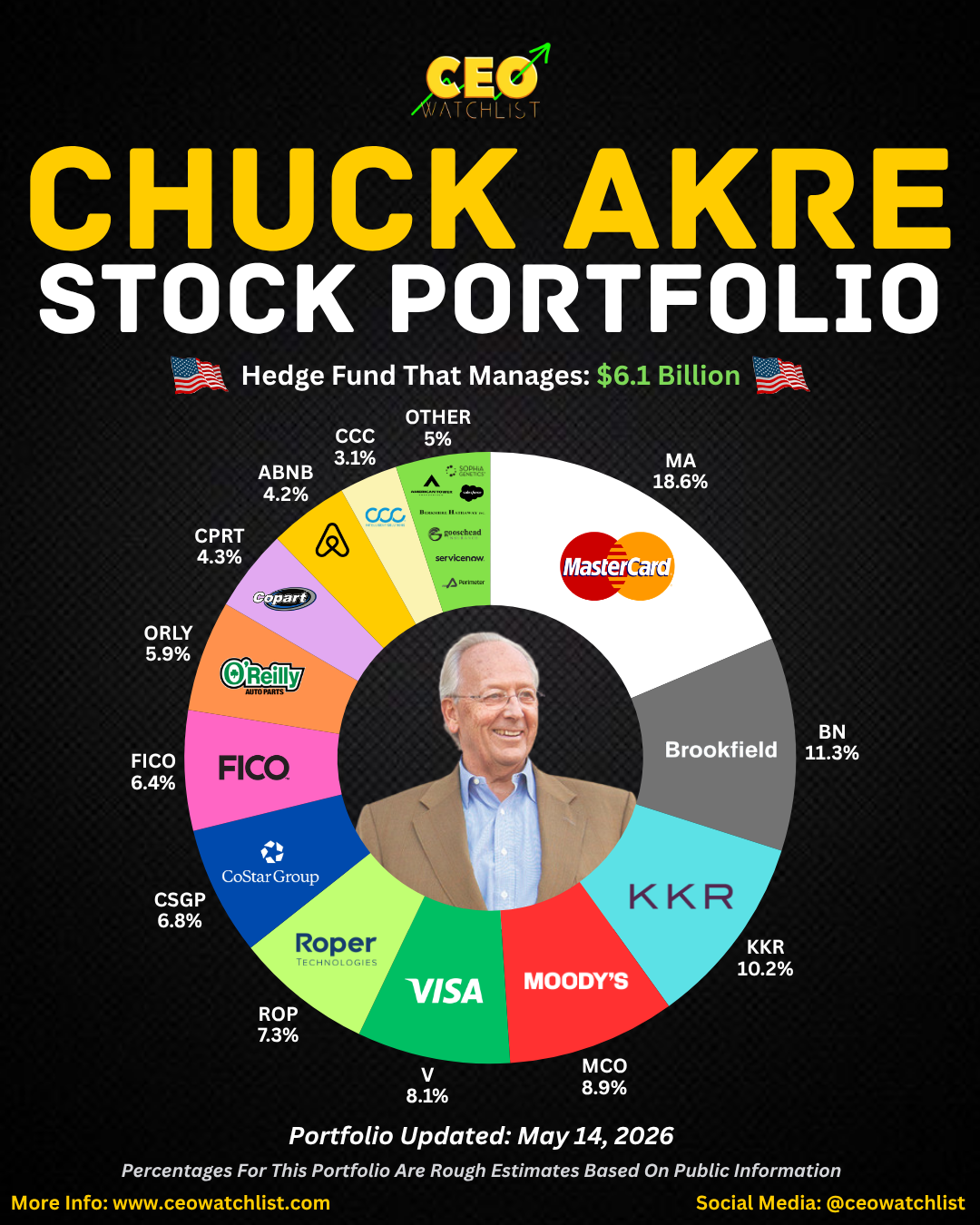
INFOGRAPHICS FOR THE WEEK:

CONTACT US: [email protected]
Responses