TOP NEWS AFFECTING THE STOCK MARKET THIS WEEK:
A New Sheriff at the Fed: Who It Is and How They're Shaping The Stock Market Moving Forward (Source)
Stocks mentioned: N/A
This article is going to be a little different than what we would normally put out for you. This article is going to focus on a general market narrative and how we expect the market to move going forward, rather than our usual article that would cover a few select stocks. Sometimes it's more important to understand the general market narrative and what direction the market could move in, rather than a couple stock picks. Because of a major change this past week at the Federal Reserve, the market is struggling with a state of uncertainty and the unknown of what's to come with all the changes that were just announced by the new Fed Chair. With that said, let's start with who this new Fed Chair is, why everything is suddenly changing, and how that affects the markets, and in turn, our portfolios.
Kevin Warsh was sworn in as the 17th chair of the Federal Reserve on May 22, 2026, taking over for Jerome Powell. For anyone who doesn't live and breathe this stuff, the Fed (short for the Federal Reserve) is essentially the institution that controls the monetary policy, interest rates, inflation, AKA pretty much anything that has to do with money in America. The Fed has the ability to influence the entire economy, and cause the stock market to shoot up or crash down. That's why it's very important to pay attention to what the Fed is doing, and specifically, the man in charge (Warsh). This past Wednesday, June 17, Warsh held his very first press conference as the head of the Federal Reserve. Unfortunately, the report was taken very negatively by the markets. Warsh decided to make changes to how the Fed operates, such as removing forward guidance and a complete revamp on how they use data. The markets didn't like the unknown of how these changes would affect things moving forward. But the bigger issue didn't come from the changes that Warsh made, but rather from his committee members. One thing most people don't know about the Fed, is that Warsh doesn't have full autonomy over the decisions made. Rather, he leads a committee called the Federal Open Market Committee (FOMC) and they're the group that votes, with 12 of the 19 members each getting an equal vote. So while everyone watches the chairman (Warsh), the real decision comes down to a simple majority vote of those 12 members. Unfortunately for Warsh, on his debut, the committee sent a message the market wasn't thrilled about.
To understand why, you need to know about something released at 2:00pm that day called the dot plot:
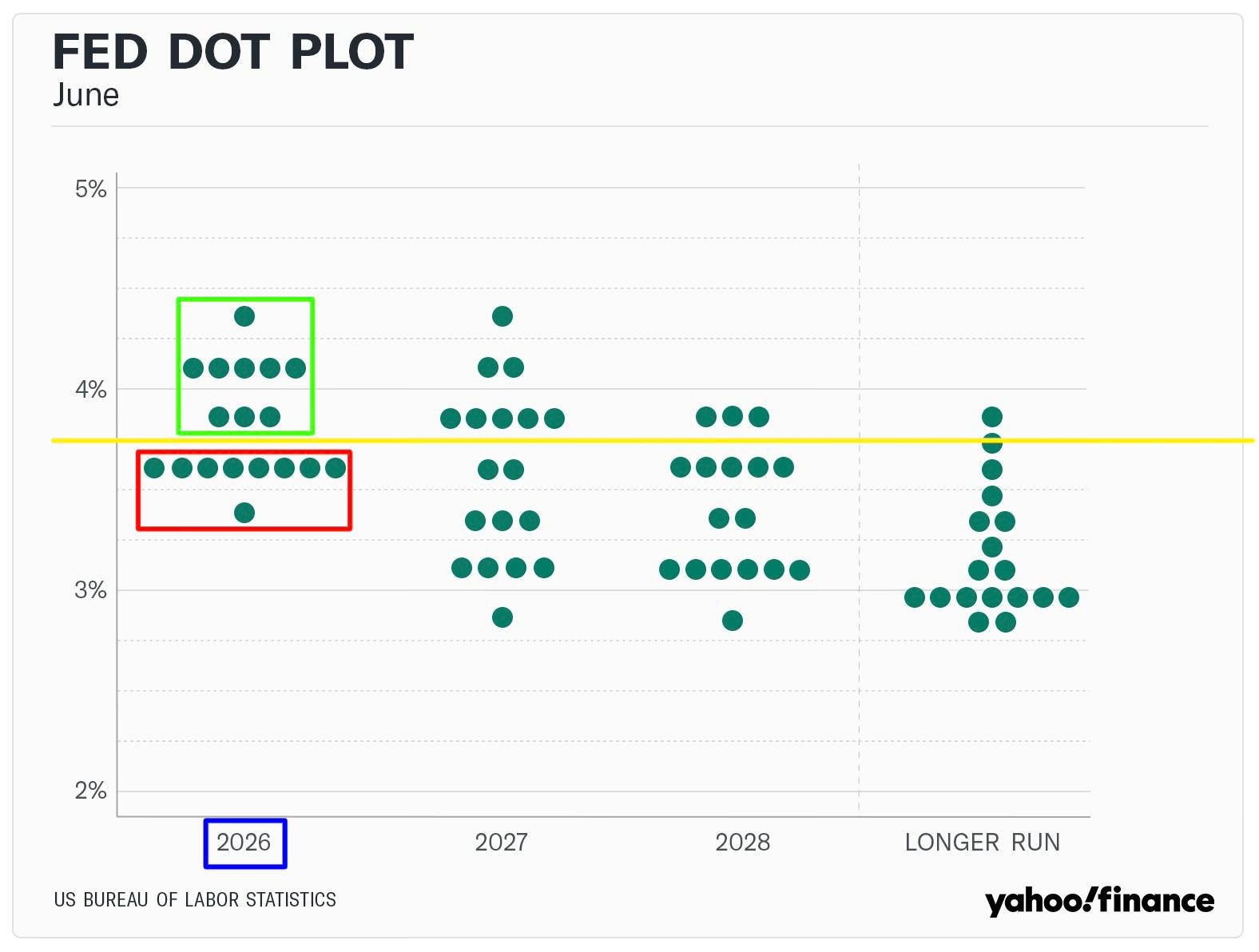
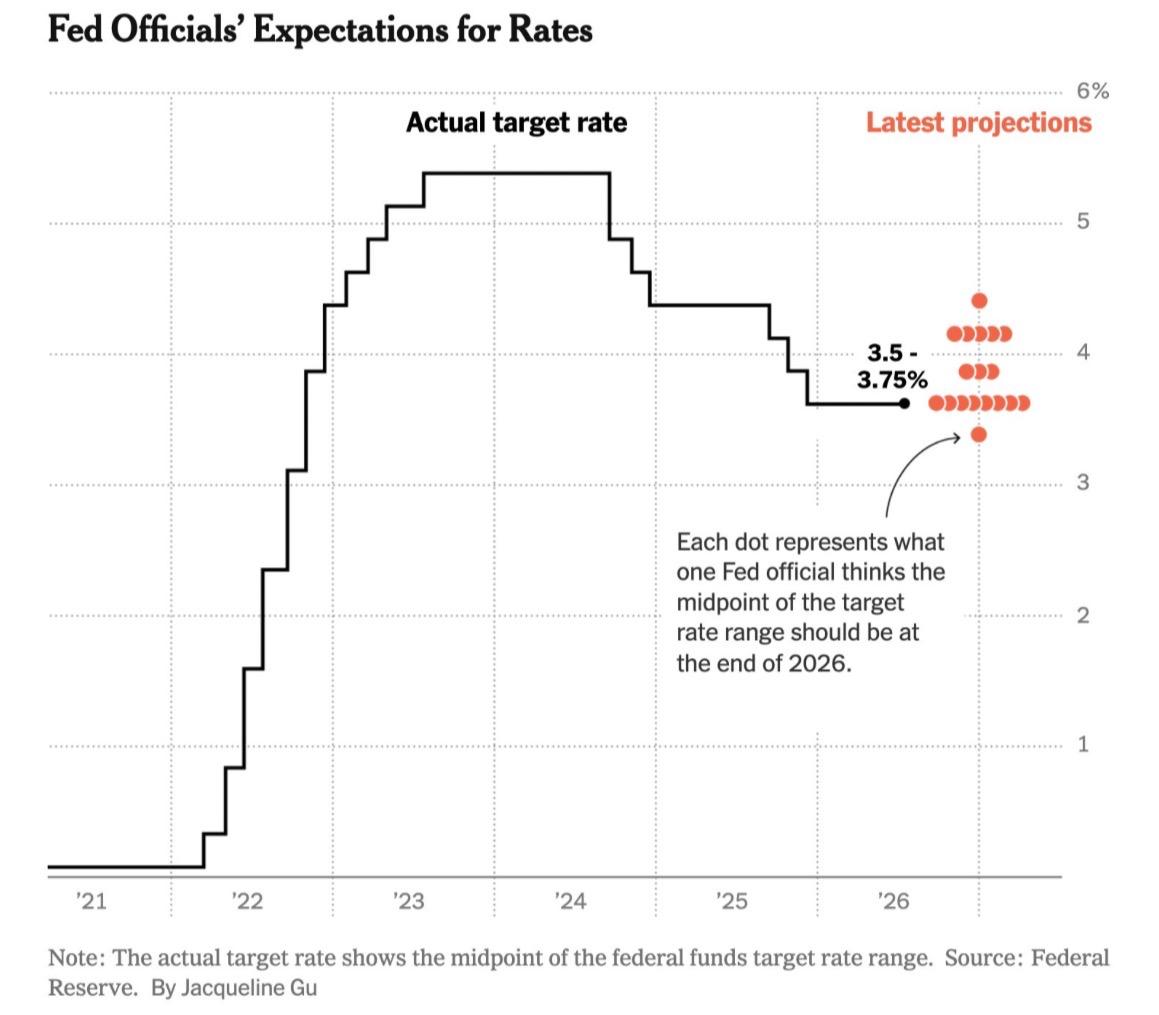
Pictured above is the dot plot, in which each Fed official, anonymously, places a single dot showing where they personally think interest rates should be in the coming months and years. Stack all those dots together and you get a quick visual of the committee's collective thinking, kind of like asking everyone in a room to secretly write down their prediction, then plotting them so you can see where the crowd leans. This particular dot plot landed with a thud. The committee held rates steady in a range of 3.5% to 3.75% (marked by the yellow line in the image above), but the projections turned noticeably more hawkish (negative) when looking at what they're predicting from now until the end of the year. The reason why it's more hawkish is that stocks tend to go down when rates are high, so if the Fed is considering hiking rates, then naturally, that's a negative for stocks. What we want to see is the Fed dots pricing in a cut, rather than a hike, as that would be good for stocks since that would be lowering rates. When we look at the image above, we can see that for this year (2026) 9 members of the Fed want a hike (the dots above the yellow line, highlighted with a green box) AKA negative for the stock market. As for the other 9 members, they want a cut (the dots below the yellow line, highlighted with a red box) AKA positive for the stock market. Translation: instead of the rate cuts investors were hoping for earlier in the year, half the committee is now eyeing hikes. The market did not like that one bit, because again, higher rates generally make stocks less attractive, and this is why the market sold off right after this meeting.
So what does all this mean for the market going forward and our portfolios? In the short term, probably more turbulence. Markets are creatures of habit, and Warsh just took away the security blanket they'd grown used to. Analysts expect his approach to produce more willingness to surprise bond markets and ultimately more rate volatility, precisely because investors can no longer lean on the Fed's forward guidance and instead have to react to raw economic data as it comes. When you remove the guardrails, the ride gets bumpier. Throw on top of that an FOMC that incresingly wants to hike interest rates and with the market at all time highs, this doesn't look like the most ideal scenario. But there's still hope for the market because despite this bearish Fed meeting, we are in one of the strongest bull markets we've ever seen. It seems like no matter what is thrown at this market, it only wants to go higher. Historically, it's been a fool's game to go against that momentum. But it's not even just the market's strength, it's also that Wash was hand-picked directly by Trump, and we know Trump wants the market to go higher. So that leaves us with a current standoff with half the Fed wanting to hike, and half wanting to cut, and Warsh being the tie breaker in between who more than likely has Trump in one ear pushing him to do what's best for the stock market. If Warsh does follow what Trump wants, and we see a rate cut, then this market could hit new all time highs going into the end of this year. If not, and Warsh decides to do his own thing by going down the route of a rate hike, we would expect a market correction out of fear that this could possibly be the beginning of multiple hikes. For now, it's anyone's guess which way this plays out, but that's why we'll be paying very close attention to everything Warsh says in the following months.
To sum it all up, Kevin Warsh just chaired his first meeting, the committee held rates but flashed a hawkish dot plot that spooked investors, and then Warsh used his debut presser to tear up the old playbook, such as killing forward guidance. Near-term, expect volatility as markets adjust to a Fed that increasingly is pricing in rate hikes rather than rate cuts. Long-term, if Warsh delivers price stability alongside rate cuts, this could mark the beginning of a very long bull market, and that's something worth watching very closely.
New Partnership Between Apple and Intel? What This Could Mean For The Stocks Moving Forward... (Source)
Stocks mentioned: $AAPL, $INTC, $NVDA, $TSM
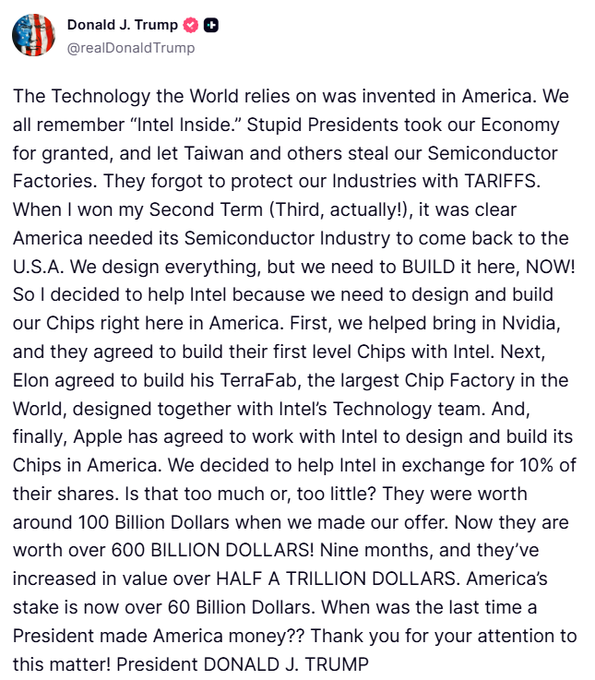
Let's set the scene. This past Thursday, June 18, President Trump went on Truth Social (his social media platform) and made an announcement that lit up the entire tech world. He said Apple has agreed to work with Intel to design and build its chips in America. In his post, Trump framed it as part of a bigger mission, writing that "we design everything, but we need to BUILD it here," and arguing that past leaders let Taiwan and others take America's semiconductor factories. To understand why this is a big deal, you need to know that semiconductors (the tiny chips that power everything from your iPhone to AI data centers) are mostly manufactured overseas, particularly in Taiwan. This announcement fits squarely into a growing theme of bringing chip manufacturing back to U.S. soil to reduce America's reliance on foreign suppliers. And the timing is notable, coming right as Apple CEO Tim Cook warned that price hikes on its products are "unavoidable" due to rising chip costs from the AI boom.
Now let's meet the players, because this story is really about two giants with very different recent histories. First, Apple (AAPL), the world's largest consumer electronics company, the maker of the iPhone, iPad, and Mac. Here's a detail many people don't realize: Apple designs its own chips (the brains inside its devices), but it doesn't actually manufacture them. For years, it has leaned almost entirely on one company in Taiwan to physically build those chips. That brings us to the second player, Intel (INTC), a storied American chipmaker that once dominated the industry but stumbled badly over the past decade, losing its manufacturing lead. Intel has been fighting to claw its way back as a "foundry" (a company that manufactures chips for others), and it's been gaining real momentum. Trump noted that Nvidia (NVDA) agreed to build some chips with Intel, and that Elon Musk's TerraFab project, billed as the largest chip factory in the world, is being designed together with Intel's technology team. So Intel is suddenly at the center of America's chip comeback story.
Here's the crucial caveat, and we'd be doing you a disservice to gloss over it. As exciting as this sounds, the details are extremely thin. Neither Apple nor Intel has officially confirmed the partnership. Reports suggest the two companies have been in intensive negotiations for over a year, and a preliminary agreement on certain chip components surfaced back in May, but specifics like exact product lines or manufacturing nodes remain unconfirmed. In other words, the President announced it, but the companies themselves have stayed quiet, and we don't yet know which chips, what timeline, or how much money is involved. Despite that uncertainty, the market reacted with serious enthusiasm. Intel's stock surged about 10% on Thursday, part of a staggering 464% gain over the past 12 months that pushed its market cap past $600 billion. When a stock jumps double digits on a single tweet, that tells you how hungry investors are for an Intel turnaround.
But let's be balanced, because there's a real bear case here. Manufacturing high-performance chips in the U.S. is genuinely hard and genuinely expensive. Experts remain cautious about the execution of such a complex transition, since moving high-volume, high-performance production is no small feat. American production costs tend to run higher than overseas, which could eventually feed into pricier products for consumers. And until Apple and Intel actually sign on the dotted line and share specifics, a chunk of this excitement is running on a presidential social media post rather than a confirmed contract. So where do we land? As long-term investors, we view this as likely bullish for American tech, even with the question marks. If it materializes, this kind of partnership could spark manufacturing job creation, reduce the geopolitical risk tied to Taiwan tensions (a constant worry given that island's fragile relationship with China), and strengthen a foundational American company like Intel in a way that ripples out to benefit the broader economy and innovation ecosystem.
So in summary, Trump announced an unconfirmed but potentially game-changing partnership between Apple and Intel to build chips on American soil, fitting a larger push to reshore semiconductor manufacturing and cut dependence on foreign suppliers like Taiwan Semiconductor (TSM). Intel's stock rocketed on the news, even though neither company has confirmed the specifics, and legitimate concerns remain around execution and cost. But the long-term thesis (a stronger domestic chip industry, more jobs, less geopolitical fragility) is compelling, and we think this is a story worth watching very closely as the details come into focus. The chips, quite literally, are starting to fall in America's favor.
"Super Investor" Spotlight: Warren Buffett (Source)
Stocks mentioned: $BRK.B, $AAPL, $AXP, $KO, $BAC, $CVX, $OXY, $GOOGL, $CB, $MCO, $KHC
If you've spent any time in investing circles, you've probably heard people obsess over what the "smart money" is buying. That obsession has a name: "Super Investors". A "Super Investor" is a fund manager or firm with such a strong long-term track record and such deep market instincts that the rest of us literally watch their moves for clues. By law, any institution managing over $100 million has to file a 13F every quarter, which is a public document listing the U.S. stocks they own. It's basically a peek into the smart money's hand, filed up to 45 days after the quarter ends. And this week we're looking at the most famous investor who ever lived: Warren Buffett.
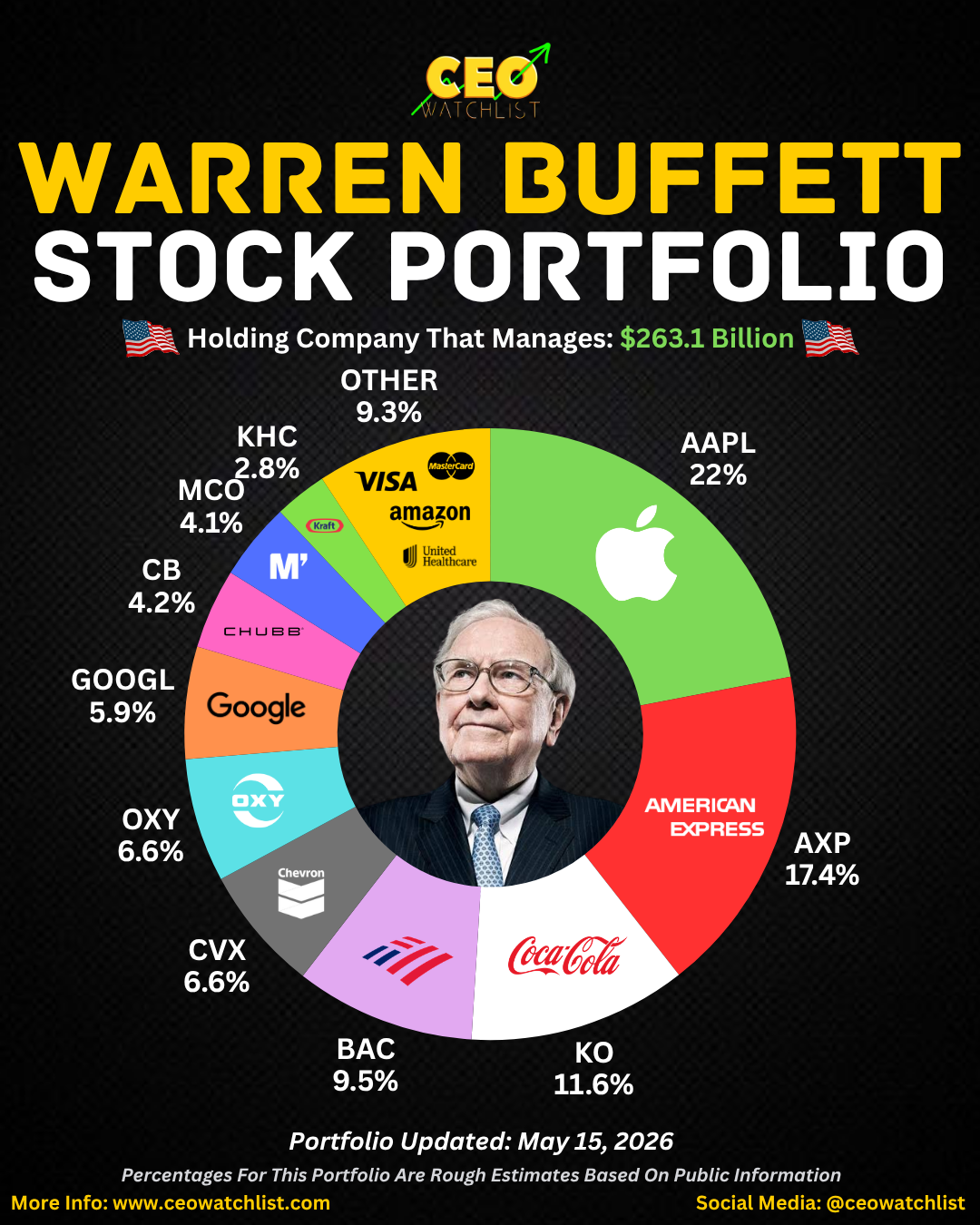
Buffett built Berkshire Hathaway (BRK.B) into a $1 trillion-plus empire over six decades, and he's widely considered the greatest investor of all time. His style is the opposite of flashy: buy wonderful businesses at fair prices, hold them basically forever, and let compounding do the heavy lifting. One important update for context, Buffett actually stepped down as CEO at the end of 2025, handing the reins to his longtime successor Greg Abel, who took over as CEO of Berkshire Hathaway in 2026. So the portfolio you're about to see reflects the machine Buffett built, but now being steered by Abel. Berkshire's reported stock book manages around $263.1 billion, and it's famously concentrated in a handful of names Buffett has loved for years.
Here's the latest snapshot of Berkshire's top 10 stock holdings, ranked by how much of the portfolio each makes up:
- Apple (AAPL) - 22%
- American Express (AXP) - 17.4%
- Coca-Cola (KO) - 11.6%
- Bank of America (BAC) - 9.5%
- Chevron (CVX) - 6.6%
- Occidental Petroleum (OXY) - 6.6%
- Google (GOOGL) - 5.9%
- Chubb (CB) - 4.2%
- Moody's (MCO) - 4.1%
- Kraft Heinz (KHC) - 2.8%
Now here's the part that makes this filing genuinely exciting, and it's all about Google (GOOGL). On the pie chart below, Google sits at 5.9%, good for the 7th largest position. But that snapshot is already stale, and this is the key lesson about 13Fs: they only come out once every three months, so what you're looking at is a photo of where things stood at quarter-end, not where they are today. Since then, Berkshire agreed, on June 1, to invest an additional $10 billion in Google through a private placement. Translation: by the time the next 13F drops, Google could very plausibly leap into Berkshire's top 5. And what we find fascinating is that they're piling in aggressively even at these elevated price levels, which is striking for a firm known for hating overpaying.
So what's the takeaway? In simple terms, tech is still king. Whether you're young or you're old, everybody seems to want to invest into technology. It's pretty clear technology is only going to continue to advance, and money is going to continue to flow into this sector over time. As investors, we shouldn't overcomplicate things when it comes to picking the sectors that are going to benefit going forward. Right now, technology is looking you in the face, and it's a golden goose that won't stop laying golden eggs. When one of the most famous funds in the entire world shifts from decades of value investing to making growthy-technology stocks a huge chunk of their top holdings, we need to acknowledge that this change is real, and that technology is where the money is to be made.
INSIDER STOCK TRADES FROM THE WEEK:
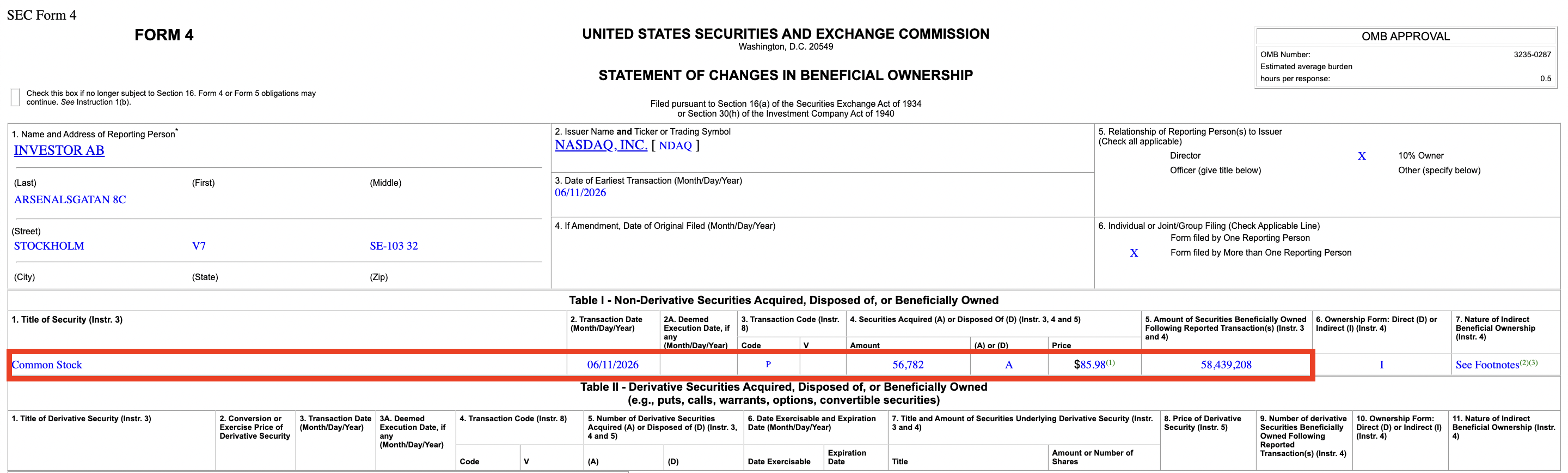
1. Nasdaq (NDAQ) - Investor AB (Swedish holding and investment company) bought roughly $5,000,000 of NDAQ at an average price of $85.95/share on June 11, 2026, but it wasn't reported to the public until June 15, 2026. (Source)
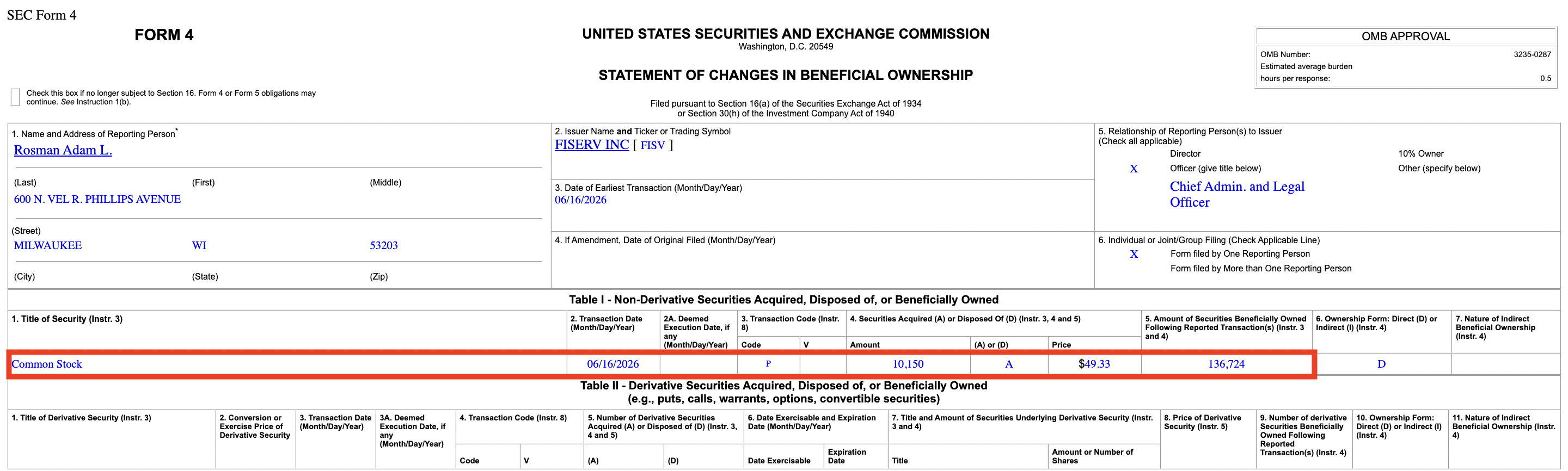
2. Fiserv (FISV) - Adam Rosman (CFO) bought roughly $500,000 worth of FISV at an average price of $49.70/share on June 16, 2026, but it wasn't reported to the public until June 18, 2026. (Source)
3. LuluLemon Athletica (LULU) - Charles "Chip" Bergh (Director, Former CEO of Levi Strauss & Co.) bought roughly $500,000 of LULU at an average price of $117.05/share on June 15, 2026, but it wasn't reported until June 16, 2026. (Source)

Over 2,000 people have already signed up for my FREE Masterclass video on how to unlock my exact strategies for finding winning stock/options trades! I'll share everything including how to find what Politicians and CEOs are buying. Don’t miss your chance to get in for FREE before spots fill up!

INFOGRAPHICS FOR THE WEEK:

CONTACT US: [email protected]
Responses