
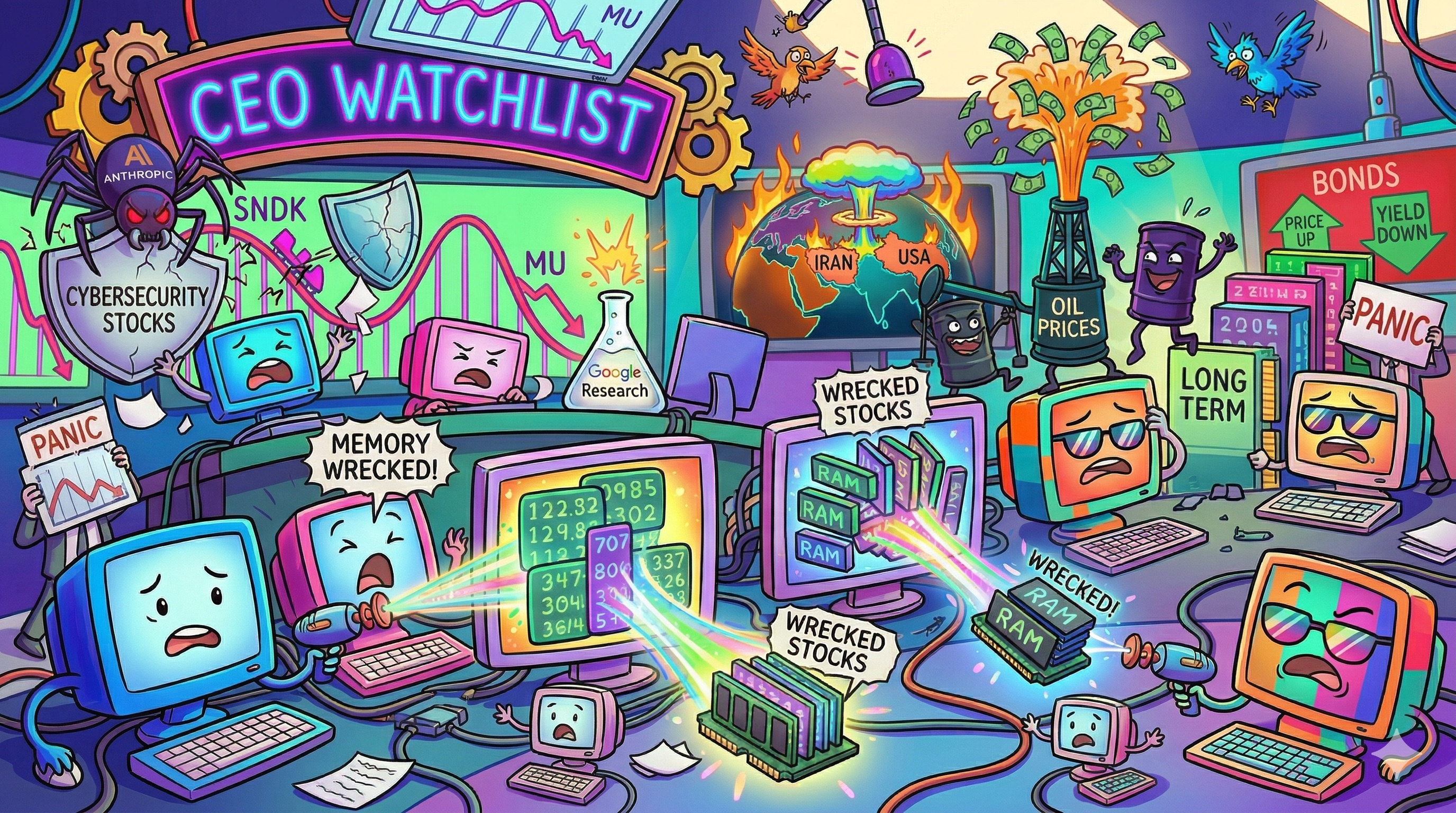
TOP NEWS AFFECTING THE STOCK MARKET THIS WEEK:
Google Throws a Wrench Into The Memory Sector: 3 Stocks We Think Can Still Bounce Back... (Source)
Stocks mentioned: $GOOG, $MU, $SNDK, $WDC
The AI industry just hit its "Pied Piper" moment. Google (GOOG) Research has unveiled "TurboQuant", which is a breakthrough memory compression technology that acts as a digital shrink-ray for artificial intelligence. In layman’s terms, think of an AI’s memory, specifically its "Key-Value Cache", as a massive, ever-expanding notebook where it scribbles down every word of a long conversation so it doesn't forget the context. Normally, this notebook is heavy, expensive, and fills up instantly, forcing companies to buy more "shelves" (memory chips) to store them. TurboQuant uses advanced mathematics to compress that notebook by 6x without losing a single word of accuracy, while simultaneously making the AI up to 8x faster. It’s a software masterclass that allows existing hardware to do significantly more work with a fraction of the physical resources.
Predictably, this "do more with less" breakthrough has sent a lightning bolt of volatility through the memory and storage sectors. Heavyweights like Micron ($MU) and SanDisk ($SNDK) saw immediate intraday pullbacks as the market grappled with a scary question: If Google can make AI 600% more efficient, do we still need to buy mountains of new chips? This technology has rattled the "scarcity trade" that fueled the triple-digit gains of the past year. Investors who were betting on an endless, unquenchable thirst for High-Bandwidth Memory (HBM) are suddenly staring at a tool that could potentially ease the global RAM shortage by making current data centers vastly more potent without a single new hardware install.
However, while the "wreck" is visible on the charts, we believe the long-term utility of these specific players is only increasing as AI becomes more efficient. So, without futher ado, here are 3 stocks that we still like despite the selloffs, along with a breakdown of why they remain essential to the AI era:
- Micron Technology ($MU): The titan of High-Bandwidth Memory (HBM). While TurboQuant compresses data, Micron provides the "highway" that data travels on. As AI models become 8x faster, they require the ultra-low latency that only Micron’s next-gen DRAM can provide.
- SanDisk ($SNDK): A leader in flash storage and enterprise SSDs. TurboQuant allows for massive context windows (longer AI "memory"), which eventually need to be offloaded from expensive RAM to high-speed storage. SanDisk is the primary beneficiary of the storage-heavy "Big Data" AI era.
- Western Digital ($WDC): The backbone of the data center. By making AI cheaper to run, Google is inviting an explosion of new AI applications. Western Digital provides the massive-scale hard drives and NAND storage required to house the trillions of parameters these new, efficient models will generate.
Overall, we believe the knee-jerk selling of these memory stocks is a classic case of missing the forest for the trees. Despite the short term noise, we overall remain bullish on the sector because memory is not just a line item; it is the fundamental physical bottleneck of the intelligence age. History shows that when you make a resource more efficient, demand for it doesn't drop, it explodes. This is known as Jevons Paradox: as the "cost" of using memory drops via TurboQuant, developers won’t just bank the savings; they will build massive, complex agents that were previously too expensive to attempt. While the bears argue software will cannibalize hardware, the reality is that TurboQuant moves AI from "centralized" to "omnipresent," requiring even more silicon in every device on the planet.
That said, we must respect the current price action. After the massive run-up in memory stocks over the last year, these names were priced for perfection. In the short term, the sell-off could intensify as momentum traders exit and institutional funds re-evaluate their entries. This isn't a "V-shaped" recovery; it’s a technical reset that could see these names pull back another 10-15% before finding a floor. Navigating these shocks requires a surgical approach to timing, and that's why our Investment Club members were alerted about these pullbacks weeks ago. While the market panics, we are identifying the next buy zones with our Investment Club Members. If you are not yet a member, then [CLICK HERE] now and take $200 OFF your membership and see our real-time alerts and research on not only these memory stocks, but all of the other stocks on our watchlist as well as when we buy and sell them. Don't let a temporary headline shake you out of a decade-long supercycle, [CLICK HERE] to join the CEO Watchlist Investment Club for $200 OFF and secure your edge!

The Market is Making the Same Mistake Twice: How We Plan To Profit from 5 Stocks During The Anthropic-Induced Panic! (Source)
Stocks mentioned: $CRWD, $PANW, $RBRK, $NET, $MA
If the stock market felt like a powder keg this week, Anthropic just threw a lit match into the center of it. The broader market was already reeling from a "triple threat" which includes a full-scale conflict with Iran that has sent crude oil screaming past $100 a barrel, a bond market where spiking yields are crushing stock valuations, and a general sense of panic as the "inflation monster" rears its head again. Then, last Friday, a massive data leak, ironically caused by a simple human configuration error, revealed internal documents for an unreleased AI model codenamed "Claude Mythos." In layman’s terms, Mythos is described as an autonomous "Super-Hacker." The leaked docs suggest this AI can find, exploit, and patch software vulnerabilities in milliseconds. To a market already looking for an excuse to sell, the headline was simple: If AI can provide "perfect" automated security, the multi-billion dollar moats of today’s cybersecurity giants are officially under siege.
This "AI-Fear" triggered a violent "de-risking" event, with investors dumping cybersecurity leaders as if they were legacy hardware companies. But we believe this panic is a gift. While a tool like Mythos makes attacking easier, it makes human-scale defense impossible, meaning automated, AI-native security platforms are no longer a luxury; they are the only way to survive. You don't fight a machine-gun attack with a bolt-action rifle, and you don't fight an AI-driven exploit with a manual security team. The "forced upgrade" cycle for global enterprises is just beginning.
As the "SaaS Apocalypse" sentiment washes over the sector, these are the key players we are watching for a generational bottom:
- CrowdStrike ($CRWD): The undisputed king of the "endpoint." CrowdStrike isn't just a software company; it’s a massive security data-lake. While the market panics that Mythos will replace them, $CRWD is already using its own AI agents to neutralize these very types of autonomous threats before they even reach a customer’s server.
- Palo Alto Networks ($PANW): The master of "Platformization." Palo Alto has consolidated the most fragmented parts of the security stack into one AI-driven shield. In a world where Mythos can jump from network to network, Palo Alto’s unified "Command Center" approach is the only architecture robust enough to respond in real-time.
- Rubrik ($RBRK): The "Data Vault." If Mythos represents the ultimate lock-pick, then Rubrik is the safe. As AI attacks become more successful at bypassing firewalls, the ability to secure and instantly recover "clean" data becomes the final line of defense for every Fortune 500 company.
- Cloudflare ($NET): The Shield of the Web. Cloudflare sits in front of nearly 20% of all internet traffic. As AI-driven DDoS attacks and "intelligent" bots become the norm, Cloudflare’s global edge network acts as the essential filter, scrubbing the "noise" of AI attacks from the "signal" of real customers.
- Mastercard ($MA): The "Stealth" Cyber Titan. Most people see a credit card, but in 2026, Mastercard is one of the world's most sophisticated cyber-intelligence operations. Through its recent acquisitions, $MA now monitors global threat actors in real-time to protect the financial plumbing of the world. They are a "recession-resistant" way to play the cyber-supercycle.
To summarize, we are currently navigating a "perfect storm" of volatility. As we mentioned in the first story, we’ve seen Google’s TurboQuant shake the foundations of the memory sector by promising extreme efficiency, and now Anthropic’s Mythos has rattled the cybersecurity sector by promising extreme disruption. When you combine these "efficiency shocks" with a war in the Middle East and a bond market in freefall, you get the "blood in the streets" scenario that creates legendary entry points. We are staying the course. The world is getting more complex, more dangerous, and more data-heavy, all of which require more chips and more security, not less. We see this short-term "wreck" as the ultimate buying opportunity for the long-term AI bottleneck theme.

"Super Investor" Spotlight: Egerton Capital (Source)
Stocks mentioned: $AMZN, $V, $MSFT, $BSX, $COF, $APH, $CRS, $IBKR, $MCO, $GOOGL
This week’s "Super Investor" Spotlight turns to John Armitage, the co-founder and Chief Investment Officer of Egerton Capital. For those new to the concept, a "Super Investor" is a high-performing fund manager who manages billions in assets and has a multi-decade track record of market-beating returns. By analyzing their quarterly 13F filings, we get a direct look into the playbooks of the world’s most successful capital allocators. Armitage, who co-founded Egerton in 1994, is a titan of "fundamental bottom-up" investing. He ignores the macroeconomic noise to hunt for high-quality companies with stellar cash flows and dominant market positions.
What makes Armitage’s recent moves so compelling is his unwavering conviction in the "financial rails" of the global economy. While many investors shifted into defensive consumer staples or utilities in early 2026, Armitage has kept his foot on the gas with tech-enabled growth and financial infrastructure. Managing roughly $9.2 billion, his strategy is defined by a concentration in businesses that are essentially the "operating systems" of modern commerce. That being said, let's take a look at the top position in his stock portfolio:
- Amazon.com Inc ($AMZN) – 14.8%
- Visa Inc ($V) – 12.5%
- Microsoft Corp ($MSFT) – 9.2%
- Boston Scientific Corp ($BSX) – 5.6%
- Capital One Financial ($COF) – 5.5%
- Amphenol Corp ($APH) – 5.5%
- Carpenter Technology ($CRS) – 5.3%
- Interactive Brokers ($IBKR) – 4.8%
- Moody's Corp ($MCO) – 4.3%
- Alphabet Inc ($GOOGL) – 3.7%
Armitage’s latest activity reveals a "Super Investor" who is not afraid to rotate aggressively when he sees a superior risk-reward profile. In the last quarter, he completely exited long-standing positions in Meta ($META) and Progressive ($PGR) to fund massive new entries into Moody’s ($MCO) and Google ($GOOGL). This wasn't a retreat from growth; it was a surgical pivot into data-monopolies. By pairing the world's largest cloud providers (AMZN and MSFT) with the primary credit and payment networks (V and MCO), Armitage has built a portfolio that captures a "toll" on almost every digital transaction made globally.
This high-conviction approach has historically served him well. While the S&P 500 has seen a historic run, returning roughly 86% from 2023 through the end of 2025, Egerton Capital has consistently stayed in the conversation as one of the best-performing hedge funds over its 30-year history. Armitage’s ability to "stay the course" with compounding giants like Amazon and Visa, while remaining nimble enough to swap out tech peers, is why we continue to watch his filings so closely. He proves that a "Super Investor" doesn't just buy good stocks, they curate a list of "un-disruptable" businesses.

INSIDER STOCK TRADES FROM THE WEEK:
1. MGM Resorts (MGM) - IAC Inc (Holding Company) bought roughly $37,200,000 worth of MGM at an average price of $37.22/share between Mar. 23-24, 2026, and it was reported to the public on Mar. 25, 2026. (Source)

2. Borr Drilling (BORR) - Tor Olav Trøim (Director) bought roughly $1,300,000 of BORR at an average price of $5.20/share on Mar. 24, 2026, and it was reported to the public on Mar. 26, 2026. (Source)

3. LuLuLemon Athletica (LULU) - Charles "Chip" Bergh (Director & Ex-CEO of Levi's) bought roughly $1,000,000 of LULU at an average price of $164.20/share between Mar. 19-20, 2026, and it was reported to the public later that same day. (Source)

Over 2,000 people have already signed up for my FREE Masterclass video on how to unlock my exact strategies for finding winning stock/options trades! I'll share everything including how to find what Politicians and CEOs are buying. Don’t miss your chance to get in for FREE before spots fill up!

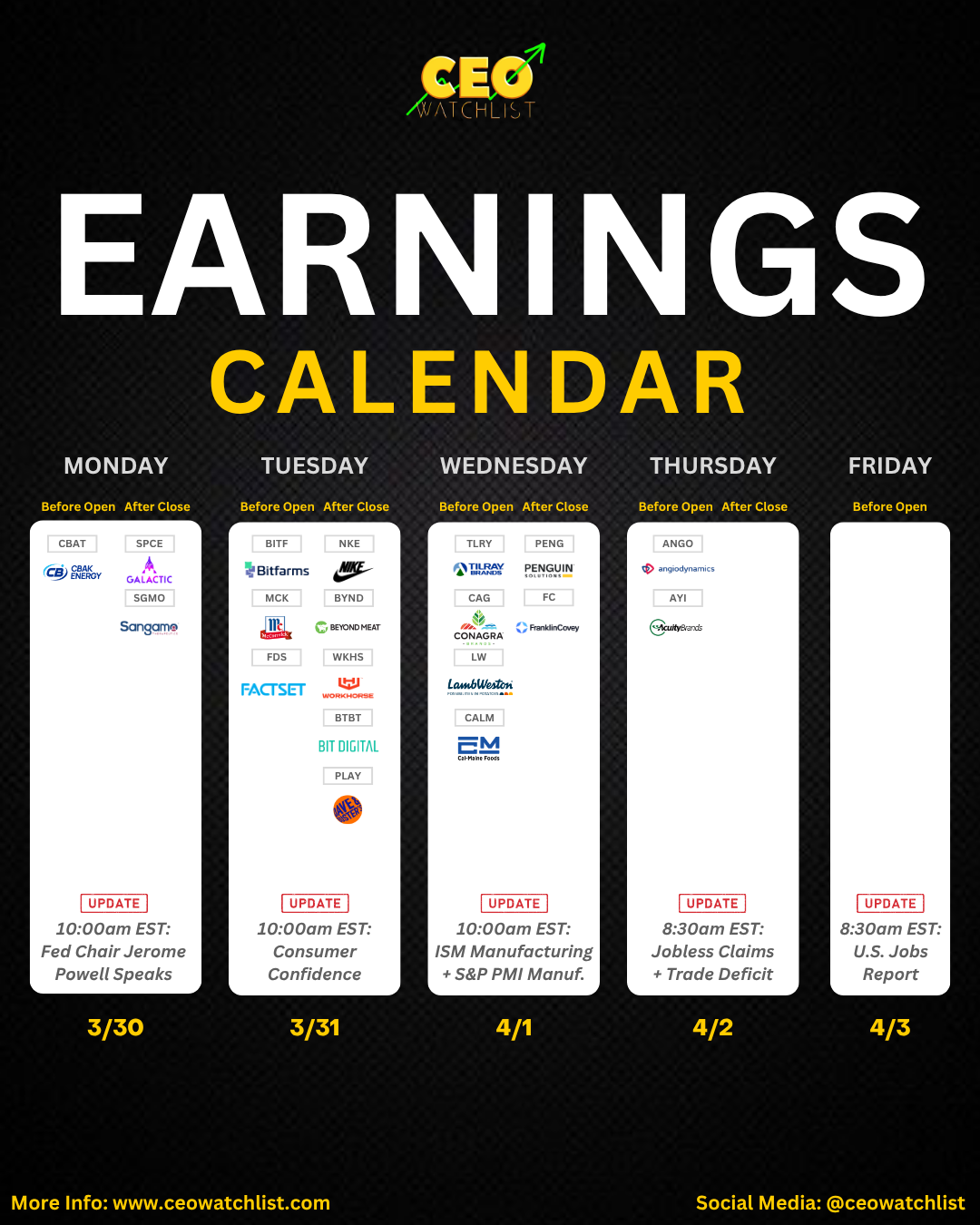
INFOGRAPHICS FOR THE WEEK:



CONTACT US: [email protected]
Responses