

TOP NEWS AFFECTING THE STOCK MARKET THIS WEEK:
Earnings Season: The 3 Stocks We Are Betting On To Beat Earnings This Week! (Source)
Stocks mentioned: $AMZN, $GOOG, $FTNT, $HOOD, $NET, $NBIS
We just wrapped up the 4th week of earnings season, and this past week reinforced how sharply the market can split winners from losers. At this stage of earnings, investors are not only judging the headline numbers, but also how much these companies are spending, and whether that spend can actually help them generate a good return in the future. For example, Amazon (AMZN) and Google (GOOG) both reported strong earnings with massive growth in their cloud divisions, but the market didn't care because they increased how much money they plan on spending (aka "capex") which caused both stocks to initially sell-off over 10% each. Whereas the companies that had good earnings but did NOT increase spend, for example Fortinet (FTNT), were rewarded with large upside returns. Clearly, this is a market that is afraid of companies spending massive amounts of money if they don't know if these companies will get a solid return on investment (ROI) in the future.
The focus now shifts to this upcoming week with several notable companies reporting earnings. So, with that being said, here are the 3 names that we like the most:
- Robinhood (HOOD) - Robinhood’s earnings will be closely watched as a barometer for retail trading activity. Investors will be looking for updates on user growth, transaction revenue, and momentum in options and crypto trading. Any commentary around new product launches or higher engagement could be a catalyst for the stock. Softer trading volumes or weaker guidance, however, would likely pressure shares since the company’s valuation depends heavily on continued user activity. We think with the recent sell-off they have a high likelihood of trending higher after earnings.
- Cloudflare (NET) - Cloudflare sits at the center of web security, performance, and infrastructure, making this report important for understanding enterprise demand. Investors will focus on revenue growth, margins, and customer adoption of its security and edge computing products. Strong results would signal that businesses are still investing in digital infrastructure, while cautious guidance could raise concerns about IT budget constraints. With the recent sell-off in software stocks, Cloudflare has been unfairly punished. We think after this earnings they will show just how strong of a company they are.
- Nebius (NBIS) - Nebius remains one of the more speculative names on the calendar, tied to AI infrastructure and data center expansion. This earnings report will be judged largely on capital spending plans, customer demand, and long-term growth strategy. Any clarity around contracts, partnerships, or profitability timelines could move the stock significantly. Because expectations are still developing, this report has the potential to swing sentiment sharply in either direction. With reports over the past couple weeks with the big mega-cap tech stocks increasing their spend, we believe Nebius is a direct beneficiary of that spend. For these reasons, we think Nebius will have a very strong quarter despite it being a gamble and their competitiors not having such a great earnings. This one is the riskiest of the 3.
So now the spotlight shifts to Robinhood, Cloudflare, and Nebius, three very different companies that together offer insight into retail trading, enterprise cloud security, and AI infrastructure spending. With the market's recent sell-off, their earnings will help determine whether investors should continue favoring stability or lean back into these growth names. And while these are the three headline names, there are many other important reports this week, which is why we included the full earnings calendar below. If you’re an Investment Club member, make sure notifications are turned on so you don’t miss any of our alerts or breakdowns.
We know this past week the market has been choppy, with sharp selloffs in many tech and growth names that left many investors feeling frustrated. That’s exactly why this week stood out for our Investment Club Members. Even in a down and difficult market last week, our students couldn't stop sharing their success. Winning trade after winning trade showed that the disciplined strategies we teach in the CEO Watchlist Investment Club still work in tough conditions. That is how some members reached returns of 250% in a single trade, while others made more than 1,000% in a single day, as you can see below:

If you've been struggling with trading and are ready for a change, now is the time to take advantage and join the Investment Club. We are offering a newsletter exclusive $200 OFF discount code for you to join the CEO Watchlist Investment Club. [CLICK HERE] to get access to your discount code. If you want to learn the strategies that have made our students hundreds and thousands of percentage gains just this past week, then what are you waiting for? You'll not only get access to our strategies, but also our entire stock and options portfolios. There's a reason why once people join, they never want to leave! I'll see you in the Investment Club soon!

The Stock Market Is Crashing: Will It Get Worse From Here?! (Source)
Stocks mentioned: $VOO
Seasonality data makes this environment even more fragile. In the four year presidential cycle, midterm election years historically have shown weakness in the first half of the year. Of course, 2026 had to be a midterm election year, and we know how the last midterm election year went in 2022. During midterms investors tend to worry more about policy, interest rates, and government spending, which can weigh on sentiment. Still, this does not guarantee a crash. Some midterm years were mild pullbacks rather than disasters, so the range of outcomes runs from choppy sideways markets to something that can be a lot more painful. Either way, this year we are in for a bumpy ride, and February is showing us just that.
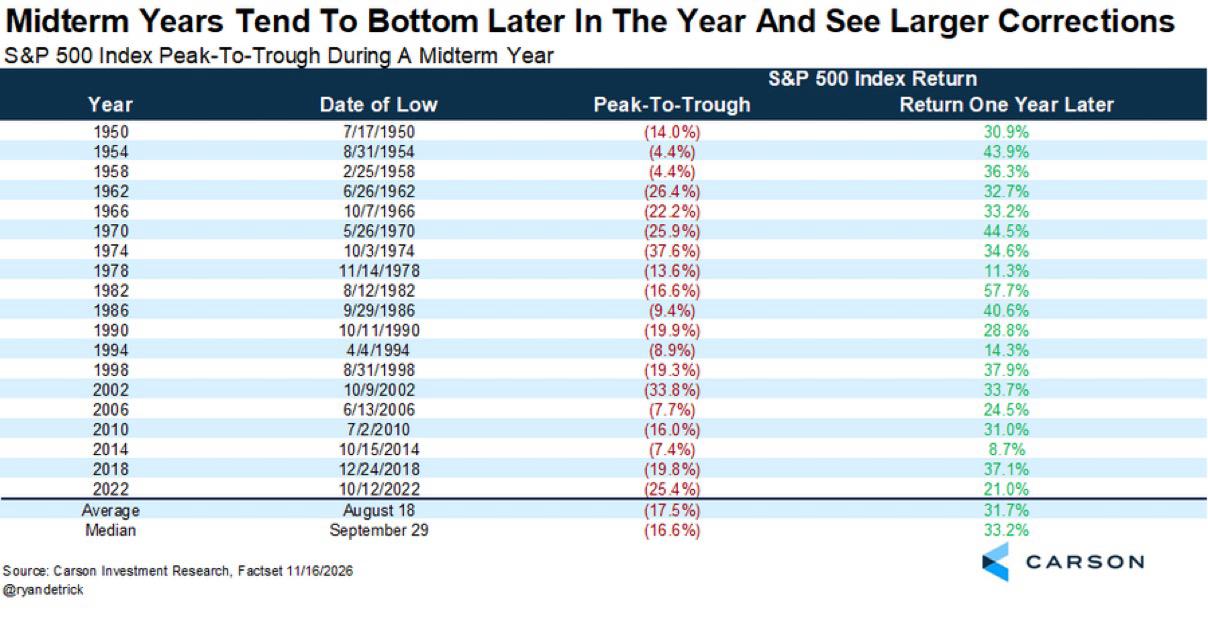
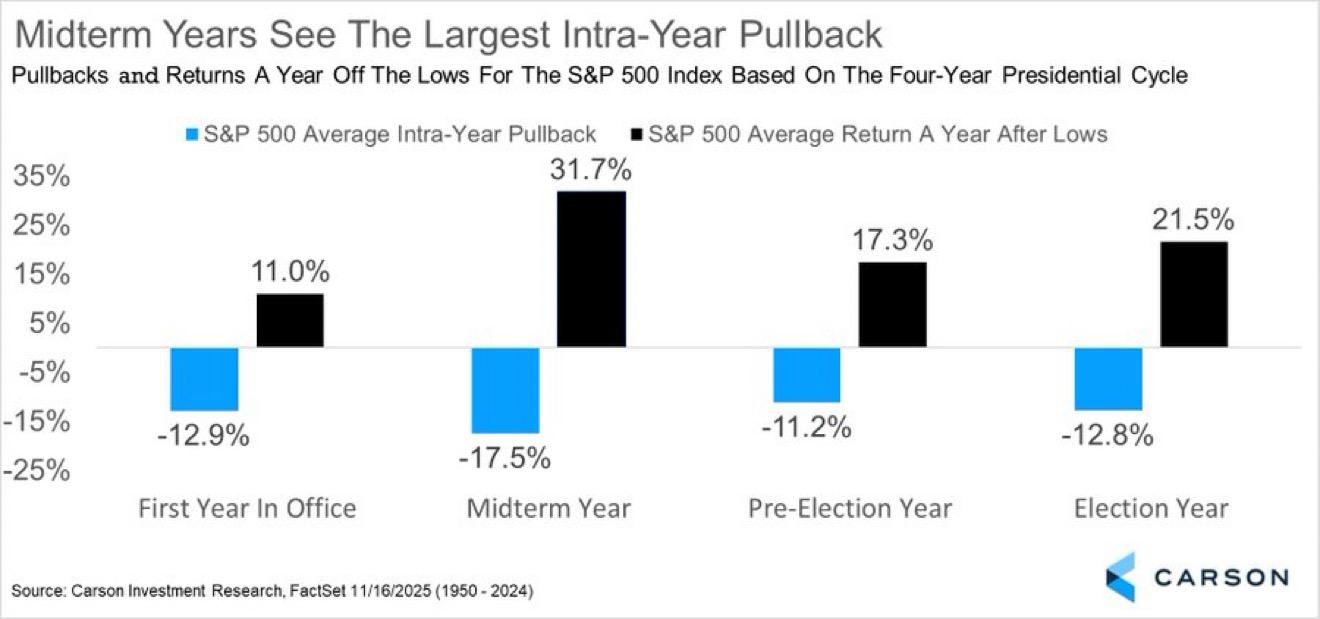
As you can see, according to the data above, midterm election years pullback on average -17.5% from their high to their low. For reference, we are currently only down less than 1%. Needless to say, if this year is like midterm election years from the past, then we can expect a lot more downside in the market. But many of you may be asking, "When should we expect that downside?" According to the data, down below, historically we tend to pull back more heavily in the first half of the year and normally bottom by the end of September. So this still leaves a lot of time for us to chop around as the markets decide whether or not they want to rally before pulling back or just pull back now and rally later. The one thing we do know, that's positive according to the data, is that the last 3 months of the year tend to be bullish for the stock market AKA stocks go higher.

Bottom line, we don't like to work on "feelings" or "hope". The way we invest is through "data" and "statistics". According to the data, we're going to see a rough patch at some point this year. So the little bit of turbulance we've seen in the past couple weeks might be the beginning of something much bigger in the coming months. After you've read this, you can no longer act shocked when and if this happens. Everyone should take a hard look at their portfolio and ask themselves "Am I managing my risk prorperly this year when the data is screaming to be cautious?" Now we're not advocating for people to go out and sell all their stocks, but we think it would be irresponsible not to reassess your risk management after learning this information. There are many ways to manage risk in the markets, and the big one is just by having a hedge for your current investments. There's many ways to do this such as: raising cash, buying put options, inverse ETFs, etc. You'll have to ask what works best for you or if you even believe in the data.
Regardless of whether a crash materializes or not, history shows a consistent outcome after every major pullback: markets have ultimately recovered and gone on to reach new all time highs. So our final takeaway is this: 1. Reassess risk management 2. Determine if a hedge is something that makes sense/how much it should be, and 3. Don't be afraid to pull the trigger on those high quality companies when they are heavily discounted. Remember, after every major market crash, we have gone on to rally to new all time highs 100% of the time. Following each of these cycles, many upset investors are left asking the same question, "Why did I not buy more when stocks were so heavily discounted?" Because although midterm election years tend to have the largest pullbacks, they also offer the best opportunity for the largest returns of any year (as can be seen in the image below). If you're an Investment Club Member, [CLICK HERE] to make sure not to miss our next conference call because we will be covering in detail how we plan on hedging our portfolios over the coming weeks, as well as what stocks we are planning on buying during "key" pullbacks.
Stock Spotlight: EnerSys (Source)
Stocks mentioned: $NVDA, $AMZN, $MSFT, $ENS, $EOSE
While the "AI trade" has made superstars out of many tech stocks, the market is finally waking up to a massive structural bottleneck: Power. As companies like Nvidia (NVDA), Amazon (AMZN), and Microsoft (MSFT) race to build out hyperscale data centers, they are realizing that a chip is only as good as the electricity keeping it online. This is where EnerSys (ENS) quietly sits, not as a speculative bet, but as the critical backup power backbone of the digital economy.
EnerSys is a global leader in stored energy solutions. They don't make the batteries in your TV remote; they make the high-capacity energy systems that keep data centers, telecom towers, and military defense systems running when/if the grid fails. Think of them as the ultimate "insurance policy" for the world's most critical infrastructure. If a data center loses power for even a second, billions of dollars in AI compute could be wiped out. EnerSys provides the lithium and advanced lead-acid systems that ensure that never happens.
What makes EnerSys the "hidden gem" of the power sector right now is how they have transitioned from a legacy industrial company into a high-tech manufacturing powerhouse. In the last year, the company has secured a $199 million Department of Energy (DOE) grant to build a 500,000-square-foot lithium-ion "gigafactory" in Greenville, South Carolina. This facility, set for commercial production by 2028, will produce defense-grade lithium cells exclusively for EnerSys, effectively onshoring a critical supply chain that was previously dominated by overseas players.
The financial narrative is just as compelling as the tech. In their most recent earnings report (released February 4th), EnerSys showed that while core industrial demand is stabilizing, their Data Center business surged 28% year-over-year. They also reported a record 50% growth in adjusted EPS (excluding tax credits), proving that their transition to higher-margin lithium products is working. Furthermore, thanks to the Section 45X tax credits for domestic manufacturing, EnerSys is sitting on a massive cash windfall, receiving over $137 million in government refunds this year alone.
This is exactly why EnerSys stands out today. It isn't a "hype" stock like EoS Energy (EOSE), which trades at nearly 150x sales despite being unprofitable. EnerSys is a real business with a $6 Billion market cap, trading at a low 14x forward P/E ratio, even after its recent run to all-time highs. It is a "picks and shovels" play on the AI data center buildout that is already profitable, already manufacturing in the U.S., and already embedded in the defense and telecom sectors.
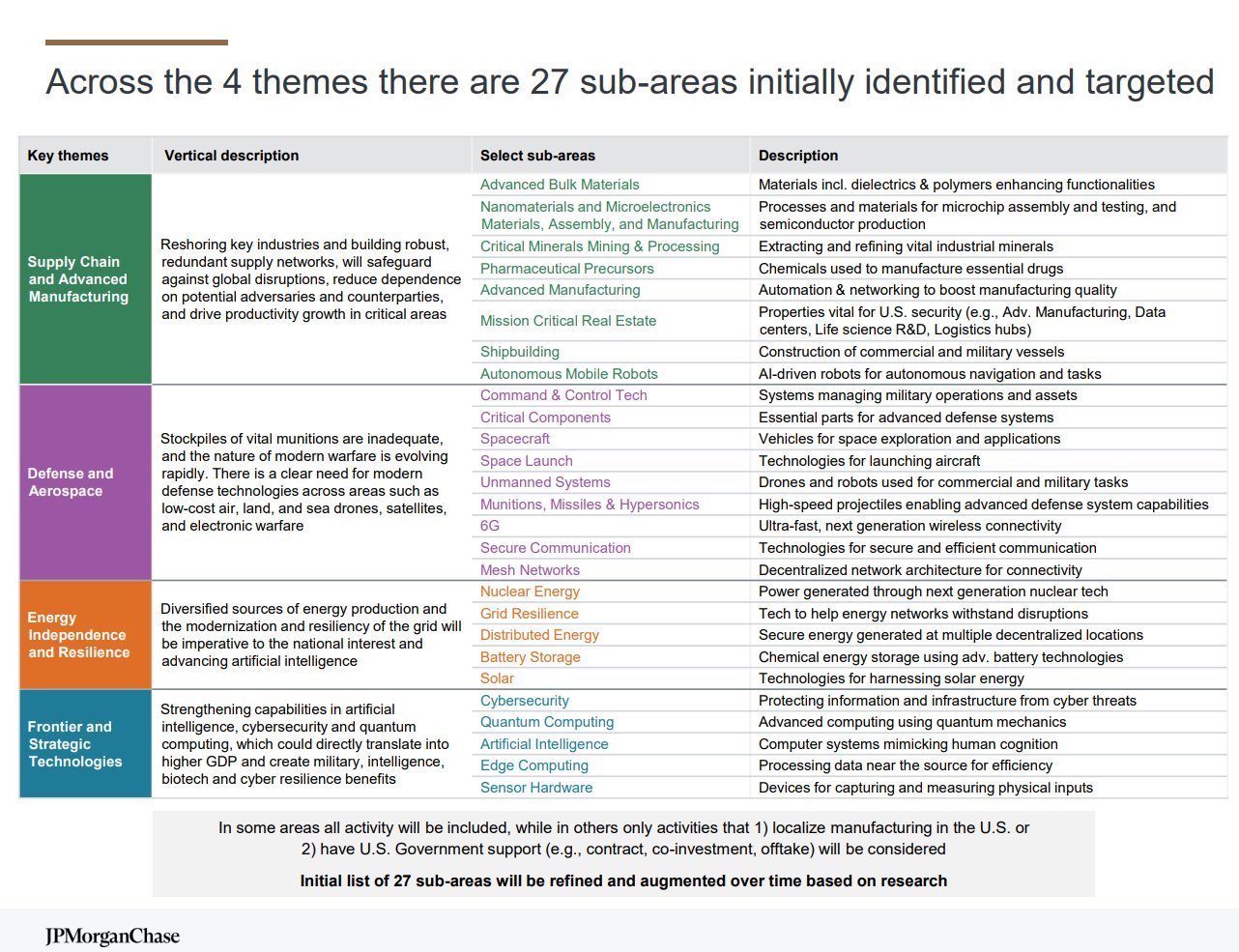
As major players like JPMorgan pour billions into "Security and Resiliency" infrastructure, EnerSys represents one of the most stable and strategic ways to gain exposure to the electrification of the global economy. For investors who want to move past the volatility of software and into the physical backbone of the AI revolution, EnerSys represents one of the strongest, most underappreciated ways to play the long-term electrification trend.
INSIDER STOCK TRADES FROM THE WEEK:
1. Lamb Weston Holdings (LW) - Eli Craps, Executive Chairman, bought roughly $2,000,000 worth of LW at $48.64/share on Feb. 6, 2026, and it was reported to the public later that same day. (Source)

2. Roper Technologies (ROP) - Patrick Joyce, Director, bought roughly $500,000 of ROP for $358.46/share on Feb. 6, 2026, and it was reported to the public later that same day. (Source)

3. Lumen Technologies (LUMN) - Kathleen Johnson, President & CEO, bought roughly $500,000 of LUMN at a price of $6.35/share on Feb. 5, 2026, and it was reported to the public later that same day. (Source)

Over 2,000 people have already signed up for my FREE Masterclass video on how to unlock my exact strategies for finding winning stock/options trades! I'll share everything including how to find what Politicians and CEOs are buying. Don’t miss your chance to get in for FREE before spots fill up!

INFOGRAPHICS FOR THE WEEK:



CONTACT US: [email protected]
Responses