
TOP NEWS AFFECTING THE STOCK MARKET THIS WEEK:
Earnings Season: The 5 Stocks We Are Betting On This Week! (Source)
Stocks mentioned: $MSFT, $NOW, $META, $AAPL, $PLTR, $AMZN, $GOOG, $AMD, $TER
We just wrapped up the third week of earnings season, and this is where the real separation began to show. Last week, software and high-multiple growth names continued to struggle, while a few select mega-cap companies proved they could still deliver in a tough environment. This is the point in earnings season when the market stops giving companies the benefit of the doubt and starts rewarding only those that execute. There’s no hiding behind narratives anymore.
For instance, Microsoft (MSFT) disappointed investors and sold off, reinforcing concerns that enterprise software spending may be slowing. Even ServiceNow (NOW), which actually posted a solid earnings report, failed to gain traction as investors continued rotating away from software names. On the other hand, Meta (META) delivered a strong quarter and surged nearly 10% as investors reacted positively to strong ad performance and confident guidance. The market had already priced in higher capital expenditures, so the results were received far better than previous quarters. Apple (AAPL) also had a solid report, driven largely by stronger-than-expected iPhone sales, which helped restore confidence in consumer demand. This past week proved to us that not all mega-cap tech names are equal. Currently software stocks are in the doghouse and we don't know if that's going to change anytime soon.
But now the focus shifts to this upcoming week, which could set the tone for the rest of earnings season. Several major companies are reporting, and their results will play a key role in shaping overall market sentiment. So, with that said, here are the 5 names we are watching this week:
- Palantir (PLTR) – Palantir remains one of the most closely watched stocks in the market. Investors will be focused on AI adoption, government contracts, and growth in its commercial business. This earnings report will be important in determining whether Palantir can continue to justify its premium valuation. Any commentary around AI demand or government spending could move the stock sharply in either direction. We think this one is a winner going into earnings.
- Amazon (AMZN) – Amazon’s earnings go far beyond e-commerce. The key focus will be AWS growth and whether cloud spending is beginning to reaccelerate. Investors will also be watching margins closely as Amazon continues to improve efficiency. A strong report could lift not just Amazon, but the broader tech sector as well. We think this one will also be a winner and if the report is good enough, we could see this one go up 10% or more.
- Alphabet (GOOG) – Google enters this earnings report at a critical point. Investors will be focused on advertising revenue, cloud growth, and progress in AI monetization. While Google remains dominant in search, the market wants to see continued growth and evidence that its AI investments are paying off. We really like Google and think it's one of the best companies as a long-term investment, but they are not as cheap as they once were a couple months ago since their recent run-up. They will need to put up extraordinary numbers for this stock to re-rate higher. But if they don't and the stock falls, we will be buying any dips in the name.
- Advanced Micro Devices (AMD) – AMD is one of the most important earnings reports of the week. The market is watching closely to see how strong demand is for AI-related chips and data center products. Expectations are high, which means the stock could see a sharp move depending on guidance. This is one of the highest-volatility reports of the week. This is a name we remain neutral on, due to their competition between Nvidia and Intel. Because of this, we think AMD's report is a gamble but if they put up incredible numbers, we wouldn't be surprised if this names pushed up towards $300/share.
- Teradyne (TER) – Teradyne may not grab headlines, but it plays a critical role in the semiconductor ecosystem as well as robotics. Its earnings provide insight into chip demand and testing activity across the industry. Strong results would suggest the semiconductor recovery is gaining traction, while weaker guidance could signal continued softness. We also want to pay attention to their robotics division and see continued growth in that area in the market. We've been bullish on this name for a long time, but it's sitting at the high end of its historical range, which creates risk due to its valuation. This is another stock we have to remain neutral on.
Stepping back, Week 3 showed us a clear divide in the market. Software and high-multiple names struggled as expectations remained elevated, while companies that delivered strong execution were rewarded. Now the spotlight shifts to five major companies that sit at the center of AI, cloud computing, and semiconductors.
Their earnings will likely determine whether the market leans back into growth or continues to trade cautiously. And while these are the headline names, there are plenty of other important reports this week, which is why we’ve included the full earnings calendar below. As always, if you’re an Investment Club member, make sure notifications are turned on in the app, so you don’t miss any of the updates we will be alerting to club members.

History Was Made: Silver's Largest CRASH of the Century and How We Plan To Profit From It! (Source)
Stocks mentioned: $AMZN, $GOOG, $META, $TSLA, $PL, $OSS, $AMPX, $GLD, $SLV, $FCX
Markets closed last week under pressure, with the sharpest selling hitting gold and silver, with gold dropping 9% while silver dropped a whopping 26%! This was the largest single-day crash (in dollar terms) of Silver in the past 100 years! But what caused this chaos in the market? And how are we planning to benefit from these volatile market moves? Well simply put, President Trump nominated an unlikely candidate to be the next Federal Reserve Chair. The person he nominated is Kevin Warsh and the reason why the markets hated this decision is because historically Warsh is known to be anti rate cuts, AKA bad for stocks and metals. So having this guy sit as the head of the Federal Reserve gave the markets a bit of a shock to say the least, especially when Trump has been preaching that he wants rate cuts. So why is the President, who wants rate cuts (good for stocks), nominating someone who historically is against rate cuts (bad for stocks)?
Well, to answer all these questions, it helps to first step back and look at what the Federal Reserve actually does. The Fed controls short term interest rates, which influence everything from mortgage costs to stock valuations. When rates go higher, borrowing slows, growth cools, and assets like stocks and precious metals (gold & silver) often struggle. When rates fall, money becomes easier to access, risk appetite rises, and asset prices usually benefit. That is why markets obsess over who runs the Fed and how they think about inflation, growth, and financial stability. Which brings us to the man Trump nominated ... Kevin Warsh.
Kevin Warsh is a familiar name in monetary policy circles. He previously served as a Federal Reserve Governor and developed a reputation as being more hawkish (bad for stocks/metals) than many of his peers, meaning he was less willing to cut rates quickly. That reputation is what shocked markets. Many investors had assumed Trump would choose someone more dovish (good for stocks/metals), someone eager to push rates lower to stimulate growth. Instead, Warsh’s potential return signaled fear that sparked the selloff. However, it is important to note that Warsh’s prior Fed tenure was years ago, under very different economic conditions. Inflation dynamics, government debt, and global pressures have changed significantly since then. There is also history here. Trump strongly considered Warsh in 2017 before ultimately choosing Jerome Powell. The two also have a long history and know each other very well, which suggests they will work well together. One thing many news outlets aren't reporting on though so that Warsh in recent interviews has actually claimed that he believes the Fed should be cutting rates right now, which lines up perfectly with Trump's views. Thanks to Trump's strong relationship and them sharing similar views, makes this so called nomination a surprisingly tactical pick by Trump.
This is where the investment angle starts to take shape. If Warsh signals even modest flexibility once in the role, markets could reverse sharply. This is exactly what we think is going to happen. We believe that Warsh will open his Fed tenure with a surprising rate cut, which will send markets soaring higher and in turn, will come at the perfect time right before the midterm elections giving Trump and republicans a winning edge at the polls. Needless to say, stocks and precious metals will move higher if this happens, and this is exactly what we are betting on. We think markets could have a steep pullback at some point over the next quarter, and then when Warsh gets into his role and does a rate cut, we will see a sharp V-shaped recovery. So what's our investing plan and what stocks are we planning to buy? Simply put, we want to be heavy in cash and look for a pullback in the S&P500 of 10% from its all time high, and then deploy capital specifically in tech stocks, small to mid-cap stocks, and precious metals (as long as they are significantly off their highs). Specific stocks we are looking at include:
- The "Mag 7" Names - AMZN, GOOG, META, and TSLA
- Small To Mid-Cap Stocks - PL, OSS, and AMPX
- Precious Metals - GLD, SLV, and FCX
These are just a small sample of the dozens of names that we are tracking in our stock watchlists currently. The key takeaway is that if this selloff, that we saw this past week, was just the beginning of a bigger correction, then there will be a lot of opportunities as long as you don't let fear consume you. We think the next couple months can be very choppy for the stock market, so taking a more cautious approach while nibbling at our stock shopping list during any big pullbacks is the way we are approaching this current market environment.

Stock Spotlight: Planet Labs (Source)
Stocks mentioned: $PL, $TSLA, $AMZN, $GOOGL, $MSFT
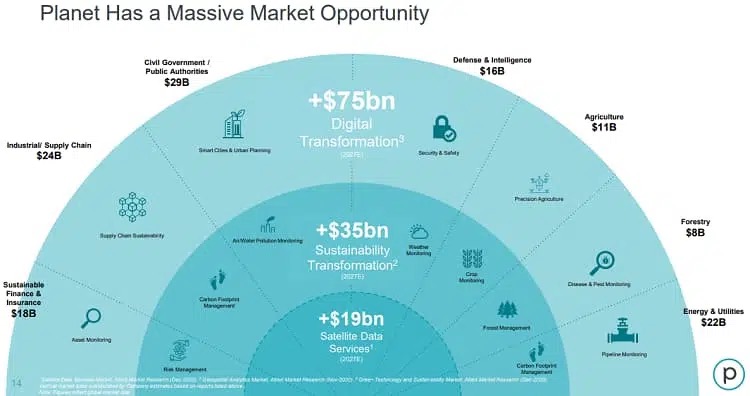
The space industry is entering a "second act," and most investors are still looking at it through the lens of rockets and hardware. While everyone focuses on launch providers like SpaceX, a much more lucrative shift is happening in orbit. It’s no longer about just getting to space; it’s about what we do with the data we are gathering from space. As AI models demand more data and more power than Earth can sometimes provide, the infrastructure of the future is moving off-planet. This is where Planet Labs (PL) sits.
Planet Labs is the leading provider of daily Earth-imaging data. In simple terms, they operate the world’s largest fleet of Earth-observation satellites, over 200+ satellites that photograph the entire landmass of the Earth every single day. If you think of Google Maps as a static photo, Planet Labs is the live video feed. They provide the "source code" for global change, helping everyone from government intelligence agencies to agricultural giants track everything from troop movements to crop yields in real-time.
What makes Planet Labs the most interesting "Space-AI" play right now is a project called Suncatcher. As terrestrial data centers hit an energy wall on Earth, Google ($GOOG), a major backer and 10% owner of Planet Labs, is looking to the stars. Google recently selected Planet Labs to build and launch prototype satellites for a moonshot initiative to scale AI training in space. By using satellites equipped with Google’s TPUs (Tensor Processing Units), they can leverage 24/7 solar power and natural vacuum cooling to process data where it’s collected. This effectively transitions Planet from a data provider to a "Satellite-as-a-Service" infrastructure company.
The numbers are finally starting to reflect this massive shift. For the most recent quarter (Q3 2025), Planet reported record revenue of $81.3 million, a 33% increase year-over-year. More importantly, their backlog has exploded to $734 million, up over 200% as governments and allied nations sign massive nine-figure deals to secure their data feeds. The company has now achieved four consecutive quarters of positive adjusted EBITDA, proving that the business model is successfully scaling from a "promising story" to a profitable reality. This is exactly why Planet Labs stands out today. It isn't just a speculative space play; it is a foundational data layer for the AI era. As the "physical world" becomes a primary dataset for AI models, and as "Space-Based Compute" moves from science fiction to a multi-billion dollar industry, Planet Labs sits at the direct entry point of that transition.
INSIDER STOCK TRADES FROM THE WEEK:
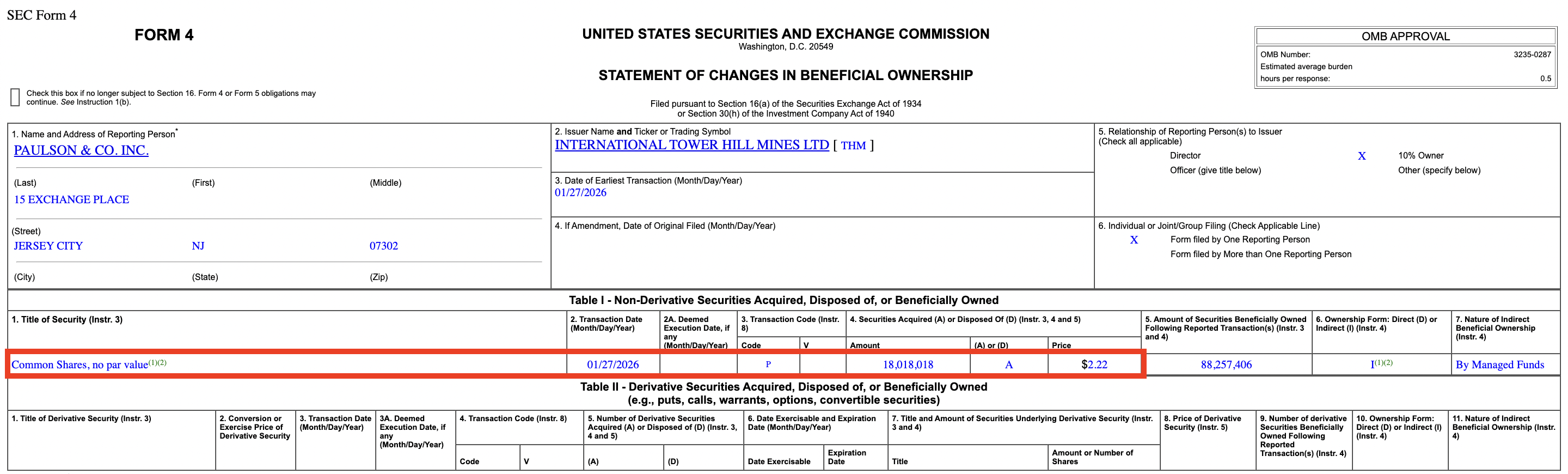
1. International Tower Hill Mines (THM) - Billionaire John Paulson, through his investment firm Paulson & Co., bought roughly $65,000,000 worth of THM at an average price of $2.22/share between Jan. 27-28, 2026, but it was most recently reported to the public on Jan. 30, 2026. This is the second time in the past month that this billionaire has bought up millions of dollars of shares. (Source)
2. USA Rare Earth (USAR) - Michael Blitzer, Director, bought roughly $2,100,000 of USAR for $21.43/share on Jan. 29, 2026, and it was reported to the public later that same day. (Source)

3. Intel Corp (INTC) - David Zinsner, CFO, bought roughly $250,000 of INTC at a price of $42.50/share on Jan. 26, 2026, but it was reported to the public on Jan. 27, 2026. This is the first insider purchase since 2024. (Source)

Over 2,000 people have already signed up for my FREE Masterclass video on how to unlock my exact strategies for finding winning stock/options trades! I'll share everything including how to find what Politicians and CEOs are buying. Don’t miss your chance to get in for FREE before spots fill up!

INFOGRAPHICS FOR THE WEEK:



CONTACT US: [email protected]
Responses