

TOP NEWS AFFECTING THE STOCK MARKET THIS WEEK:
Nancy Pelosi Retires: The 3 Politicians We're Watching Now... (Source)
Stocks mentioned: $XLK, $NGD, $NVDA, $QQQ
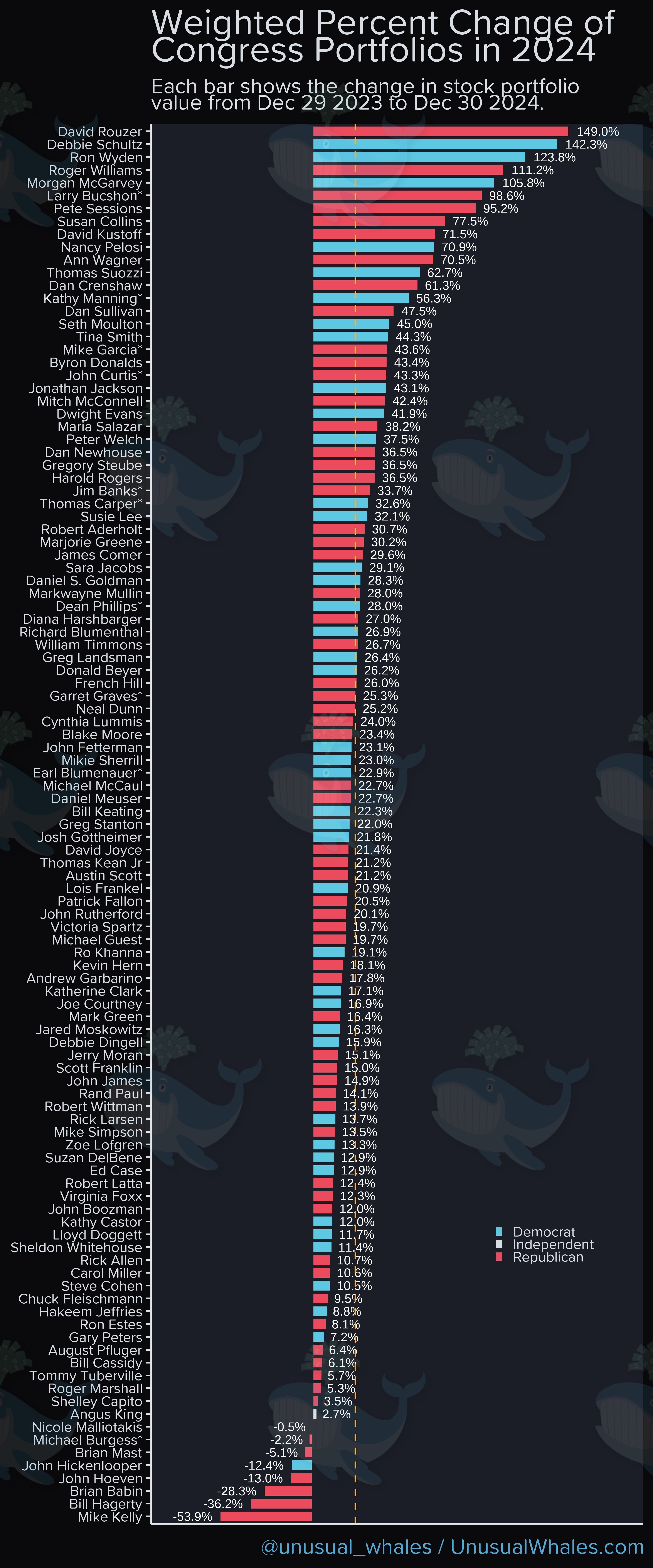
For years, Nancy Pelosi’s trades shaped an entire corner of the retail investing world. Her portfolio’s uncanny timing and consistent outperformance made her one of the most-watched figures on Capitol Hill. But now, with Pelosi stepping away from Congress, the market’s favorite political benchmark is gone, leaving millions of investors wondering: who do we follow next? The answer is already clear. According to the latest data, three congress members have actually outperformed even Pelosi, despite their names going under the radar. As Washington channels trillions into infrastructure, AI, and industrial reshoring, the most connected lawmakers continue to outperform Wall Street hedge funds, despite not having any significant background in finance or economics. With Pelosi retiring, we will be focusing our attention on these three names: David Rouzer, Debbie Schultz, and Ron Wyden.
Let’s take a closer look at the stock portfolios of these 3 politicians who have outperformed Nancy Pelosi:
1. David Rouzer - Republican U.S. Representative from North Carolina’s 7th district and a former state senator who serves on the House Committee on Science, Space and Technology (Subcommittees on Research and Technology and Environment). This is important because a large portion of his portfolio is in technology stocks, which has made him a significant amount of money, while sitting on the House Committee on Science, Space, and Technology. His top holdings are focused on tech-centric names, and that's why we see his largest position being the tech-based ETF, XLK. While Pelosi's stock portfolio rose roughly +71% last year, David Rouzer's rose an estimated +149%!

2. Debbie Schultz - Democratic U.S. Representative from Florida’s 25th district and serves on the House Committee on Appropriations (with roles on the Subcommittees on Agriculture, Rural Development, Food and Drug Administration & Related Agencies; Energy & Water Development & Related Agencies; and Military Construction, Veterans Affairs & Related Agencies). A large portion of her holdings are in the materials sector, with her largest position being Newgold (NGD). While Pelosi's stock portfolio rose roughly +71% last year, Debbie Schultz's rose an estimated +142%!

3. Ron Wyden - Democratic U.S. Senator from Oregon, serving as Ranking Member of the Senate Finance Committee and also a member of the Senate Budget Committee, the Senate Energy and Natural Resources Committee, the Select Committee on Intelligence, and the Joint Committee on Taxation. His top holdings are focused on tech-centric names, and that's why we see his largest position being Nvidia (NVDA) and a tech-centric ETF, QQQ. While Pelosi's stock portfolio rose roughly +71% last year, Ron Wyden's rose an estimated +123%!

Critics often dismiss congressional trading as anecdotal, arguing that past performance doesn’t guarantee future success. But the consistency of these returns across multiple members, and across both parties, suggests that policy awareness and market foresight continue to compound together. These lawmakers aren’t just trading stocks; they’re trading the direction of U.S. economic policy itself, from health innovation to advanced manufacturing to AI infrastructure.
Pelosi’s exit doesn’t end the era of political market insight, it expands it. Investors who once tracked her every move now have a new trio of lawmakers leading the pack. Rouzer, Schultz, and Wyden each represent a different corner of America’s growth story, and their portfolios reflect where capital, innovation, and government incentives are converging next. The opportunity isn’t in speculating what they "might" know, but rather acknowledging their massive outperformance of the market. Whether you're on the right or the left, red or blue, one thing both sides can agree on is they both like the green! That's exactly why we follow the money, not the political theatre. Following these policy makers has helped us make a lot of money in our careers, and just because Nancy Pelosi is retiring, it doesn't mean we're going to stop tracking them and reporting it to all of you. The show must go on!
The Government Has Been Shut Down For Over A Month, And Stocks Are Starting To Feel The Pain... (Source)
Stocks mentioned: $HOOD, $AMKR, $NTCT
When the federal government shuts down operations because Congress cannot pass the necessary spending bills, the disruption ripples through the economy in more subtle but no less potent ways. A government shutdown halts or delays services, furloughs hundreds of thousands of workers, and puts a temporary freeze on many forms of spending. In turn, economic growth slows, confidence falters, and for the stock market the risk is two-fold: a growth drag and an information vacuum. Markets hate both! As the current shutdown stretches further into record territory, the weight on equities is no longer hypothetical but real.
Our macro-thesis is this: the ongoing shutdown doesn’t simply pause government spending, it exacerbates the structural constraint of economic visibility, which in turn amplifies valuation risk in an already richly priced market. This is why we've seen growth stocks underperform this past week. Once the shutdown ends and clarity returns, the market can resume its rally higher into the end of the year.
With that in mind, here are 3 stocks positioned to benefit when the deal is done and clarity returns:
- Robinhood (HOOD) – A leader in retail investing platforms that thrives when market confidence returns. Once the government shutdown is resolved, risk appetite will resume and stocks like HOOD can rally higher once again.
- Amkor (AMKR) – A major player in semiconductor packaging and testing that stands to gain as supply chains and federal tech initiatives resume. Due to this being a smaller company, it's inherently considered "higher risk" and so once this is resolved, we expect it to also benefit from a risk-on rally.
- Netscout Systems (NTCT) – Specializes in network monitoring and cybersecurity visibility tools, critical for both government and enterprise systems. This stock just reported a phenomenal earnings, and if it wasn't for the government shutdown, we think this stock could easily go 10% higher than where it is today.
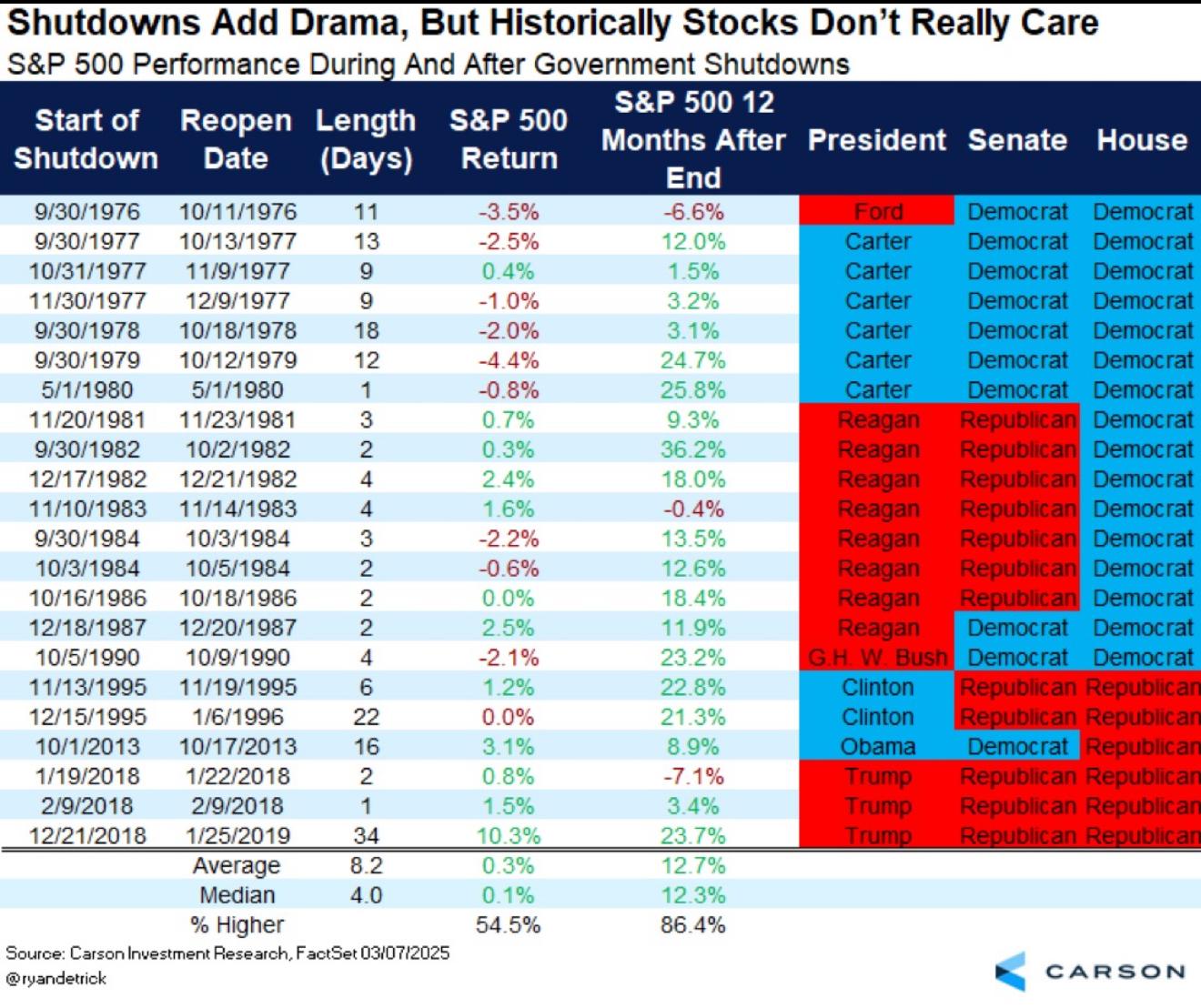
A government shutdown deal is inevitable, but since we've never experienced one this long before, we are currently in uncharted territory, and that is what is spooking the market. Long term, we think stocks can continue their bull market rally because as history has shown us, stocks are up 86.4% of the time one year after government shutdowns are resolved (as can be seen in the data below):
In conclusion, the shutdown is not just political drama, it is a heavy weight on stock market returns. If we want the stock market to continue its rally into the end of the year, we need a deal to be made. We don't know the effects of a prolonged government shutdown, because we've never been through one before. For the sake of the economy, as well as the stock market, let's hope this gets resolved soon. We'll be rotating our stock portfolios into new buys this week. If you're an Investment Club Member, and you haven't seen the stocks we plan on buying this week, as well as our research into them, make sure to [CLICK HERE] to log in and see all the stocks we are currently buying and selling because of this event. If you're not an Investment Club Member yet, we are granting you $200 OFF today when you sign up. [CLICK HERE] to take advantage of this offer! Once you sign up for the Investment Club, make sure to download the app, and turn on notifications so you will be immediately alerted whenever we make a move.
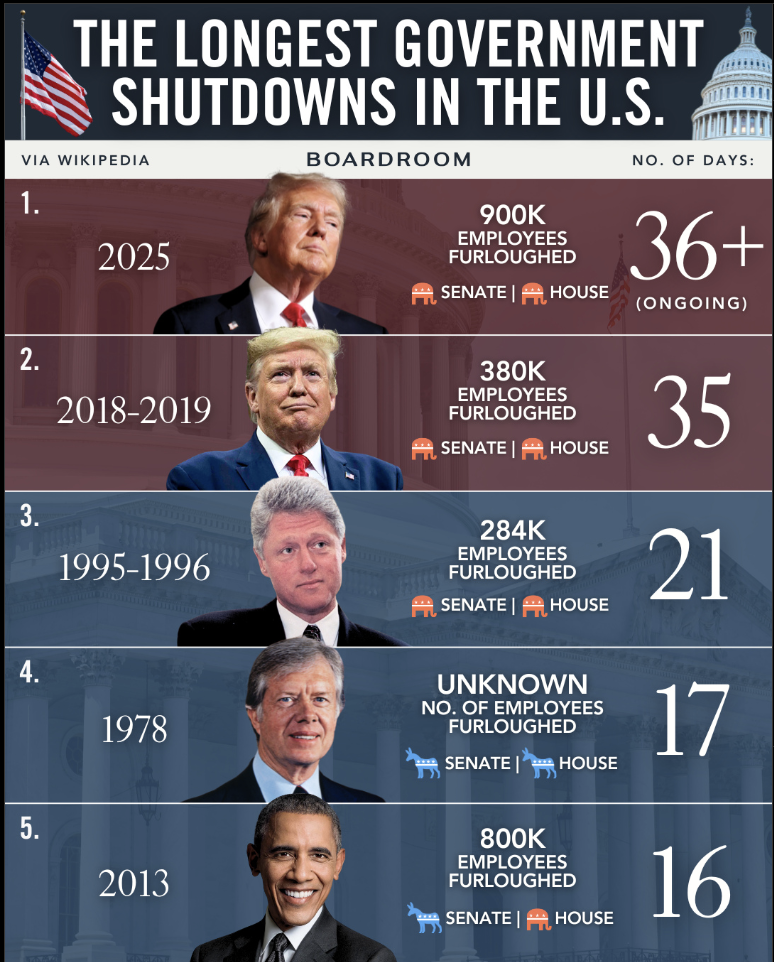
Note: This image is updated as of Nov. 5, 2025. The current government shutdown is now over 40 days, and ongoing.
"Super Investor" Spotlight: Amazon (Source)
Stocks mentioned: $AMZN, $RIVN, $VITL, $ALAB, $MRVL, $NAUT, $IONQ, $AMD
This week’s "Super Investor" Spotlight shines on Amazon (AMZN), a name that hardly needs introduction but deserves deeper attention for its increasingly strategic investment arm. For those that don't know, it's not just hedge funds that invest in the stock market, it's also publicly traded companies. As we've covered before, we've shown you Nvidia's stock portfolio, and because we got such positive feedback, this week we wanted to cover the stocks that Amazon is invested in.
So with that being said, here’s a breakdown of Amazon’s top 5 holdings:
- Rivian Automotive (RIVN) – 94.37%: Electric vehicle manufacturer partnering with Amazon on custom delivery vans and sustainable logistics.
- Vital Farms (VITL) – 2.55%: A consumer goods brand focused on ethically sourced food, aligning with Amazon’s Whole Foods vision.
- Astera Labs (ALAB) – 2.21%: Semiconductor connectivity company enabling next-gen data center performance, a clear complement to Amazon Web Services (AWS).
- Marvell Technology (MRVL) – 0.77%: A chip designer specializing in cloud and 5G infrastructure, further reinforcing AWS’s technological backbone.
- Nautilus Biotechnology (NAUT) – 0.05%: A life sciences innovator focused on proteomics, bridging health data and cloud analytics.
One notable development this quarter is Amazon’s full exit from IonQ (IONQ) and Advanced Micro Devices (AMD), both showing a 100% reduction in shares. IonQ is a quantum computing company, and AMD is a major chip supplier, so the decision to divest could suggest that Amazon is either re-prioritizing its exposure to hardware innovation or reallocating internally toward its own in-house AI infrastructure projects.
Amazon’s latest 13F isn’t about short-term profits, it’s about long-term dominance. The near-total concentration in Rivian highlights its commitment to vertical integration and sustainability, while smaller stakes in AI infrastructure and smart home technology reflect its wide-ranging strategic vision. For investors watching the evolution of Big Tech, Amazon remains one of the few companies that builds the future from the inside out, and this portfolio is a roadmap for where that future is headed.

INSIDER STOCK TRADES FROM THE WEEK:
1. Blackstone (BX) - James Breyer, Director, bought roughly $2,000,000 of BX between $142-145/share on Nov. 4, 2025, but it wasn't reported to the public until Nov. 5, 2025. (Source)

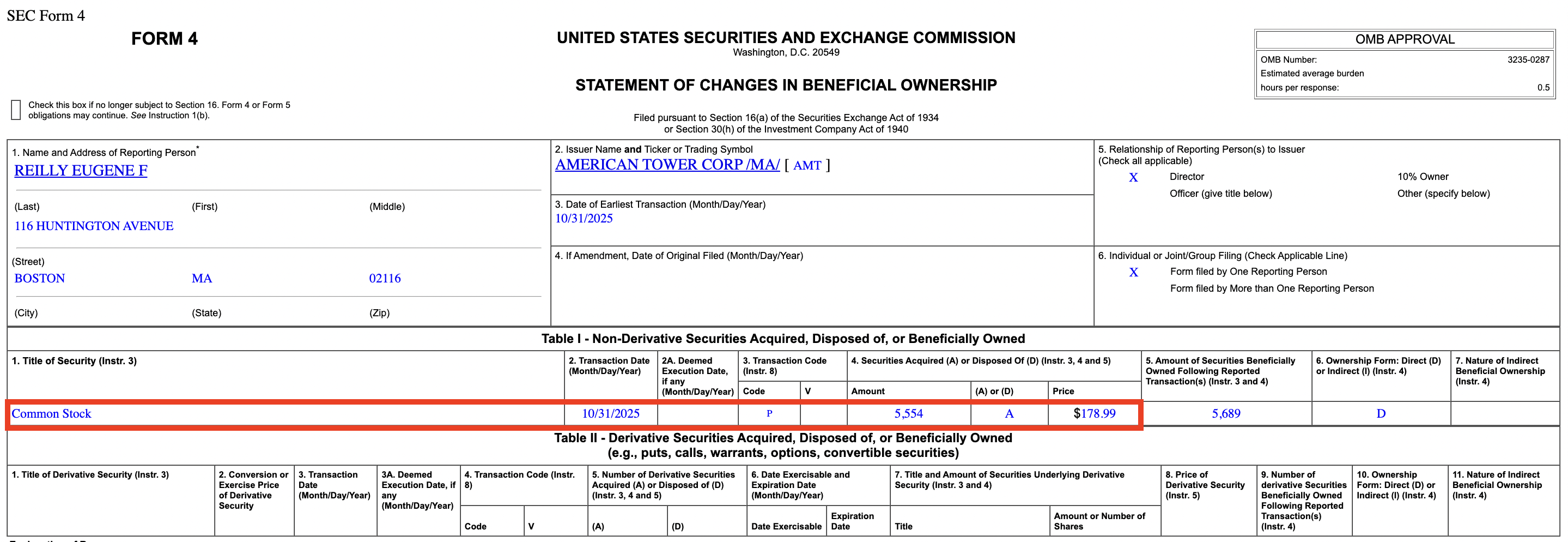
2. American Tower (AMT) - Eugene Reilly, Director, bought roughly $1,000,000 of AMT at $178.99/share on Oct. 31, 2025, but it wasn't reported to the public until Nov. 4, 2025. (Source)
3. Fiserv (FI) - Lance Fritz, Director, bought over $650,000 worth of FI at $65.18/share on Oct. 30, 2025, but it wasn't reported to the public until Nov. 3, 2025. (Source)

Over 2,000 people have already signed up for my FREE Masterclass video on how to unlock my exact strategies for finding winning stock/options trades! I'll share everything including how to find what Politicians and CEOs are buying. Don’t miss your chance to get in for FREE before spots fill up!

INFOGRAPHICS FOR THE WEEK:



CONTACT US: [email protected]
Responses