

TOP NEWS AFFECTING THE STOCK MARKET THIS WEEK:
Warren Buffett's Surprising New Stock He Bought...and Bill Gates' Shocking Stock He Sold!!! (Source)
Stocks mentioned: $BRK.B, $GOOGL, $MSFT
Warren Buffett is approaching retirement, and with that transition looming, most investors expected a quiet final chapter rather than a bold, market shaking move. Instead, his Q3 2025 13F filing delivered a shock: Berkshire Hathaway (BRK.B) has initiated a new position in Google (GOOGL).
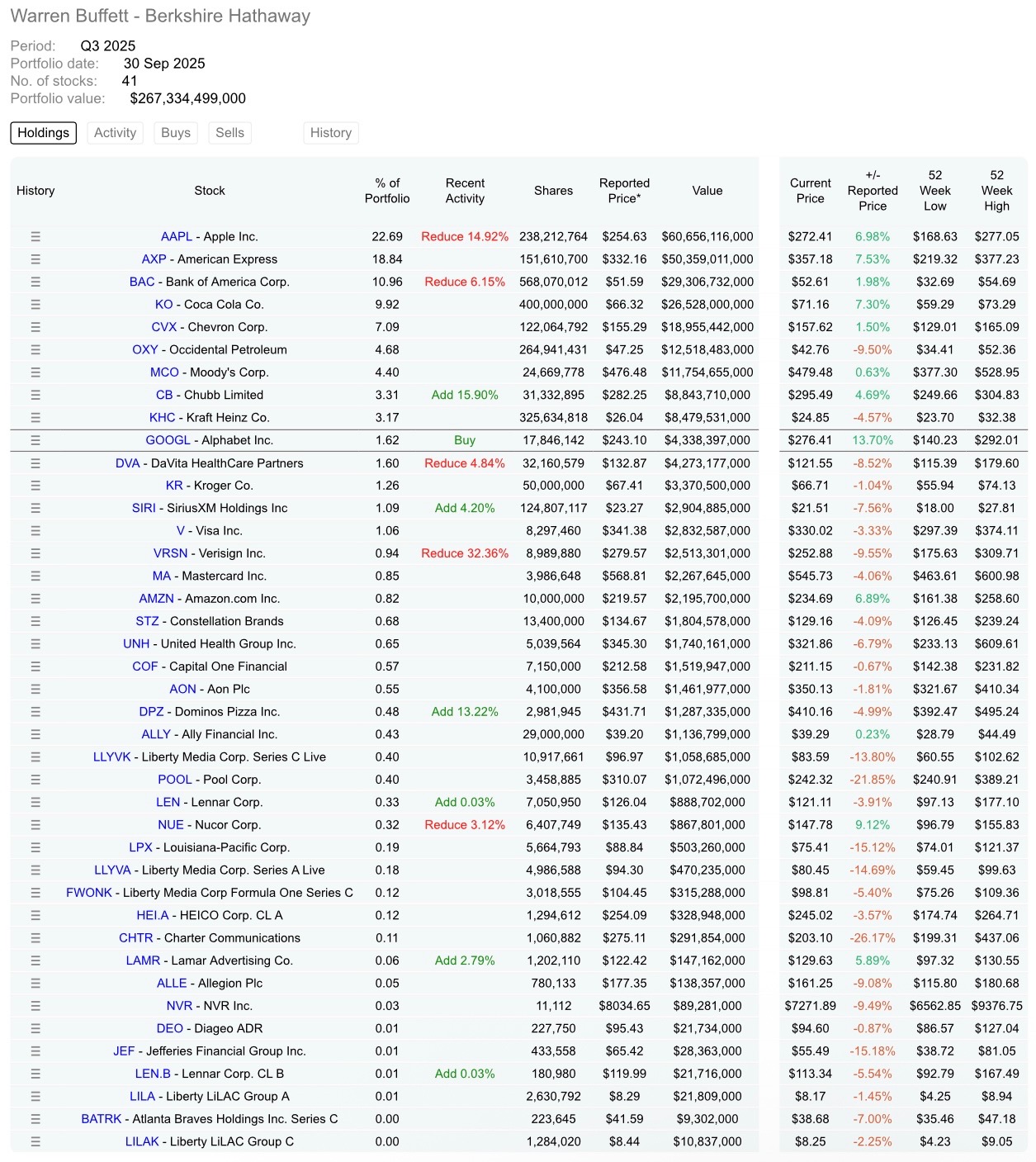
This is not a routine portfolio tweak. Buffett has spent decades avoiding most of Silicon Valley, insisting that fast moving tech businesses sit outside his circle of knowledge and risk tolerance. Yet as he prepares for his final year at Berkshire, he has chosen Google as one of his last major bets. That alone challenges the familiar narrative that "Big Tech" is incompatible with value investing.
Here is the macro picture that makes this moment so important. Buffett, at his core, is a value investor, meaning he seeks companies trading below what he believes they are truly worth based on long term cash flow. That discipline kept him out of many high growth sectors for most of his career, and it is why he has been sitting on a cash pile that now exceeds any historical Berkshire level. He has repeatedly said that he has avoided buying because most stocks look expensive. The bottleneck in his strategy has not been lack of capital, it has been lack of value. So when a disciplined value investor with more than $300 billion dollars in cash suddenly decides Google is mispriced, it signals a structural shift. Buffett views Google as a misunderstood asset in a market crowded with momentum driven trading, and he is wagering that its core businesses still possess a durable, cash generating moat.
But Buffett's surprising buy in Google isn't the only hard hitting story that came out on Friday. One of his closest friends, and famed technology founder, Bill Gates, just sold roughly 65% of his Microsoft (MSFT) stake!
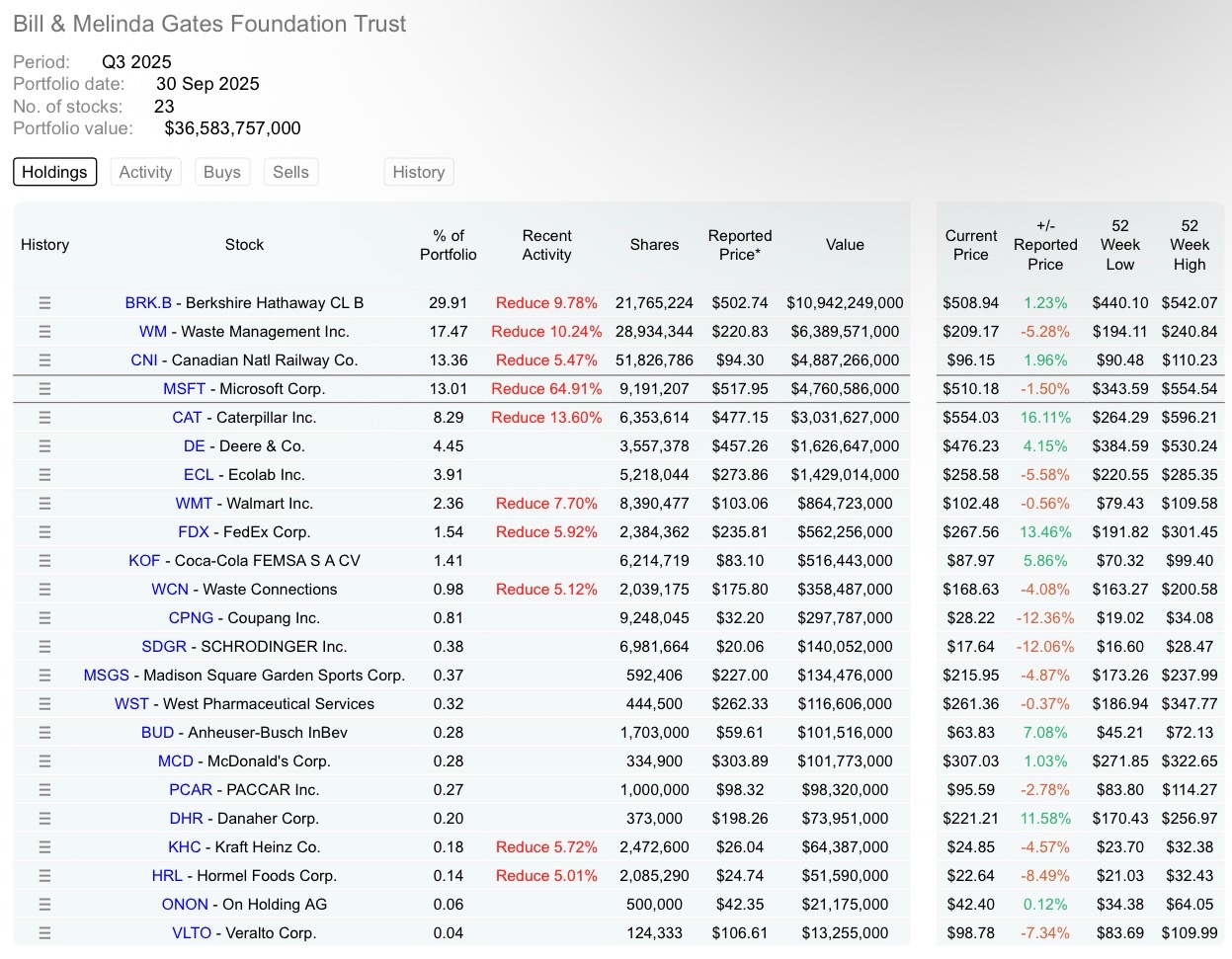
This is unusual behavior for a founder, and while stock sales can happen for routine reasons like diversification or liquidity, the scale and sudden timing raises questions. Investors do not normally overreact to sales because they often reflect personal circumstances instead of business insights. However, when the architect of the company steps away from more than half of his position without a stated plan for reallocating the capital, it creates uncertainty. Microsoft remains a strong company with world class execution, but caution is warranted until we understand whether or not this is the start of a deeper shift in Gates’s long term view towards his own company he created. Prudence, not panic, is the correct response.
Alphabet and Microsoft now sit at a fascinating crossroads. One tech titan is being validated by the greatest value investor of all time. Another is being partially abandoned by the founder who shaped its identity. Markets often misprice inflection points because they assume the future will resemble the past. Yet Buffett’s final major move suggests the center of value is changing, and only a few investors are recognizing it early. If history is any guide, the shift he is signaling is not just real, it is inevitable, and the market has not fully priced it in.

Stock Markets Sell-Off: Famous Investor Concerns and 3 Stocks To Hedge A Portfolio! (Source)
Stocks mentioned: $NVDA, $PLTR, $WM, $JNJ, $DUK
The market spent the past week reminding investors that speculation has consequences. Growth and high-risk names, which had been ripping higher for months, suddenly pulled back with force. What made the timing remarkable was that it happened immediately after famed investor Michael Burry publicly revealed that he was shorting tech, specifically Nvidia (NVDA) and Palantir (PLTR), the two most beloved symbols of the current AI-driven bull run. Nvidia represents the blue chip core of the AI ecosystem, while Palantir captures the more volatile, story-driven side of the sector. For newer investors, Burry is the same contrarian who shorted the housing market ahead of the 2007 to 2008 crash, the storyline that became the film “The Big Short.” His warning shot landed at the exact moment the market started to wobble, and for a moment, it looked like history might rhyme.
This time, Burry’s frustration goes far deeper than a single stock. He has argued that the entire tech sector is mispricing the depreciation of the chips they are buying, meaning companies may be overstating the longevity of their most expensive assets. In his view, this has inflated valuations beyond what fundamentals can justify. His criticism grew so pointed that he announced he would close Scion Capital Management and hinted on social media that he may simply be early again, just as he was before the housing collapse. Supporters argue that tech valuations are stretched and vulnerable. Critics push back, saying the AI demand curve is unlike anything seen before and that secular growth can support even elevated valuations. But either way, Burry’s timing was impossible to ignore, and the heavy selling across indexes showed that the market took his signal seriously.
Whether you side with Burry’s caution or the bulls’ conviction, one fact remains: portfolios concentrated in tech are exposed to violent swings, and this week proved how fast those swings can happen. That is why now is a smart moment to explore hedges that soften the blow of a sharp tech pullback without abandoning upside entirely. Below are three stocks that add stability, cash flow visibility, and defensive qualities that help balance portfolios during periods of tech volatility. Each operates in a part of the economy that moves independently of AI hype cycles, yet still offers steady long-term value.
Three hedging stocks to reduce tech concentration risk:
- Waste Management (WM): a leading waste and recycling company, in the industrial sector, that delivers consistent cash flow and strong pricing power. Its revenue depends on essential services, not market sentiment, which gives portfolios a stability anchor when growth stocks whipsaw.
- Johnson and Johnson (JNJ): a global healthcare leader with diversified pharmaceutical and medical device segments. Healthcare demand remains steady across economic cycles, and JNJ’s long dividend history can offset volatility from high beta tech names.
- Duke Energy (DUK): a major regulated utility that provides predictable earnings and reliable dividend income. Utilities are classic defensive plays that tend to hold up when investors rotate out of expensive growth names and into stability.
In the end, the market’s reaction to Burry’s short position revealed an uncomfortable truth that investors sometimes ignore. Tech can experience breathtaking drawdowns even in strong bull cycles, and the smartest portfolios are the ones built to absorb those shocks. Whether Burry is early again or simply wrong this time, the larger shift is already underway. Investors are waking up to the idea that diversification may be a necessity after markets have rallied so much. But sometimes moreso than being diversified, it's important to know when to take a bet against the market like Burry did. Most people don't know how to do this successfully, but that's exactly what we teach inside the Investment Club.
Whether markets go up or down doesn't matter to us, we know how to profit in any scenario. Similar to Burry, we use what is called put options to take advantage of downtrends in the market. Knowing how to use put options and time them correctly is the tricky part. But that's exactly what we teach our students. Our Investment Club Members have locked in gains of over 150% in a single day just this past week, while the markets were crashing! You can see some of their results below:
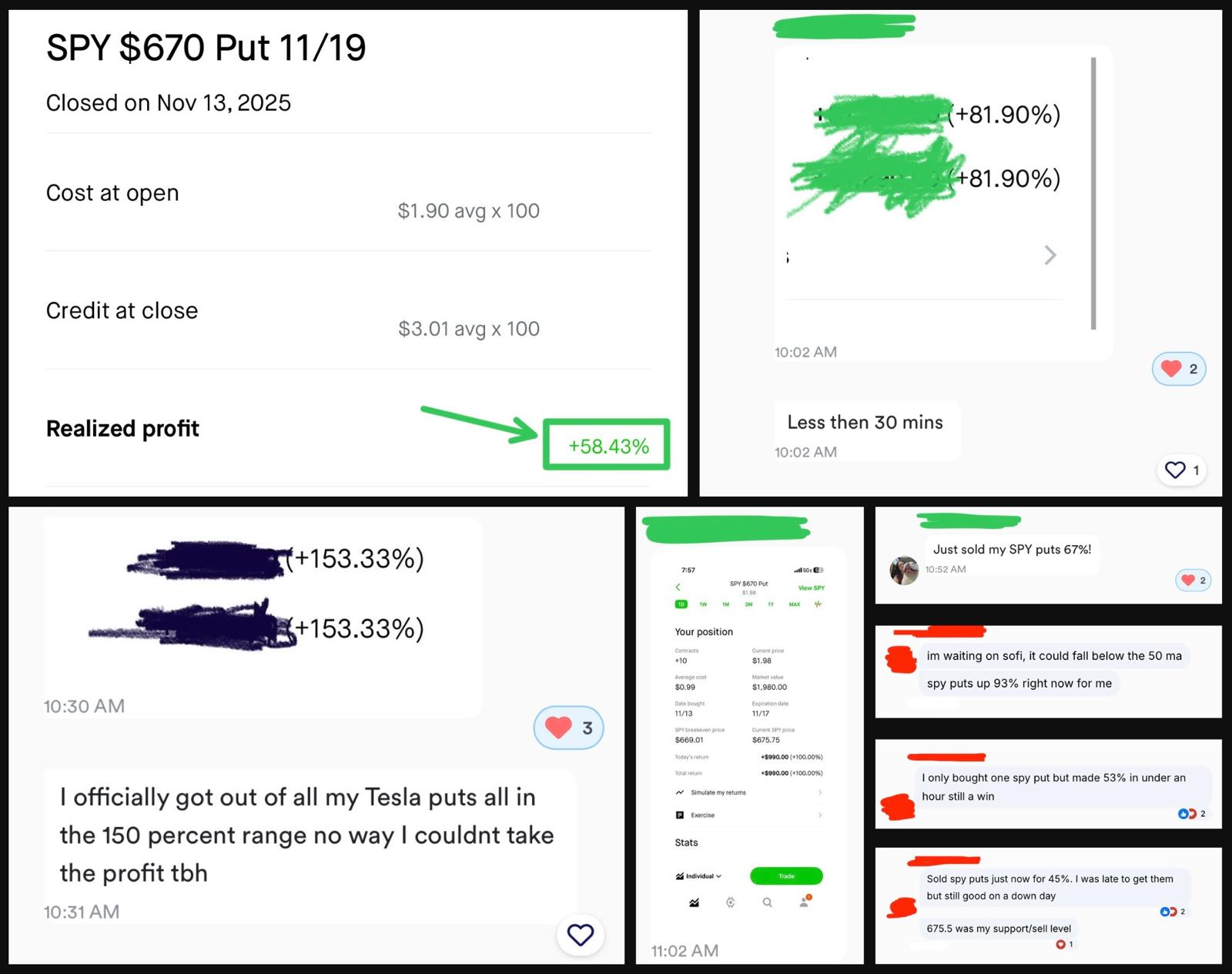
As you can see above, a lot of money was made in this "down market". It's incredible that students can make $1,000 with less than 1 hour's worth of work in a single day. So, if you're tired of not being able to successfully trade, or worse, losing money in this market, it's time for you to join the Investment Club and learn how options work!
If you're an Investment Club Member, we're putting out our new options plays for this next week, as well as the rest of the month and how we expect the markets to move going forward. [CLICK HERE] to log in and see our options portfolio and the strategies we are implementing now. If you're not an Investment Club Member yet, then [CLICK HERE] to join today with your $200 OFF newsletter subscriber discount. Spots are limited as we are not taking on many more students, so take advantage of this offer before it's no longer available.

Nvidia Earnings Are On Wednesday: Can The A.I. Rally Continue? (Source)
Stocks mentioned: $NVDA, $META, $AMZN, $TSM, $MSFT, $GOOG, $LRCX, $KLAC
For weeks, investors have obsessed over macro noise, tariffs, and the Fed. That framing is outdated. The real pivot point for markets now sits in a single earnings report. Despite strong results across the sector this season, several mega caps have sold off on great numbers, confusing casual observers and rattling sentiment. Beneath the volatility, one truth is becoming clear: the final verdict on whether tech finishes the year in a rally or a correction will be delivered by Nvidia (NVDA) this week on Wednesday. This is not an overstatement. With its size, its influence on capex cycles, and its central role in AI infrastructure, Nvidia’s earnings could either ignite momentum or drain what remains of investor confidence.
The macro backdrop only amplifies the stakes. Most big tech companies, from Meta (META) to Amazon (AMZN), just raised capital expenditure plans far beyond Wall Street expectations. That is not a trivial detail. It represents a structural shift toward sustained AI investment that will likely persist regardless of the political environment or short term policy noise. Nvidia sits at the center of it, and the bottleneck is supply, not demand. When the constraint flips from customers hesitating to customers begging for more chips, the traditional bear cases lose power.
Right now the bottleneck is painfully obvious. Nvidia has already asked Taiwan Semiconductor (TSM) to increase chip production by 50% next year, signaling demand that outweighs even the most optimistic Wall Street forecasts. That is not the behavior of a company worried about tariffs or expecting a slowdown. Meanwhile, every major platform company has told us they plan to ramp spending again in 2026. Historically, when Meta (META), Microsoft (MSFT), Amazon (AMZN), and Google (GOOG) increase capex, Nvidia beats and raises. This is because a large chunk of their capex goes directly to Nvidia to buy their chips. This is the whole reason they have been increasing their spend. If that pattern holds, this week’s report will show strength in data center revenue, resilient margins, and forward guidance that surprises to the upside. That said, the counterargument is simple: at nearly a $5 trillion valuation, expectations are so high that even a strong report might not be “strong enough.” But when a company sits at the center of the world’s most important compute upgrade cycle, it's hard to doubt their ability to beat expectations.
But it's not just Nvidia who will benefit if they're able to beat earnings. Several names are poised to benefit if Nvidia delivers the upside surprise we expect. These companies sit in the supply chain and the semiconductor manufacturing layer that expands alongside Nvidia’s growth curve.
Stocks Positioned to Benefit if Nvidia Beats:
- Taiwan Semiconductor (TSM): the world’s dominant advanced chip manufacturer, gains directly from Nvidia’s request for dramatically higher production volume. As more chips are ordered from Nvidia, that means Nvidia needs to place more orders with TSM to make said chips, hence increasing their revenue, and in turn increasing their share price.
- Lam Research (LRCX): a leading provider of wafer fabrication equipment, benefits as foundries, like TSM, expand production to meet AI chip demand.
- KLA Corporation (KLAC): a critical supplier of semiconductor process control tools, scales alongside the industry’s need for more precise, higher throughput manufacturing.
Nvidia’s earnings this week are more than another quarterly update. They represent a referendum on the entire AI investment cycle, the trajectory of mega cap capex, and the direction of the market into year end. If Nvidia beats and raises, the path forward is clear: the AI supercycle reaccelerates, bottlenecks ease through expanded supply, and the stocks levered to semiconductor manufacturing lead the next rally. If Nvidia disappoints, tech could drift into a deeper correction as sentiment unwinds. Given the evidence, the former scenario appears far more likely, and the market is still underpricing that outcome.

INSIDER STOCK TRADES FROM THE WEEK:
1. Beta Technologies (BETA) - Charles Davis, Director, bought roughly $97,000,000 of BETA for $32.98/share on Nov. 5, 2025, but it wasn't reported to the public until Nov. 7, 2025. (Source)

2. Monro (MNRO) - Carl Icahn, Director and 10% owner of the company, bought over $11,000,000 of MNRO at an average of $17.38/share starting on Nov. 5, 2025, but it was most recently reported to the public on Nov. 7, 2025. (Source)

3. Cheniere Energy (LNG) - Benjamin Moreland, Director, bought over $1,000,000 worth of LNG between $208.06-$208.76/share on Nov. 4, 2025, but it wasn't reported to the public until Nov. 5, 2025. (Source)

Over 2,000 people have already signed up for my FREE Masterclass video on how to unlock my exact strategies for finding winning stock/options trades! I'll share everything including how to find what Politicians and CEOs are buying. Don’t miss your chance to get in for FREE before spots fill up!

INFOGRAPHICS FOR THE WEEK:



CONTACT US: [email protected]
Responses