

TOP NEWS AFFECTING THE STOCK MARKET THIS WEEK:
Washington Is Quietly Becoming a Venture Capitalist: 3 Stocks They Could Take A Stake In Next! (Source)
Stocks mentioned: $LAC, $INTC, $ALB, $QS, $FCX
Conventional wisdom says markets decide winners. The recent surge in Lithium Americas (LAC) after the U.S. government confirmed it would take a direct equity stake tells a different story: Washington itself is now an investor. When policymakers identify a company as strategically essential, capital floods in. LAC’s 20% single-day jump was not just about lithium, it was about a new reality: state-backed equities are reshaping markets.
The macro thesis is straightforward. The United States faces supply chain choke points in critical resources like lithium, copper, and advanced batteries. China dominates processing, while other nations control most of the inputs needed for electrification and AI. Washington’s playbook is shifting from regulation to ownership, treating key commodities the same way it treated semiconductors when it took a stake in Intel (INTC). Investors who can spot where the government is most likely to take a stake in next are the ones who are positioned to profit massively off of these moves, just as we saw with LAC and INTC.
Here are three companies that could be next in line for a direct investment from the government:
- Albemarle (ALB): A leading global lithium producer based in the U.S. Because lithium has already been flagged as critical for national security, Albemarle is a logical candidate for further federal backing.
- QuantumScape (QS): A solid-state battery innovator. If Washington wants to accelerate breakthrough energy storage technologies domestically, an equity stake in QS would provide both funding and validation.
- Freeport-McMoRan (FCX): One of the largest copper miners in the world. Copper is essential for EVs, electrification, and grid upgrades. Securing domestic copper supply could easily become the next strategic priority.
Critics will argue that government equity stakes distort markets, reward political connections, and risk subsidizing inefficiency. That concern is valid. But supply chains for clean energy and advanced technology are not just economic assets, they are matters of national security. Just as highways, space, and semiconductors required government leadership, energy, metals, and electrification now demand the same.
The conclusion is clear. Washington is not just regulating industries, it is co-owning them. That shift compresses downside risk, reduces funding uncertainty, and re-rates valuations higher. Lithium Americas was the proof of concept. The real opportunity for investors is identifying the next wave of “state-backed equities” before the announcement hits. Albemarle, QuantumScape, and Freeport-McMoRan belong on that watchlist. Markets are underpricing this structural change, and the winners will be those who move first.
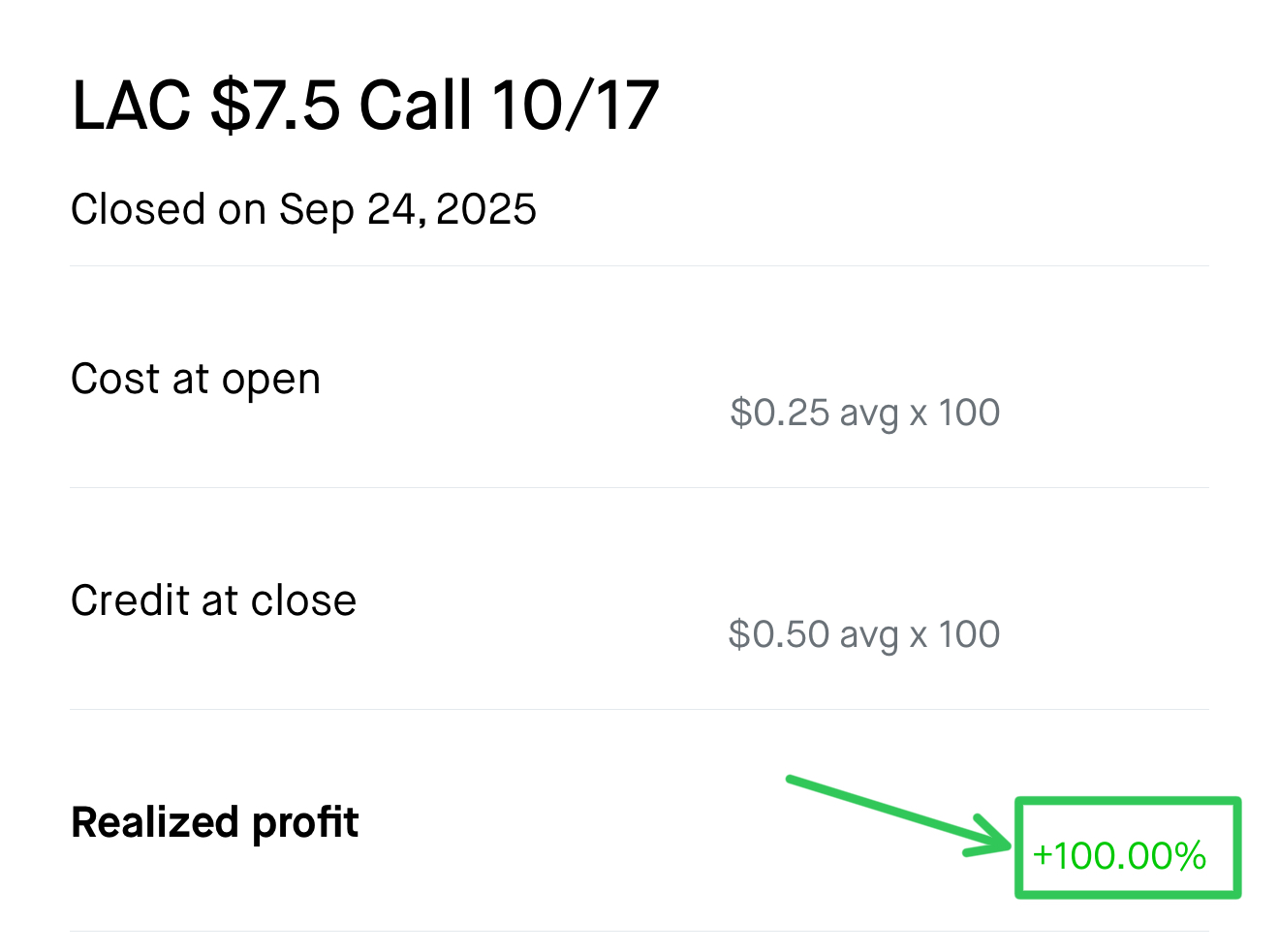
Just like our Intel trade from a couple weeks ago, we also scored big with Lithium Americas, where we got in before the massive run-up and locked in a 100% profit in just one day, as you can see below. But those trades are already behind us. Inside the Investment Club, we’ve just built a fresh batch of positions that we believe can benefit heading into the end of the year. If you’re already a Club Member, [CLICK HERE] to log in and see the new buys we made this week. Also, next week is going to be a HUGE week for the stock market, so make sure to attend the private LIVE streams with us, as we have some big trade setups prepared for next week! If you haven’t joined the Investment Club yet, and you’re tired of missing out on opportunities like these, now is the time to take action. As a subscriber to this newsletter, you get an exclusive [$200 OFF] when you join today. With that said, I'll see you in the Investment Club this week!
The Government Just Shut Down! Why We're Not Worried and 3 Stocks We're Eyeing To Buy... (Source)
Stocks mentioned: $PL, $PLAB, $CIFR
This past week, the government did something it hasn't done since 2018...it shut down! Yes, I know it sounds crazy, but even our government can close its doors. With Washington grinding to a halt, federal agencies closing, workers not working, and media headlines screaming "CRISIS!" you would think this is really bad for the stock market, but shockingly it isn't. Now although this sounds really bad and scary, data suggests it's not as bad as it may seem. Government shutdowns rarely inflict lasting damage on markets. Instead, they create dislocations, spark short-term volatility, and then fade into the background as corporate earnings, monetary policy, and global capital flows reassert themselves. This week’s shutdown is no different. It will stretch into the weekend unresolved, but for investors the real question is not “how bad can this get” but “what opportunities does this open.”
With the federal reserve opening the doors to rate cuts recently, this government shutdown news is actually a positive for the stock market because when there's a government shutdown, they don't release economic data and therefore the federal reserve is in the dark. This may sound bad, but in reality, it's good because that means the Fed needs to take a more cautious approach to the economy and that means that they will be more dovish, A.K.A. positive for the markets. If anything, this government shutdown has just guaranteed us another rate cut at the end of the month. As we've discussed in prior newsletters, rate cuts are historically bullish for the stock market. This is one reason why this government shutdown is actually beneficial for the markets.
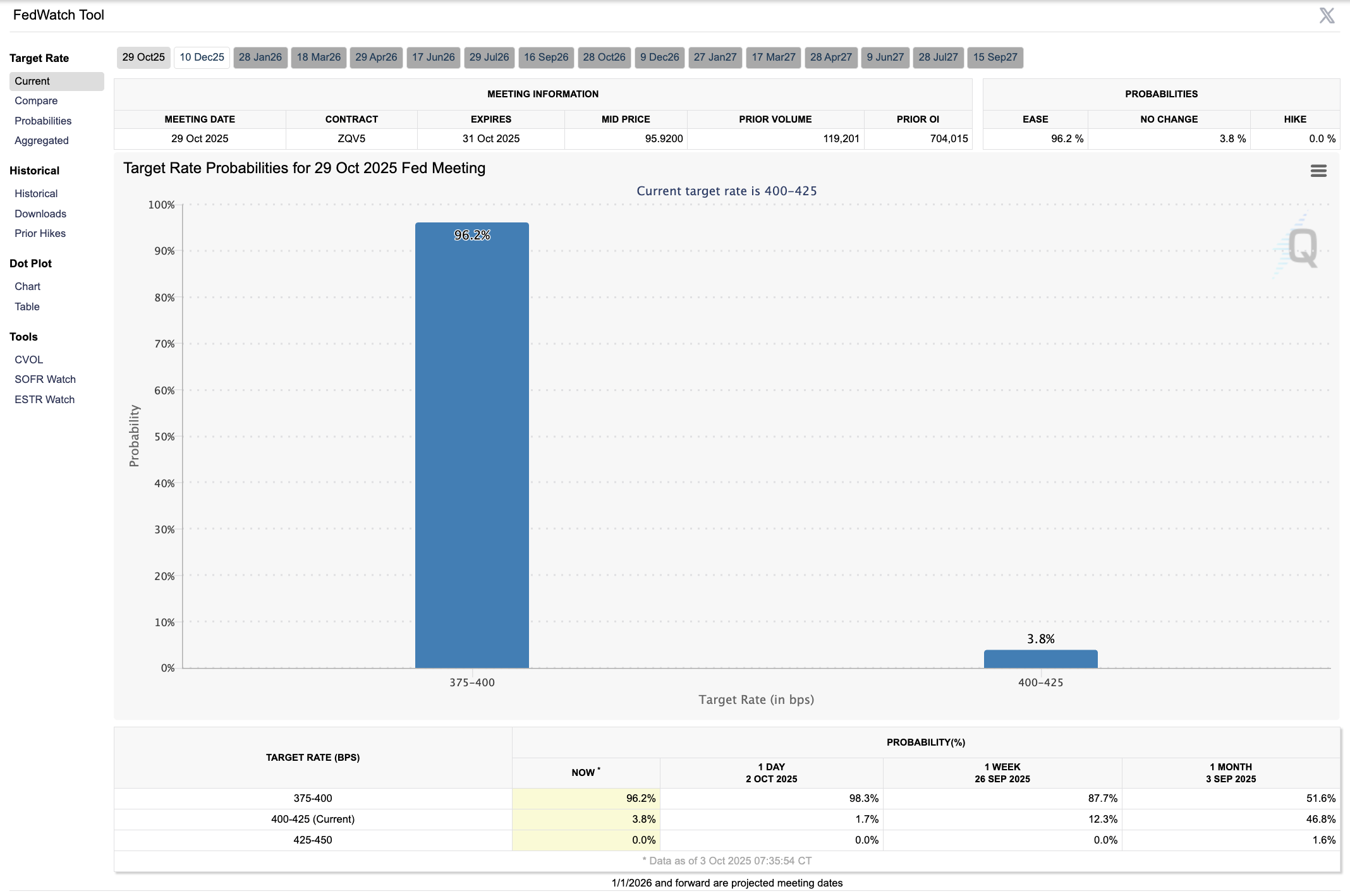
Pictured above is the "Fed Watch Tool". This shows us the odds for how much the Fed will cut rates during the next meeting. As you can see currently, since the government shutdown, the odds for a rate cut have jumped to over 96% in favor of a rate cut.
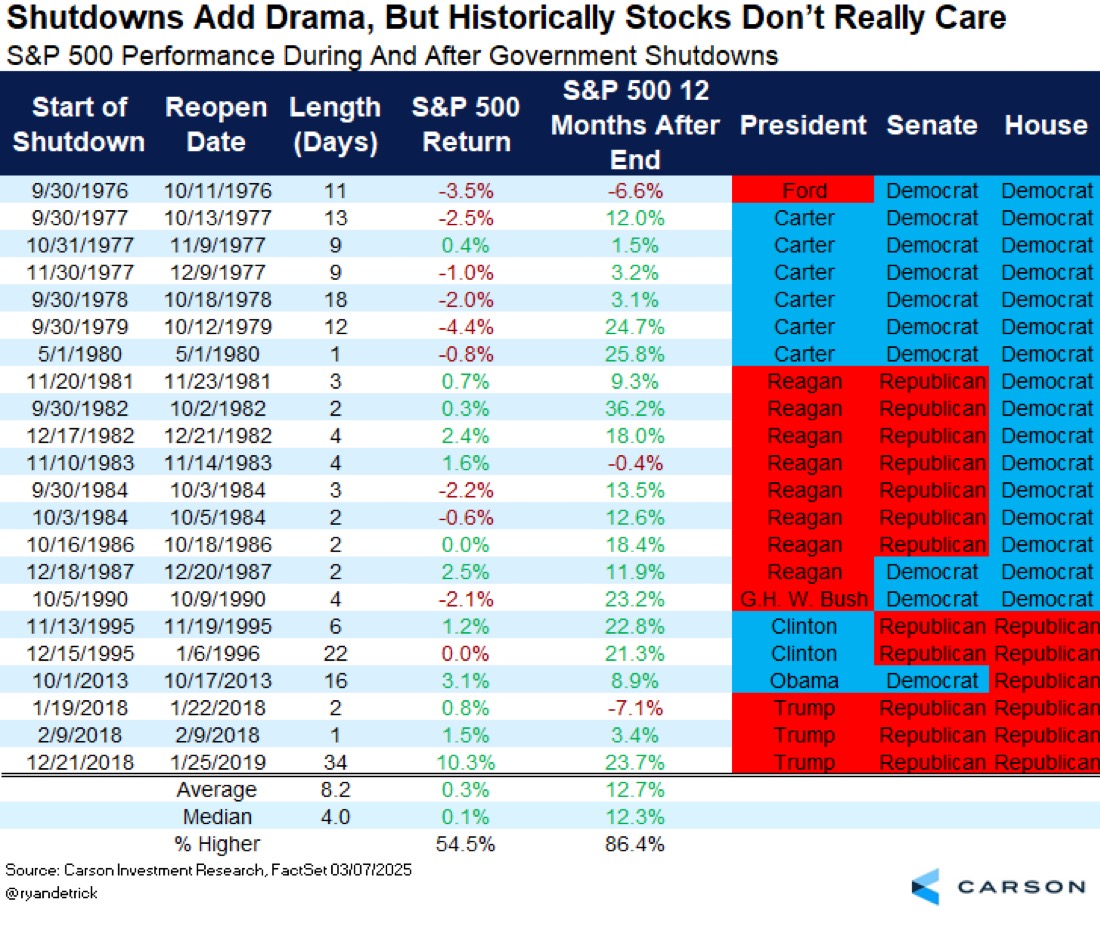
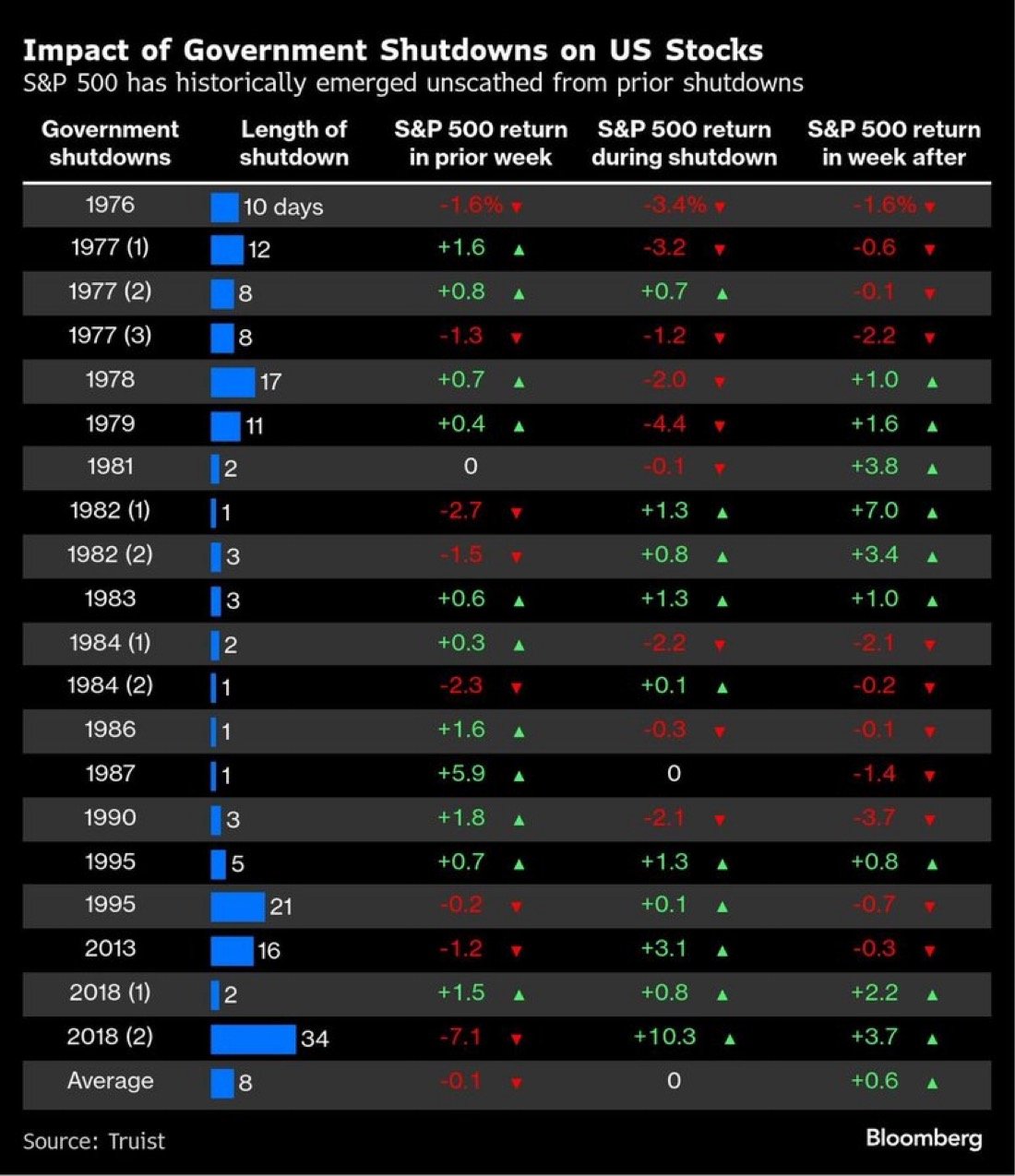
As we've preached to our Investment Club Members over the past couple of weeks, if the government did shut down, we would view it as a buying opportunity on any dips. As we saw, the market initially dipped on the news of this shutdown, and because of it, we bought a bunch of stocks this past week. The reason we did that is because beyond the benefit of more rate cuts, data suggests that markets will move higher post-shutdown. Over 86% of shutdowns during the past 50 years, end up with the stock market moving higher, on average, 12.7% over the following year, as can be seen in the data below:
For investors, the message is simple. We must ignore the "scary" media headlines of doom and gloom, and instead, focus on the hard data which tells us to stand strong in our holdings and buy any sizeable dip in the market. Because of the rate cutting environment, historically small caps stocks tend to perform extremely well. Here are 3 small-cap companies that we are eyeing to buy on any dip during this shutdown:
- Planet Labs (PL): A geospatial imaging company leveraging satellite data. As rates fall, access to capital improves, fueling its expansion into commercial and defense contracts. We believe this is one of the best high-risk, high-reward investments if you believe in the future of low altitude vehicles, and the future of space travel.
- Photronics (PLAB): A leader in photomask technology for semiconductors. Rate cuts reduce financing pressure, giving smaller semiconductor suppliers like PLAB room to scale as chip demand grows.
- Cipher Mining (CIFR): A Bitcoin mining company turning into a neo-cloud data center company. With the scaling of AI and data centers, smaller companies like CIFR, WULF, NBIS, IREN, and CRWV are poised to benefit from the large capital expenditure (capex) from the big tech companies. CIFR recently got a large deal with Google, which was massive for them. This deal serves as a potential catalyst for other mega-cap tech to invest in them in the future.
Skeptics will argue that this time is different. Political dysfunction is deeper, fiscal deficits are larger, and global risks are more acute. That view deserves consideration, but markets are forward-looking engines. They have digested worse shocks, from the eurozone crisis to pandemic shutdowns, and recovered faster than policymakers could act. The structural drivers of this market, from AI adoption to corporate buybacks to declining inflation, remain intact.
The conclusion is clear: government shutdowns are normally just political theater, not market-breaking events. If anything, they are volatility catalysts that create good entry points for buying stocks. With the Fed preparing to cut rates into year-end, the stage is set for equities to finish strong. Investors who panic and act with emotion over logic and data, risk underperforming in this market. We will continue to follow the fundamental analysis, technicals, and historical data. The winners will be those who treat this “crisis” as an opportunity. That's why we are making changes to our stock and option portfolios so we can fully capitalize in this volatile market environment.
"Super Investor" Spotlight: Li Lu, the “Chinese Warren Buffett” (Source)
Stocks mentioned: $BAC, $PDD, $GOOGL, $BRK.B, $GOOG, $EWBC, $OXY, $SOC, $AAPL
On this week’s edition of "Super Investor" Spotlight, we’re diving into Himalaya Capital's Li Lu, a man often referred to as, “The Chinese Warren Buffett.” He earned that nickname because of his disciplined value-investing approach and his close ties to Buffett, who not only praised him publicly but also entrusted him with managing part of the Buffett family’s fortune through Himalaya Capital. Since founding the firm in 1998, Li Lu has reportedly delivered nearly 30% annualized returns. A track record that puts him in the highest tier of "Super Investors". What makes his strategy so compelling is not just performance, but the clarity of conviction behind it. Thanks to quarterly SEC 13F filings, which reveal the stock holdings of large money managers, we get a front-row seat to study how Li Lu is deploying his capital today. And what we see is a portfolio that is anything but ordinary: highly concentrated, deeply researched, and built to withstand economic cycles.
Here’s a full breakdown of Himalaya Capital’s stock portfolio:
- Bank of America (BAC) – 18.36%: Li Lu’s single largest holding, showing enormous conviction in the U.S. banking sector. Bank of America remains one of the most systemically important financial institutions in the world.
- PinDuoDuo (PDD) - 17.93%: A fast-growing Chinese e-commerce platform focused on group buying and deep discounts in lower-tier cities. This is a new buy for Li Lu and he trimmed BAC to buy it. Clearly he wants some exposure to Chinese tech. If we had to invest in Chinese tech, we would prefer Alibaba (BABA) or Baidu (BIDU).
- Alphabet (GOOGL) – 16.67%: A dominant force in search, AI, and cloud. This stake highlights Li Lu’s recognition of tech platforms as durable cash-flow machines.
- Berkshire Hathaway (BRK.B) – 16.22%: A nod to his mentor Buffett, this position provides diversification across insurance, energy, and Apple through Berkshire’s wide-ranging empire.
- Alphabet (GOOG) - 16.17%: Another class of Alphabet shares (non-voting class), giving him dual exposure to the same economic engine.
- East West Bancorp (EWBC) – 10.43%: A niche but strategic regional bank with deep ties to Asian-American communities and businesses, offering exposure to a unique financial ecosystem.
- Occidental Petroleum (OXY) – 2.29%: Energy exposure with a Buffett overlap, aligning Himalaya with the long-term thesis that oil remains critical despite the energy transition.
- Sable Offshore (SOC) - 1.10%: A micro position in an oil & gas exploration firm, likely a small high‐beta play or speculative tilt.
- Apple (AAPL) – 0.84%: One of the most consistent tech companies of the last decade, still delivering consistent free cash flow and ecosystem lock-in.
The headline here is the sheer concentration: over 80% of Himalaya Capital is locked into just five names. This level of concentration is rare and reflects a Buffett-style belief that true opportunities are scarce but worth betting heavily on when found. The conclusion is unmistakable. Li Lu and Himalaya Capital are sending a message of discipline and conviction: concentrate on a handful of world-class companies, ride through volatility, and trust that durable franchises will outlast cycles. For investors today, the real takeaway is not to mirror his portfolio trade-for-trade, but to recognize the power of conviction, patience, and aligning with structural winners. Few embody this as well as Li Lu and his mentor, Warren Buffett.

INSIDER & POLITICIAN STOCK TRADES FROM THE WEEK:
1. United States Antimony Corp. (UAMY) - Gary Evans, CEO and Chairman of the board, bought ~$600,000 of UAMY stock on Sep. 26, 2025, but it wasn't reported to the public until Sep. 30, 2025. (Source)

2. Intuitive Surgical (ISRG) - Markwayne Mullin, Oklahoma Senator (R), bought between $50,001-$100,000 of ISRG on Sep. 24, 2025, but it wasn't reported to the public until Oct. 1, 2025 (Source)

3. Opendoor Technologies, Inc. (OPEN) - Cleo Fields, U.S. Rep in Louisiana, bought up to $15,000 OPEN stock on Sep. 19, 2025, but it was most recently reported to the public on Oct. 1, 2025. (Source)

Over 2,000 people have already signed up for my FREE Masterclass video on how to unlock my exact strategies for finding winning stock/options trades! I'll share everything including how to find what Politicians and CEOs are buying. Don’t miss your chance to get in for FREE before spots fill up!

INFOGRAPHICS FOR THE WEEK:



CONTACT US: [email protected]
Responses