TOP NEWS AFFECTING THE STOCK MARKET THIS WEEK:
This Week Is Make Or Break For The Stock Market: Why I’m Calling This the Most Pivotal Week of 2026! (Source)
Stocks Mentioned: $AMKR, $GOOG, $MSFT, $INTC, $AMZN
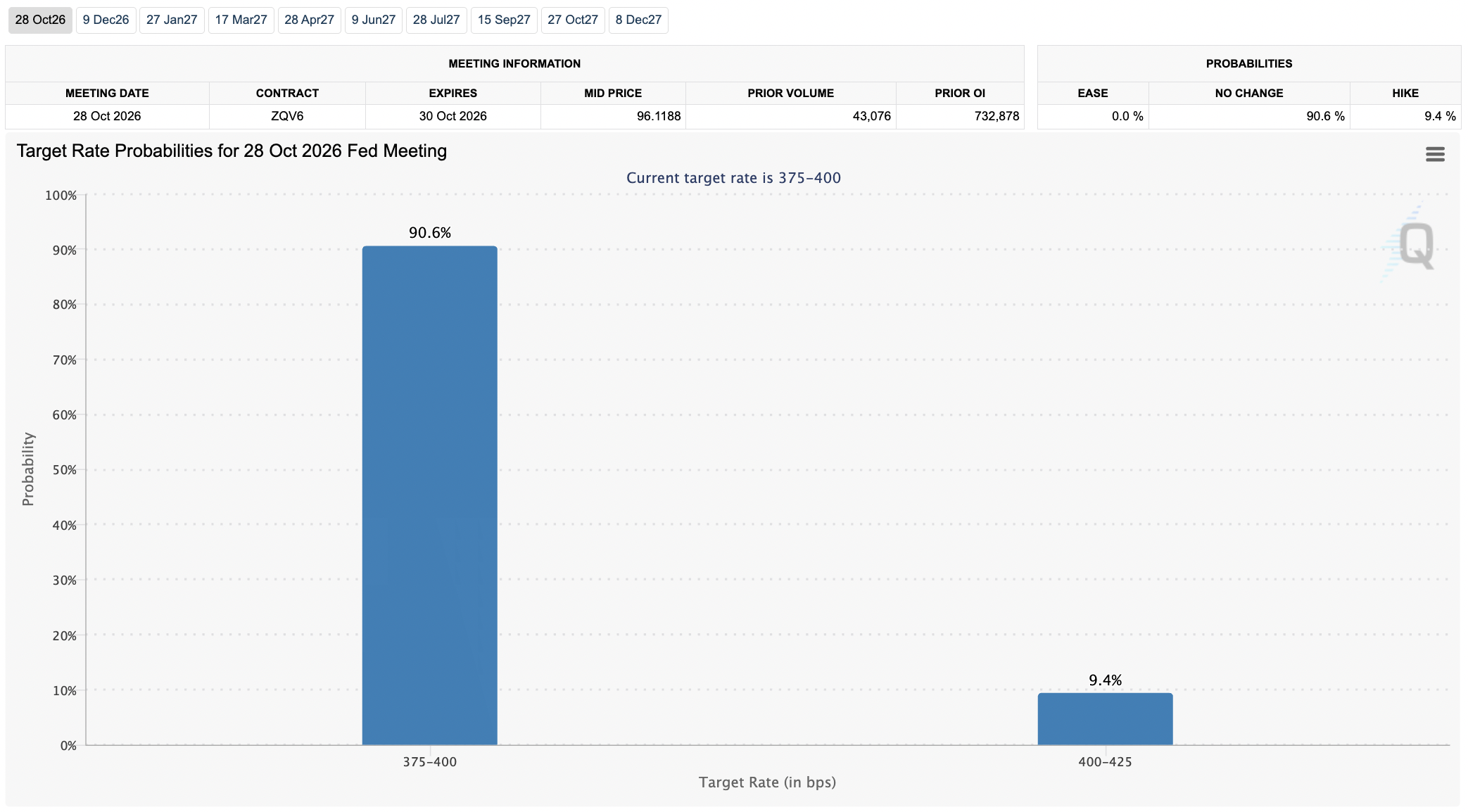
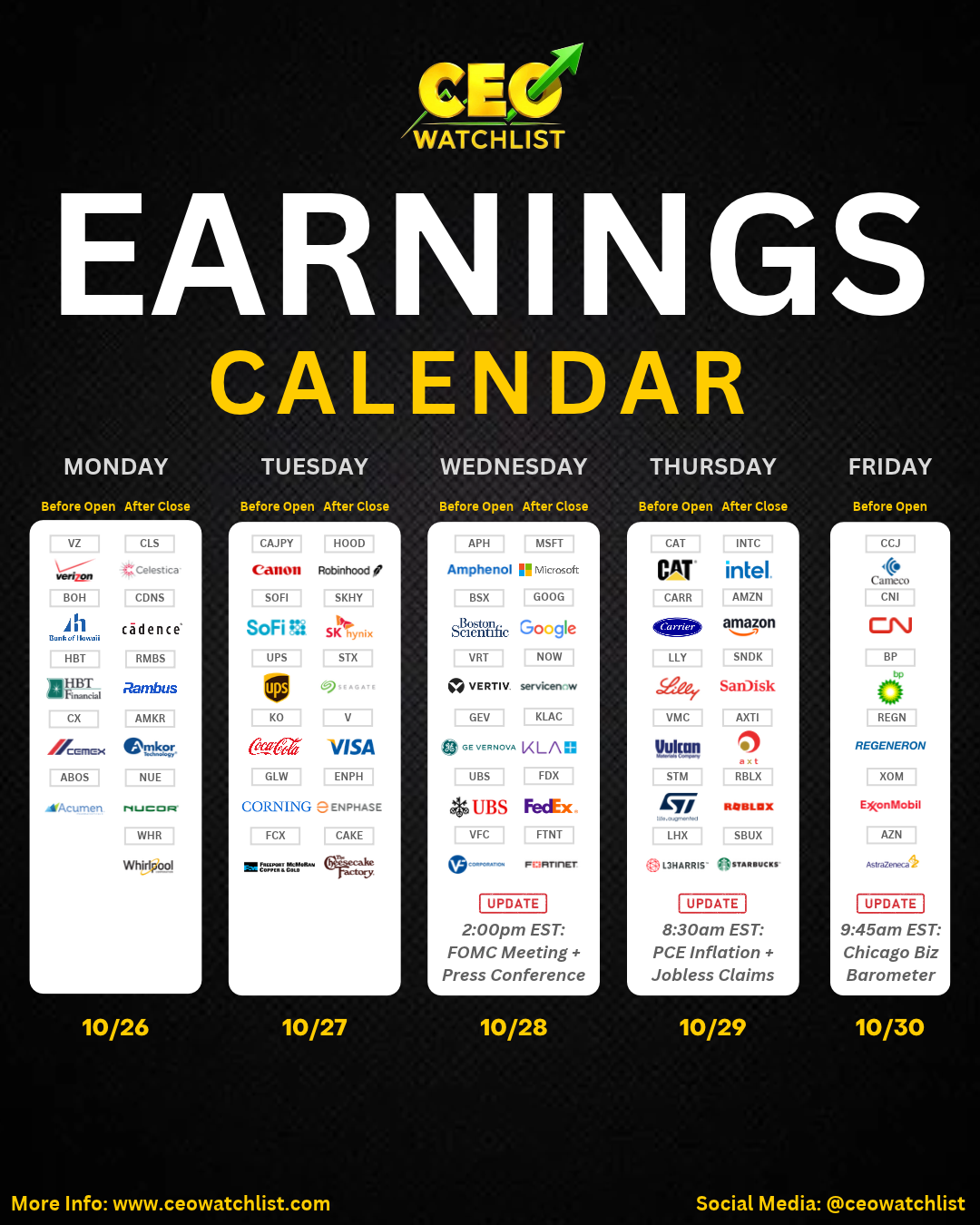
This week is going to decide whether or not stocks rally into the end of the year, or crash hard. Not only do we have the largest companies in the world reporting earnings, but we may have the most consequential economic decision of 2026 this Wednesday. What is this "economic decision" you may ask? The decision is around whether or not The Federal Reserve will hike or pause interest rates. To keep it simple, if they decide to hike rates, that is very bad for stocks while a pause would be more favorable for stocks. Although that will move the markets, the more important thing we are paying attention to is their guidance on whether they are expecting more or less rate hikes in the future. Remember, the stock market is forward looking, so it cares about what is going to happen in the next 6-12 months, not so much what is happening in the present and what has happened in the past. Whether you realize it or not, interest rates and these decisions in particular move the markets dramatically. That's why it's so important to pay attention to this event at 2:00pm EST this Wednesday, October 28. As of October 23, traders put the odds at about 90.6% for a hold and 9.4% for a hike, with roughly a 74.2% chance of a hike at the December meeting.
The Fed meeting is extremely important but so is earnings season, which is why I'm paying such close attention to these 5 stocks that are reporting this week:
- Amkor Technology (AMKR) - The world’s largest U.S.-headquartered company that packages and tests computer chips. If TSM bakes the chips, Amkor wraps them, tests them and makes sure they’re ready to ship. It reports after the close on Monday, October 26, with the call at 5:00 p.m. Eastern. Amkor guided for $1.95 billion to $2.05 billion in revenue and $0.72 to $0.82 per share, and analysts are sitting right in the middle at $0.78 on $2.04 billion. Management expects computing revenue to jump nearly 30% from last quarter, driven by AI data centers. Last quarter the stock fell 6.5% after the report because it had already run up about 210%. But this time the stock is down over 50% from its highs, so a lot of negativity is baked into this name and makes the risk-reward attractive for us here.
- Alphabet (GOOG) - Google’s parent company, home to Search, YouTube and Google Cloud. It reports after the close on Wednesday, October 28, with the call at 4:30 p.m. Eastern. Analysts expect $127.4 billion to $131.8 billion in revenue and $3.04 to $3.10 per share, up from $119.8 billion in revenue last quarter. The big story is spending. Last quarter Alphabet raised its 2026 spending plan to $195 billion to $205 billion, and free cash flow went negative for the first time ever at minus $5.9 billion. I’ll be watching whether Google Cloud’s growth is strong enough to justify that bill.
- Microsoft (MSFT) - The software giant behind Windows, Office and the Azure cloud. It also reports after the close on Wednesday, October 28. Microsoft guided for about $90.4 billion in revenue and Azure growth of around 45%, up from 43% last quarter. It expects $50 billion in capital spending this quarter alone. Starting with this report, Microsoft will disclose Azure’s actual dollar revenue instead of just its growth rate, so we’ll finally see the full size of the business. I’ll be watching whether Azure beats that 45% guide.
- Intel (INTC) - The chipmaker in the middle of one of the biggest turnaround stories in tech. It reports after the close on Thursday, October 29, with the call at 5:00 p.m. Eastern. Intel guided for $15.8 billion to $16.8 billion in revenue and $0.38 per share, and analysts expect $0.37 on $16.40 billion. Last quarter Intel crushed expectations with $16.13 billion in revenue against a $14.40 billion estimate. The stock has cooled off lately and if they can deliver a similar beat as last time, this thing could easily run 20%.
- Amazon (AMZN) - The online retail king and owner of AWS, the biggest cloud business in the world. It reports after the close on Thursday, October 29, with the call at 5:00 p.m. Eastern. There's not much to say here with Amazon besides that we think it offers one of the best opportunities in the market in terms of stability. Amazon has been consolidating for 5 years now, and we believe it is primed for a breakout. It trades at historically low multiples, it's AWS growth is oustanding, and its in almost every bullish sector you can imagine. We think this name can double in value in the coming years, and that's rare to say for a multi-trillion dollar company.
With the Fed rate decision and these huge earnings, this next week is going to be extremely volatile for the markets. But there's one critical variable that historically moves markets this time of year, and that is the end to the midterm elections. I have covered many times in this newsletter the volatility surrounding midterm election years. I've explained it a multitude of times and shared many datasets explaning how stocks tend to pull back leading into the midterm elections in November. For reference, here is one of the main charts that I've shared with you in the past:
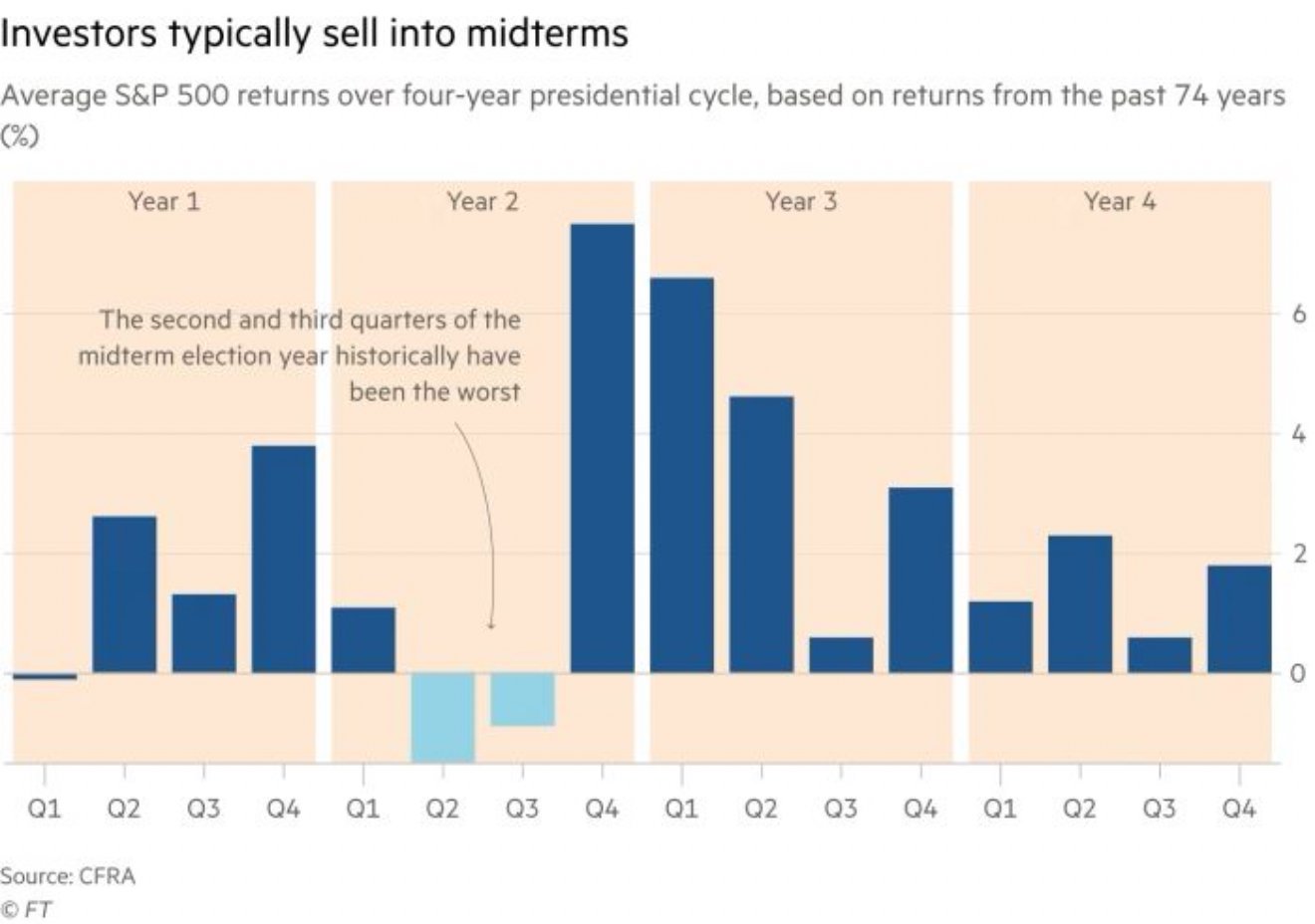
The good news is midterm elections will end 6 days following the Fed decision. Now historically, markets tend to do well post midterm election, but leading into it, markets tend to pull back. So the bad news is we still have a week that the markets historically have shown a lot of volatility. With this in mind, we have structured our stock and options portfolios accordingly. If you're a CEO Watchlist Investment Club member, [CLICK HERE] to log in and see our gameplan for the coming weeks. We have a list of a dozen+ stocks to buy, so make sure to have your notifications turned on in the app to not miss a thing! If you are NOT a CEO Watchlist Investment Club member, and you want to get in before these critical events, then [CLICK HERE] to claim your $200 OFF discount code (it will automatically be applied). With that being said, it's going to be a crazy couple of weeks ahead, with a lot of changes to our stock portfolios, so keep an eye out for our research and alerts and I'll see you in The Club soon!
The Boring Trade: Why I’m Paying Attention to the Stocks Nobody Talks About!!! (Source)
Stocks Mentioned: $WCN, $HII, $COST, $LLY, $PG
Let’s be honest about who we are: we’re growth investors. When we buy a fast-growing tech stock, we’re not really paying for this year’s profits. We’re paying for the much bigger profits we think the company will earn five or ten years from now, kind of like buying an orchard full of saplings because you know what those trees will produce once they’re grown. That’s why growth stocks often trade at a high P/E ratio (price-to-earnings, which is just how many dollars we pay for every $1 of yearly profit). The catch is that a high price only holds up as long as everyone keeps believing in the future harvest. This week that belief cracked. On Thursday the Nasdaq dropped 2.6%, its worst day since early June, as worries about whether all that AI spending will ever pay off spread across chips and the Magnificent 7, leaving the index roughly 5.8% below its October 6 high. Meanwhile the Dow, which is packed with older, steadier businesses, finished basically flat. That gap is the whole story and exactly why it's important during volatile times to shield our portfolio with "hedges", which is just a fancy word for insurance (a position that’s supposed to hold up when the rest of the portfolio is getting hit).
When we go hunting for a hedge, we keep coming back to 3 sectors: certain industrials, healthcare, and consumer staples. The thread connecting them is what Wall Street calls “defensive” demand, meaning people keep paying for these things no matter what the economy or the stock market is doing. Here’s the easiest way we’ve found to picture it. When money gets tight, you might not buy the newest iPhone, but you don’t cancel trash pickup, your prescription, or toilet paper. Consumer staples are those everyday essentials (toothpaste, diapers, groceries). Healthcare is medicine and treatment, which people need in good times and bad. And when we say “certain” industrials, we mean the ones that run on long-term contracts or essential services, like waste haulers and defense shipbuilders, not the factory-equipment makers that boom and bust with the economy. This isn’t some brand-new idea we cooked up, either. Money has been rotating into these corners on and off all year, and during the chip sell-off on October 15 it was healthcare stocks that led the S&P 500 back into positive territory while bonds rallied.
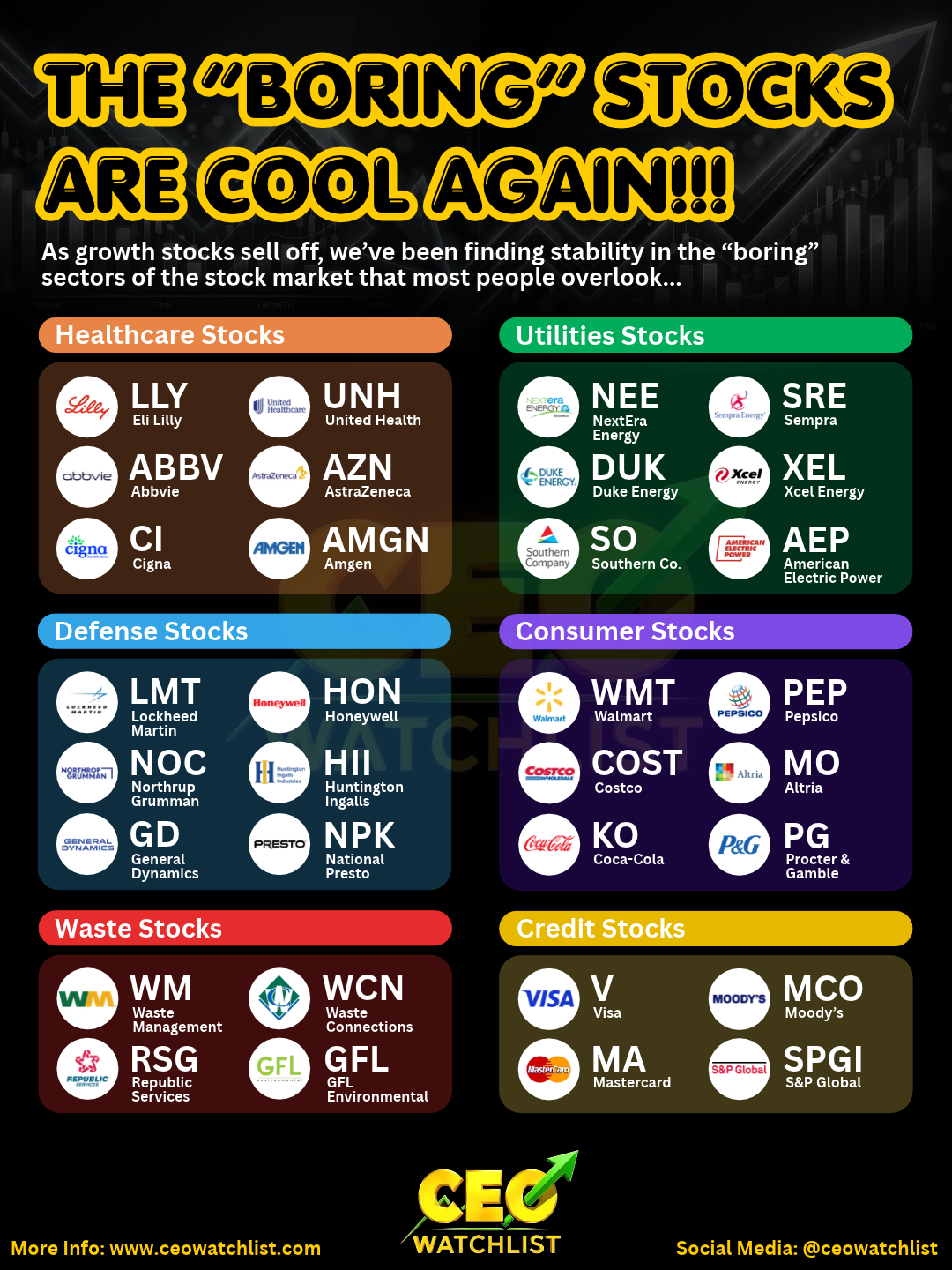
So which specific companies are we watching? Here are the 5 we like as a hedge right now, plus what each one actually does and why it tends to hold its ground when the market gets nervous:
- Waste Connections (WCN) - WCN picks up trash, runs landfills, and handles recycling across North America, often in smaller markets where it’s the main (or only) hauler in town. Trash doesn’t stop in a recession, and new landfills are incredibly hard to get permitted, which gives existing operators a moat (a built-in advantage competitors can’t easily copy). On October 21 the company reported Q3 revenue of $2.638 billion, up from $2.458 billion a year ago, raised its full-year outlook, and bumped its dividend 10%.
- Huntington Ingalls Industries (HII) - HII is the largest military shipbuilder in the U.S., building aircraft carriers, submarines, and destroyers for the Navy. Its revenue comes from multi-year government contracts, which creates a huge backlog (orders already signed, like a restaurant booked solid for years). In Q2 it posted $3.4 billion in sales, grew shipbuilding revenue 16%, landed $6.7 billion in new awards, and raised its 2026 shipbuilding revenue guidance to $10.2 to $10.4 billion. None of that depends on consumer spending or AI budgets.
- Costco Wholesale (COST) - Costco makes much of its profit from membership fees, not from marking up what’s on the shelves. As of its fiscal Q2 report in March, it had 82.1 million paid members, a renewal rate around 89.7%, and membership fee income up 13.6%. When budgets get tight, people tend to shift more of their spending toward bulk value, not less, which is why this stock acts like a staple even though it’s a retailer.
- Eli Lilly (LLY) - Lilly is the pharma giant behind the leading GLP-1 diabetes and weight-loss drugs. Patients don’t stop taking medication because the Nasdaq had a bad week, and Lilly’s growth story has nothing to do with data center spending. Last quarter it reported $23.0 billion in revenue against estimates of about $20.5 billion, and it reports again on October 29. This is probably the riskiest name of the 5, but offers a nice blend of stability and growth for a hedge position.
- Procter & Gamble (PG) - P&G owns Tide, Pampers, Gillette, Charmin, Crest, and a long list of other brands people buy on autopilot. On October 22 it reported quarterly sales of $23.3 billion, with sales volume up and growth in all 10 of its product categories. It has also raised its dividend for 70 straight years, which tells us a lot about how reliable that cash machine has been.
What ties these 5 together is simple: their profits show up on schedule. That matters a lot right now because of how interest rates work. A dollar we get today is worth more than a dollar promised ten years from now, and the higher rates go, the bigger that gap gets. Growth stocks are mostly made of those far-off dollars, so when rates climb (Treasury yields pushed above 5% during this month’s selloff), their value shrinks fastest. These 5 companies, on the other hand, are mostly made of near-term dollars: trash fees, Navy contract payments, membership renewals, prescription refills, and diaper restocks. Most of them also have pricing power, meaning they can raise prices without losing many customers, which helps when costs are rising. It’s a seesaw. The problem is that if markets turn around post midterm election, and growth takes center stage yet again, these stocks could fall out of favor and have money rotate out of them, back into the high-growth tech names. This is why a balanced and diversified portfolio is important during volatile markets. Like any insurance policy, a hedge has a cost, and that cost is giving up some upside when things go well.
Here’s where we land. We still believe growth tech is where the biggest long-term wins come from, and we’re not walking away from it. But this month’s AI selloff is a reminder that expensive stocks are priced on confidence, and confidence can disappear overnight. That’s why we like having some "boring" in the mix. Industrials with locked-in contracts, healthcare companies selling medicine people need, and consumer staples selling stuff people buy on autopilot all tend to keep earning when the market is panicking. Waste Connections, Huntington Ingalls, Costco, Eli Lilly, and Procter & Gamble are some of our favorite examples of that idea right now: trash, warships, memberships, medicine, and toilet paper. Not exciting, and that’s exactly the point. They come with real trade-offs, including premium valuations on a couple of them and the near certainty that they’ll lag if tech rips higher again. For us, that’s an acceptable price for a portfolio that can take a punch. As always, this is how we’re thinking about our own positioning, not a recommendation for anyone else’s. And if you like these ideas, we've put together an infographic on a dozen other names you may want to research as well down below:
"Super Investor" Spotlight: Chris Hohn (Source)
Stocks Mentioned: $GE, $V, $MCO, $SPGI, $CP, $GOOG
Most people in the investing world know Chris Hohn as the founder of TCI Fund Management, one of the most successful and concentrated hedge funds on the planet. He’s built a reputation as a long-term activist investor who takes enormous positions in a small number of high-quality businesses and holds them for years. Hohn is also famous for pairing that investing success with massive philanthropy through his foundation. Like every major institutional player, TCI is required to disclose its public holdings every quarter through a 13F filing. As a sidenote for newer readers, a “Super Investor” is just our term for a major institutional player, think massive corporations, elite hedge funds, or billionaire-run funds, whose quarterly stock disclosures give the rest of us a rare window into where the world’s smartest capital is flowing. Hohn sits right at the very top of that list, and his filing is one of the most closely watched because of just how concentrated and conviction-driven it is.
Hohn’s reputation is built on extreme concentration in businesses he considers to have unbreakable competitive moats. His whole philosophy centers on owning a tiny handful of what he calls high-quality, predictable, cash-generative companies, often with monopoly or duopoly characteristics, and then holding them for the very long haul. That shows up loud and clear in this portfolio. It’s one of the most concentrated books we cover, with just a few names making up the overwhelming majority of the entire fund. What stands out immediately is how much of the portfolio sits in a single position and how heavily the whole book leans into infrastructure, payments, and financial data.
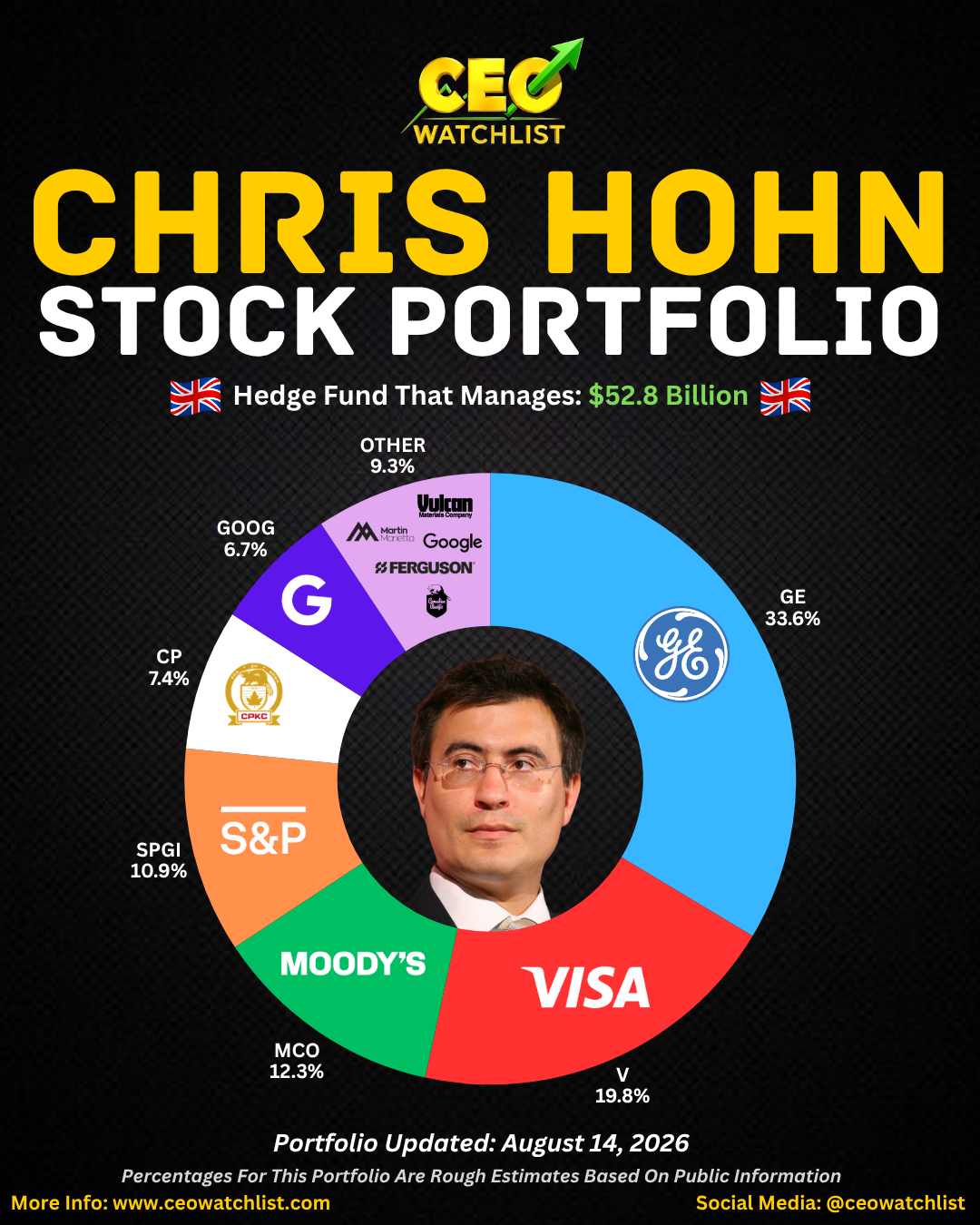
Here’s a full breakdown of Chris Hohn’s entire public stock portfolio:
- GE Aerospace (GE) – 33.6%
- Visa (V) – 19.8%
- Moody’s (MCO) – 12.3%
- S&P Global (SPGI) – 10.9%
- Canadian Pacific Kansas City (CP) – 7.4%
- Alphabet (GOOG) – 6.7%
- Ferrovial SE (FER) - 2.7%
- Canadian National (CN) - 2.1%
- Alphabet (GOOGL) - 1.7%
- Martin Marietta (MLM) - 1.4%
- Vulcan Materials (VMC) - 1.4%
The headline here is GE Aerospace, which alone makes up more than a third of the entire portfolio. That kind of position size in a single name is almost unheard of outside of a manager like Hohn, and it reflects his deep conviction in the aerospace engine business, which benefits from decades-long service contracts and a dominant position in jet engines. Right behind it sits Visa just under 20%, and when you add in the wide-moat financial data duopoly of Moody’s and S&P Global, you can see the clear theme running through this book. These are toll-booth businesses with enormous pricing power, exactly the kind of predictable compounders Hohn has always gravitated toward.
The rest of the portfolio stays true to that same quality-infrastructure mold. Canadian Pacific Kansas City gives him exposure to the irreplaceable North American rail network, another business with a massive moat and nearly impossible to replicate. Alphabet rounds out the named positions, adding a dominant technology and search platform to the mix. Even the “Other” bucket, which includes names like Ferguson, fits the pattern of a durable, high-return businesses. We will continue to monitor Chris Hohn’s portfolio, as well as dozens of other hedge funds and politicians and will continue to report on them every week to you all with updates on any new stock buys they make.
INSIDER STOCK TRADES FROM THE WEEK:
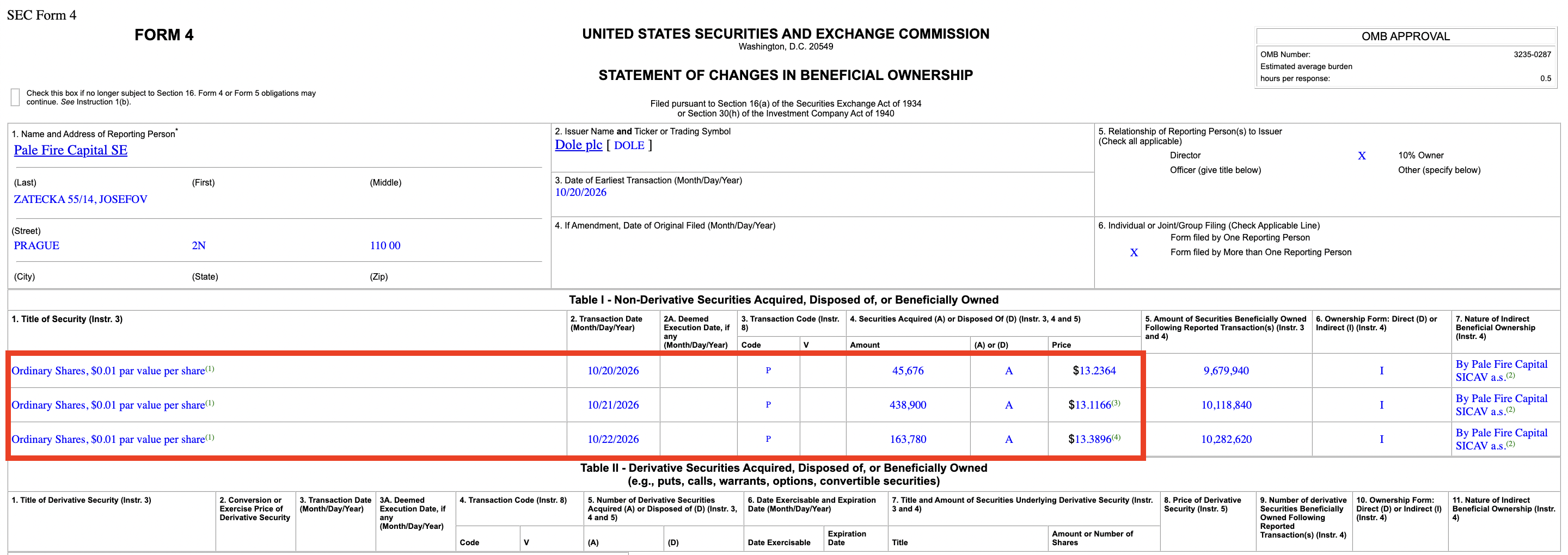
1. Dole (DOLE) - Pale Fire Capital (10% owner) bought over $8,550,000 of DOLE at an average price of $13.19/share on October 20, 2026, but it wasn't reported to the public until October 22, 2026. (Source)
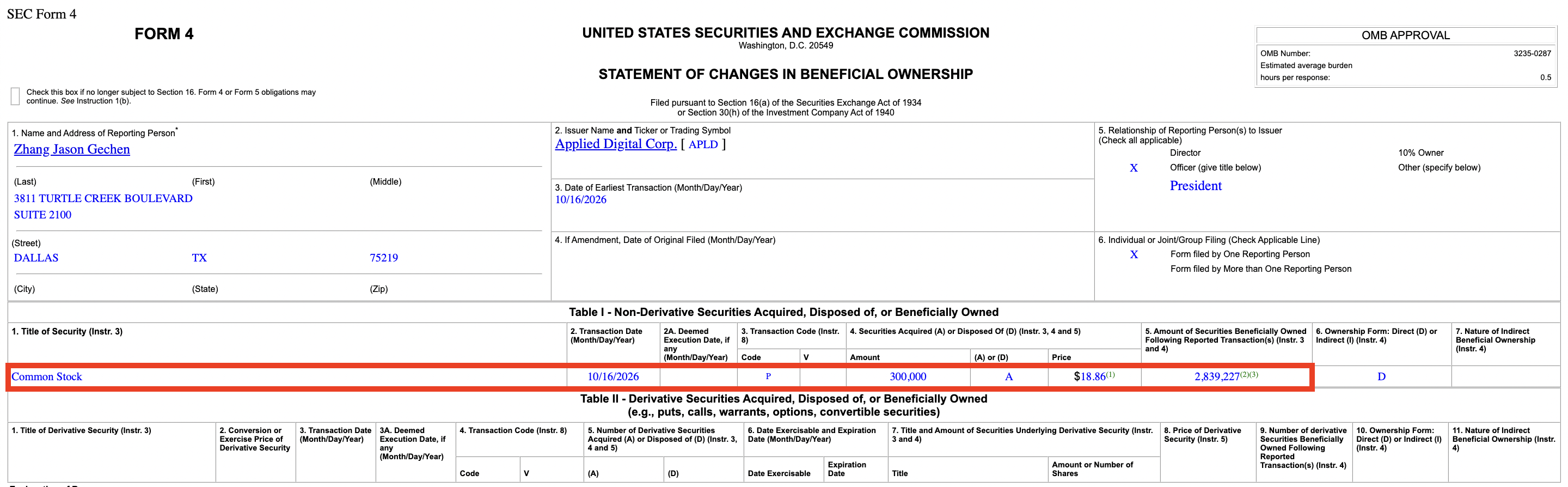
2. Applied Digital (APLD) - Jason Zhang (President) bought roughly $5,600,000 worth of APLD at an average price of $18.86/share on October 16, 2026, but it wasn't reported to the public until October 19, 2026. (Source)
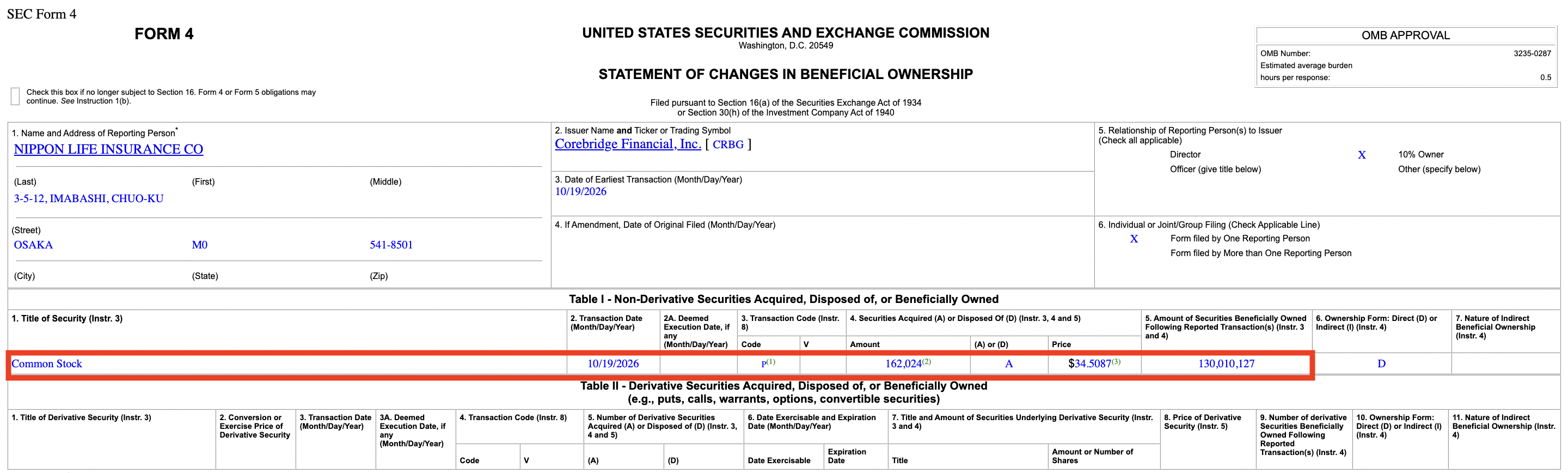
3. Corebridge Financial (CRBG) - Nippon Life Insurance (10% Owner) bought over $5,590,000 of CRBG at an average price of $34.51/share on October 19, 2026, but it wasn't reported to the public until October 21, 2026. (Source)
Over 2,000 people have already signed up for my FREE Masterclass video on how to unlock my exact strategies for finding winning stock/options trades! I'll share everything including how to find what Politicians and CEOs are buying. Don’t miss your chance to get in for FREE before spots fill up!

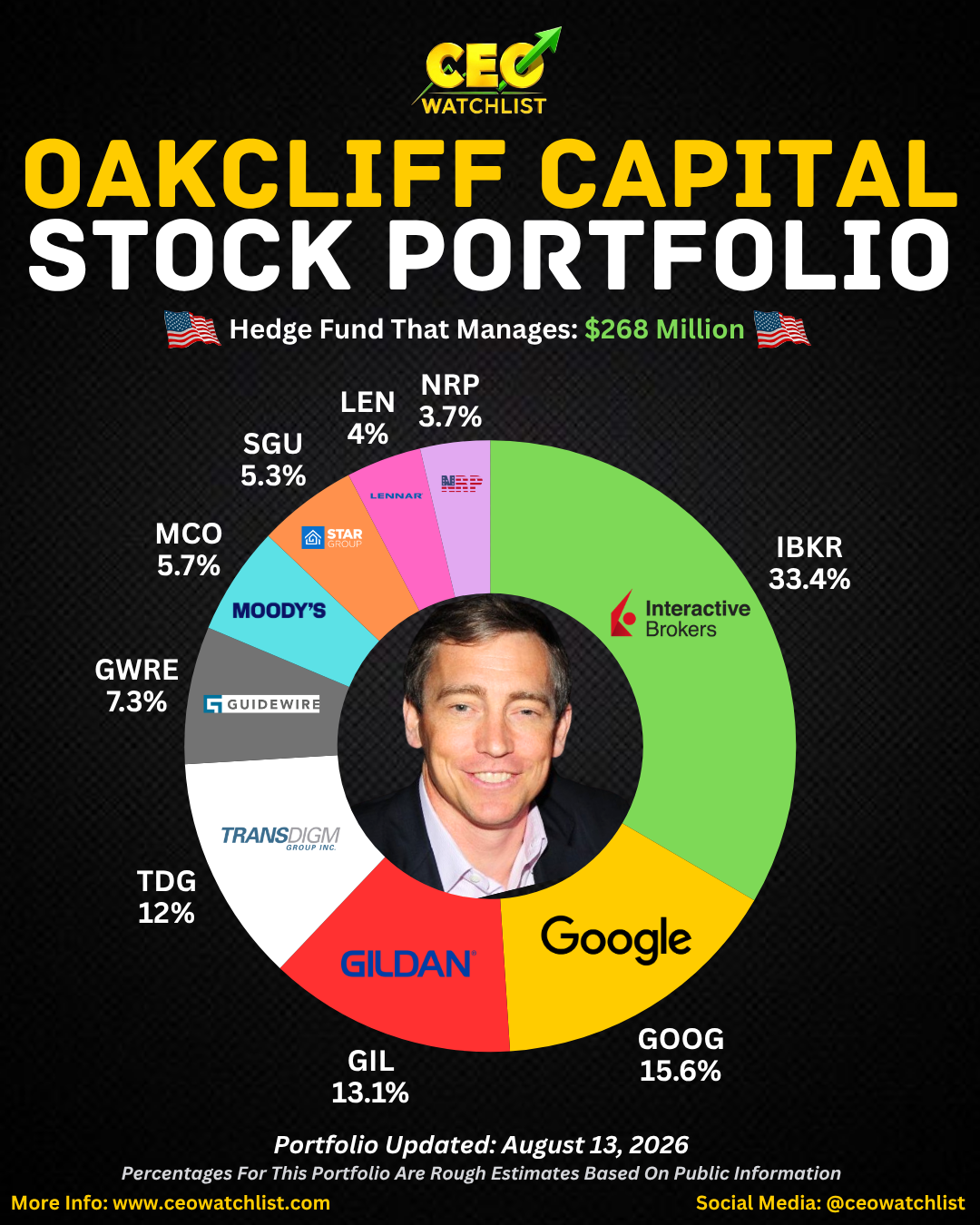
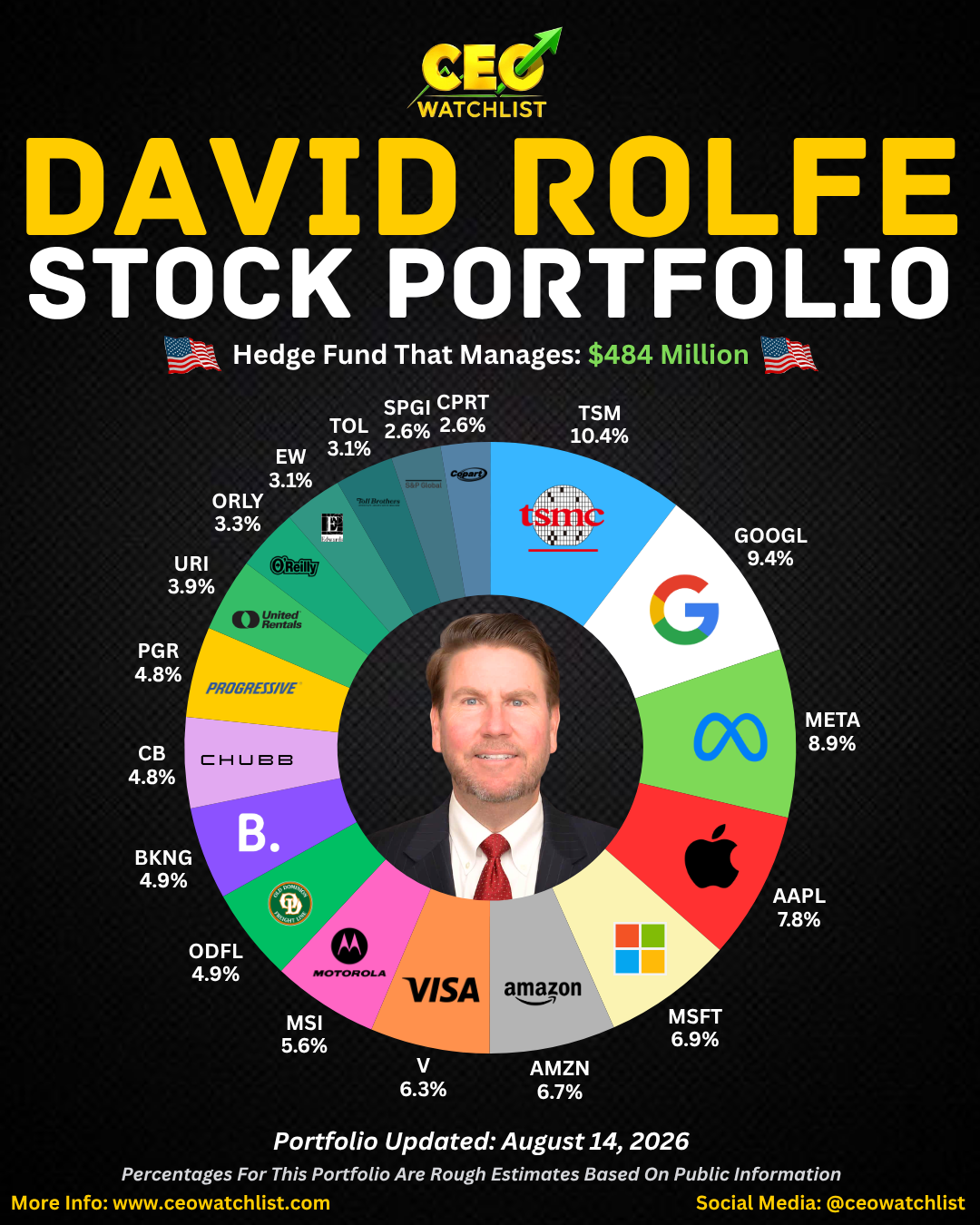
INFOGRAPHICS FOR THE WEEK:

CONTACT US: [email protected]
Responses