

TOP NEWS AFFECTING THE STOCK MARKET THIS WEEK:
The First Week of Earnings Season Is Over, Here Are 3 Stocks We’re Watching Closely Next! (Source)
Stocks mentioned: $TSM, $JPM, $BAC, $JPM, $WFC, $TSM, $NFLX, $ISRG, $IBKR
We just moved through the first real test of this earnings season, and it set the tone fast. The opening week was dominated by the largest U.S. banks and a single, critical technology bellwether: Taiwan Semiconductor (TSM). Think of this phase like the opening lap of a race, you are not crowning winners yet, but you can immediately tell who showed up in shape. Banks told us how consumers and businesses are behaving under current rates, while TSM showed us whether the engine of global tech demand is still accelerating. Together, they gave investors a clean snapshot of economic reality rather than theory.
Bank earnings were mixed. Results for some of the financials like JPMorgan (JPM) and Morgan Stanley (MS) were very postive with double beats on revenue and EPS, while results for banks such as Wells Fargo (WFC) really disappointed with a double miss and naturally a sell-off in the market. Without any clear trend from the financials, the entire sector traded down over the past week. Normally financials will dictate how the market does moving forward, but based on these mixed results, this could be a very volatile earnings season.
On the technology side, TSM was the headline. For those that don't know, TSM is the company that makes 90%+ of the entire world's high-end chips, so those chips from Nvidia (NVDA) and AMD (AMD) that everyone is fighting over, without TSM, they wouldn't exist. Needless to say, TSM is an extremely important company. As for their earnings report, the company reported another strong quarter, with revenue and EPS surging alongside a raise in guidance. When its numbers are strong, it means companies building AI chips, data centers, and advanced electronics are placing real orders, not just talking about them. With blowout earnings like the one TSM put out, the whole narrative around a possible "AI bubble" should be put to rest. It's clear that AI still has a long way to go and that tech stocks still have an extremely long runway to the upside. The cautious view is that AI enthusiasm could cool, but the reality is that TSM’s backlog reflects signed commitments, not hype. That distinction matters, and it is why this report carried so much weight.
Now the focus shifts forward. Next week brings a broader mix of companies that touch entertainment, healthcare technology, and legacy semiconductors. These are our top stocks to watch:
- Netflix (NFLX): This is a familiar name that everyone should know. We believe they'll have a good quarter, but to be honest, a good quarter may not be good enough. Currently with their bid for Warner Bros, and ongoing feud with Paramount, this stock has been left in the doghouse. We don't know if any numbers will be "good enough" for the markets if Netflix doesn't come out and give some positive guidance on the issues surrounding Warner Bros and Paramount.
- Intuitive Surgical (ISRG): A leader in robotic-assisted surgery systems used by hospitals worldwide. Bullish if procedure volumes and recurring instrument sales remain strong, signaling durable healthcare demand. We really like ISRG, and as long as procedure volume continues to grow, we think this name can continue higher. Now one thing to note here is that this is a very expensive stock and so any slight miss could cause the stock to fall dramatically. It's still remain one of our top robotics plays for the coming years.
- Intel (INTC): A semiconductor company rebuilding itself around manufacturing and AI relevance. Bullish if cost discipline and foundry progress show tangible improvement. A big thing with this name is the theme around reshoring and bringing manufacturing back to America. This is why the earnings don't matter as much as what they say on the conference call. We will be listening for any talk around new orders with major companies like Nvidia, AMD, or Apple. If they announce a new major partnership, the stock could go flying!
In summary, last week told us that the financials are mixed, while the backbone of global technology demand remains strong. Next week is about 3 stocks that have had some difficulties over the past year, and now is their time to prove themselves. If you're a CEO Watchlist Investment Club Member, make sure your notifications are turned on in our app because we will be reporting these earnings live as they happen, as well as any changes we are making to our stock and option portfolios.

These Under The Radar Stocks May Just Have The Most Upside If You're Betting On The Future Of Robotics (Source)
Stocks mentioned: $TSLA, $ALGM, $NOVT, $VICR, $OUST, $AMBA, $SSYS
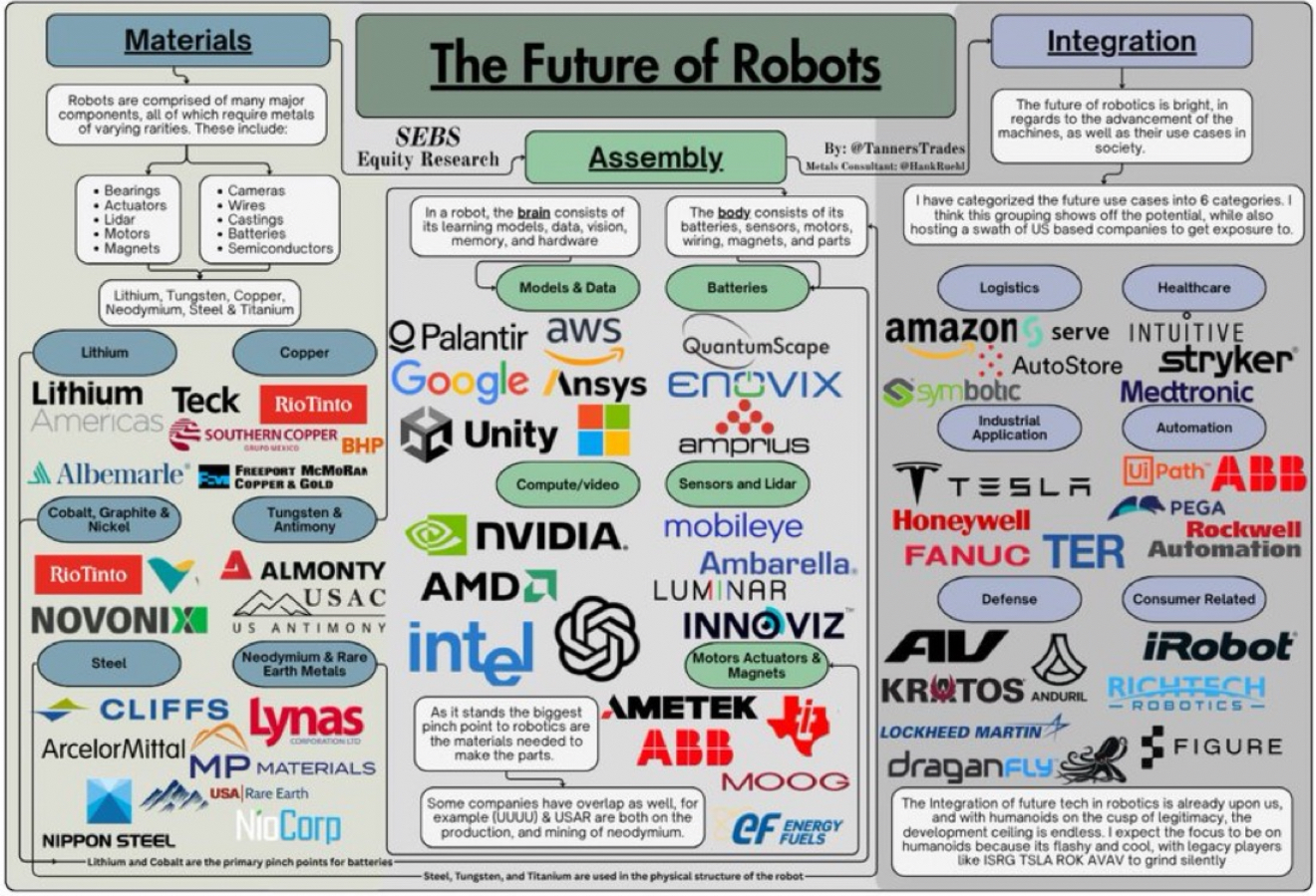
The biggest misconception in the robotics theme is that the best way to invest is by buying the robots themselves. Names like Tesla (TSLA) grab the headlines because humanoid robots make for great demos and bold promises. But history shows that the most durable returns in major technology shifts often come from the suppliers, not the brands on stage. Think of the gold rush, most gold miners failed, but the people selling picks and shovels made consistent money no matter who struck gold. Robotics is shaping up the same way.
A robot is not a single product, it is a system of many moving parts that all have to work together perfectly. Motors make joints move, sensors help the robot understand the world, power systems keep it running, and specialized materials form the skeleton that holds everything together. If even one of these components fails, the robot fails. That means every robot built creates demand for dozens of less visible companies supplying these critical pieces. These businesses often have pricing power, long customer relationships, and fewer competitors.
This is where the under-the-radar opportunities start to appear. Instead of betting on which robot brand wins, investors can focus on the companies supplying the core components that every robot needs. Some examples of these “pick and shovel” robotics plays include:
- Allegro MicroSystems (ALGM):
What they do: Allegro makes chips that control motion and measure position, speed, and current.
Robot role: These chips sit inside motors and joints, acting like the robot’s nerves, telling it how fast something is moving and whether it is applying the right amount of force.
Why bullish: Every robot needs precise motion control, and Allegro specializes in exactly this. As robots scale into factories and warehouses, reliability and accuracy matter more than flashy software. - Novanta (NOVT):
What they do: Novanta builds high precision motion, feedback, and control systems.
Robot role: Their components help robots know exactly where their arms, hands, and joints are in space, similar to human proprioception.
Why bullish: Advanced robots require extreme precision to safely work around humans. Novanta benefits as robots move from demos into real workplaces where errors are costly. - Vicor (VICR):
What they do: Vicor designs compact, high efficiency power modules.
Robot role: They are the power backbone, delivering electricity from batteries to motors, sensors, and processors without overheating or wasting energy.
Why bullish: Robots need to do more work on less power. As robots become mobile and autonomous, efficient power delivery becomes a major bottleneck Vicor is well positioned to solve. - Ouster (OUST):
What they do: Ouster builds LiDAR sensors that create a 3D map of the environment.
Robot role: This is the robot’s eyes. LiDAR allows robots to see objects, distances, and movement in real time.
Why bullish: As robots leave controlled labs and enter messy real world environments, reliable vision becomes critical. LiDAR adoption tends to grow with autonomy, not shrink. - Ambarella (AMBA):
What they do: Ambarella designs chips that process visual data using AI.
Robot role: These chips interpret camera and sensor data, helping robots recognize objects, people, and obstacles.
Why bullish: Vision processing is one of the most compute intensive tasks in robotics. Ambarella benefits as robots require smarter on device decision making rather than cloud reliance. - Stratasys (SSYS):
What they do: Stratasys produces advanced 3D printing systems and materials.
Robot role: They help manufacture lightweight, durable robot frames, joints, and structural components, essentially the skeleton.
Why bullish: Robots need strong parts that are light, customizable, and scalable. As production ramps, advanced manufacturing becomes a choke point, giving Stratasys a quiet but powerful position.
To put it simply, robots are like the human body. Software is the brain, but hardware is the bones, muscles, nerves, and heart. You can have the smartest brain in the world, but without a strong skeleton and reliable muscles, nothing moves. Many of these suppliers effectively own a specific “organ” inside the robot, which makes them hard to replace once production scales. As robotics moves from prototypes to real-world deployment, these bottlenecks become more valuable, not less.
The takeaway is that the robotics boom is likely to reward patience and positioning more than hype. The companies quietly supplying the essential components may benefit regardless of which robot brand dominates headlines. As production ramps up over the next few years, demand for these parts should grow steadily and repeatedly. For investors, the real opportunity may not be betting on the robot you can see, but on the invisible parts that make every robot possible.
"Super Investor" Spotlight: Nelson Peltz (Source)
Stocks mentioned: $JHG, $GE, $SOLV, $IVZ, $WEN, $FERG
A quick reset for new readers. A “Super Investor” is an elite investor who has consistently outperformed the broader market across full market cycles by making high conviction decisions rooted in business fundamentals, governance, and long term strategy. These investors are required to file quarterly 13F reports, which disclose their U.S. equity holdings and give us a rare look into how some of the most experienced investors in the world are positioning real capital. Concentration and changes reveal where conviction is highest today.
Nelson Peltz is one of the most influential activist investors of the past several decades. As the co founder of Trian Fund Management, Peltz built his reputation by taking meaningful stakes in large, often underperforming companies and pushing for operational discipline, board accountability, and sharper strategic focus. His track record spans consumer, industrial, healthcare, and financial businesses, with notable involvement at companies like Procter and Gamble, GE, Heinz, and Mondelez. Peltz is known for patience, persistence, and a willingness to be unpopular early if the long term economics make sense.
Here is a breakdown of Peltz’s most recent 13F portfolio, which is strikingly concentrated and highly intentional:
- Janus Henderson Group (JHG) - 34.5%
- GE Aerospace (GE) - 29.5%
- Solventum (SOLV) - 15.0%
- Invesco (IVZ) - 8.2%
- Wendy’s (WEN) - 6.8%
- Ferguson (FERG) - 6%
What stands out immediately is concentration. Roughly two thirds of the portfolio sits in just two positions, Janus Henderson and GE Aerospace. That level of focus signals deep conviction rather than diversification for comfort. The portfolio also reveals a broader theme: Peltz is positioning for a market that rewards cash flow durability, operational execution, and shareholder returns. His emphasis on asset managers suggests he believes sentiment has swung too far negative after years of passive dominance. The aerospace exposure reflects confidence in long term industrial demand rather than short term economic noise. Critics may argue this portfolio lacks exposure to fast growing technology narratives, and that concentration increases downside risk. That concern is valid. However, Peltz has historically generated returns by being early to structural shifts, not by chasing momentum.
The lesson for retail investors is not to copy positions blindly, but to study how conviction is expressed. Peltz is showing that clarity beats complexity. He is willing to concentrate when the thesis is strong and patient when results take time. His latest portfolio reinforces a powerful idea: in uncertain markets, disciplined businesses with real earnings and strategic focus tend to regain investor favor first. That is why we continue to study Nelson Peltz. His portfolio is not built to impress headlines, it is built to compound over time.

INSIDER STOCK TRADES FROM THE WEEK:
1. Alumis (ALMS) - Srinivas Akkaraju, director, bought roughly $10,000,000 worth of ALMS at $17.00/share on Jan. 9, 2026, but it was most recently reported to the public on Jan. 13, 2026. (Source)

2. Micron Technology (MU) - Teyin Liu, director, bought roughly $7,800,000 of MU for an average price of $337.14/share between Jan. 13-14, 2026, but it was most recently reported to the public on Jan. 15, 2026. (Source)

3. ASA Gold & Precious Metals (ASA) - Saba Capital Management, hedge fund, bought roughly $1,200,000 of ASA at an average price of $64.35/share between Jan. 13-14, 2026, but it was most recently reported to the public on Jan. 15, 2026. (Source)

Over 2,000 people have already signed up for my FREE Masterclass video on how to unlock my exact strategies for finding winning stock/options trades! I'll share everything including how to find what Politicians and CEOs are buying. Don’t miss your chance to get in for FREE before spots fill up!

INFOGRAPHICS FOR THE WEEK:



CONTACT US: [email protected]
Responses